
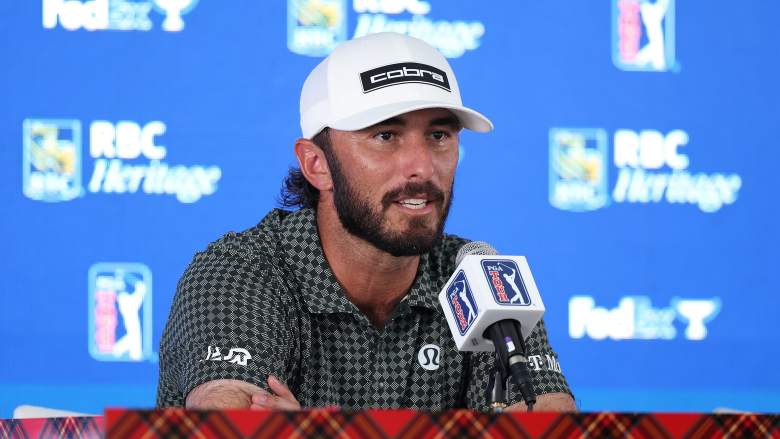
Max Homa didn’t mention Sergio Garcia by name — but his message after the Masters was unmistakable.
Just days after one of the most talked-about moments at Augusta National, Homa offered a blunt assessment of on-course outbursts, saying they reflect poorly on professional golfers and can make them look “very, very spoiled.”
The comments come after Garcia’s emotional reaction during the final round, where the 2017 Masters champion struck the tee box repeatedly and snapped his driver in frustration following a poor shot on No. 2. The incident quickly became one of the defining non-competitive storylines of the week.
Homa Weighs In on Golf’s Emotional Line
Speaking ahead of the RBC Heritage, Homa addressed the broader issue of player behavior — and didn’t hold back.
“I don’t like when people break clubs. I don’t like when people beat up the golf course because we deal with it, and I think the breaking clubs makes us look very, very spoiled,” Homa said during a news conference Wednesday.
While careful not to single out Garcia directly, Homa made it clear that those moments don’t sit well with him — especially given the privilege of playing at the highest level.
“I try my absolute best to not do it, and when it does happen, as far as slamming a tee box, I’m very upset with myself because we’re very lucky to play this game where we do, and I think it is a bad look.”
‘It’s a Tough Thing to Handle’ — But There’s a Line
Homa acknowledged that golf’s mental grind can push players to the edge, but emphasized that not all reactions are equal — and some cross a line.
“I definitely think beating up a golf course would be probably — because the rest of us have to play it. But that’s a tough thing to handle or to decide upon because it is so subjective,” he said.
“If I do something where no one is watching on TV, that gets graded a lot lower than when it’s in front of everybody. So I don’t know how you would land that plane.”
It’s a nuanced take — one that recognizes the emotional volatility of the sport while still holding players accountable for how they handle it in public moments.
Garcia Incident Still Looms
Garcia’s outburst drew immediate attention from both fans and officials at Augusta National.
After a poor tee shot on the par-5 second hole, Garcia struck the teeing area multiple times before breaking his driver near a cooler. Under the Rules of Golf, he was not allowed to replace the damaged club, forcing him to play the remainder of his round without it.
He later acknowledged the moment, saying, “I’ve been frustrated through the year,” and adding after his round, “Yeah, just obviously not super proud of it, but sometimes it happens.”
Garcia also issued an apology on social media in the days following the incident.
A Bigger Conversation in Golf
Homa also pointed to his own behavior as part of the conversation around how players handle frustration.
“I say a lot of bad words. I very much try to do it not when a kid can hear,” Homa said. “So I do think there’s some, hey, don’t say it in front of the wrong person, like be a bit aware of your surroundings. Not saying I’ve never done it.”
He added that while outbursts like slamming a tee box are a “bad look,” they also reflect the challenges of a sport that tests players mentally as much as physically.
“It’s never a bad thing to have that conversation being had,” Homa said. “That’s good. Between that and pace-of-play stuff, there’s things we can address, and we can wait until we kind of figure it out until we implement it, but at least the conversation is going that way.”
As golf continues to balance tradition with modern scrutiny, moments like Garcia’s — and reactions like Homa’s — are shaping how the sport defines professionalism in real time.
Max Homa Says Angry Golfers Look ‘Spoiled’ After Masters Outburst