
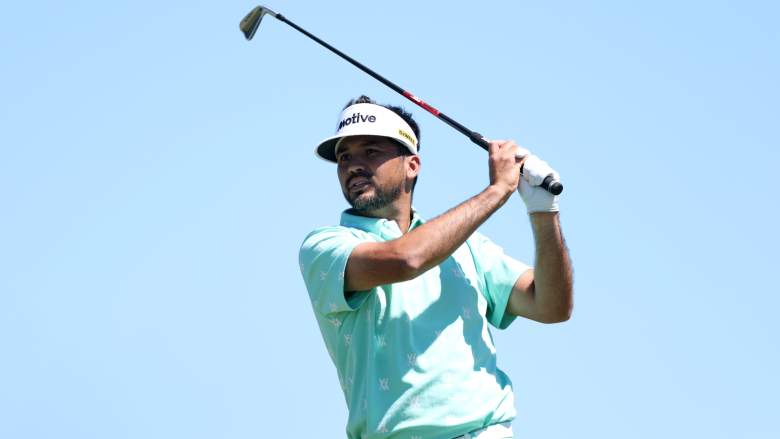
As the U.S. Open approaches, Jason Day isn’t shying away from discussing the challenges currently facing his game.
The 2015 PGA Championship winner enters the year’s third major still searching for answers after what he described as a frustrating stretch of golf, particularly with a recurring “left miss” that has affected his confidence off the tee and into greens.
Yet despite the uncertainty, Day remains optimistic that the work he’s putting in now will position him to contend when the championship begins.
Speaking ahead of the U.S. Open, Day opened up about the technical issues he’s battling, his preparation plan for one of golf’s toughest tests, and why he still believes another major championship is within reach.
Day Identifies Technical Issue Behind Recent Struggles
Day acknowledged that his recent struggles stem from more than just poor results. The Australian revealed that an unpredictable miss to the left has created uncertainty throughout his game, forcing him to play more conservatively than he would like.
“I’ve talked about having a left miss in my game,” Day explained. “When I see a flag, I’m playing to miss it in the correct spots instead of playing to an aggressive target.”
The unpredictability of the miss has made it difficult for Day to fully commit to shots. Rather than attacking pins, he finds himself protecting against a mistake that can appear without warning.
“Because I just don’t know when this left miss is going to happen,” he said. “It’s kind of like a dice roll.”
That uncertainty has created a mental challenge as much as a physical one. Day admitted that when doubt begins creeping into his swing thoughts, it becomes harder to trust his ability to execute quality golf shots under pressure.
The issue, however, isn’t purely psychological. Day identified a specific mechanical flaw involving his right shoulder and right arm moving away through impact, which can cause the clubface to close and send shots left. He has spent significant time working with his coaches to stabilize the motion and improve clubface control.
“There are some technical aspects that are problematic that are causing the shot as well,” Day said.
While the process has been frustrating, the veteran understands it’s part of the game.
“It’s not the first time that something has unraveled in my game and I’ve had to kind of piece it back together,” he said.
A Detailed Plan for U.S. Open Preparation
With major championship week presenting a unique set of challenges, Day is approaching preparation with a clear plan.
The U.S. Open has long been regarded as golf’s most demanding test, and Day expects that trend to continue. He anticipates firm conditions, difficult green complexes and heightened pressure throughout the week.
“There has to be a heightened level of stress and pressure and everything that comes along with the U.S. Open and a major championship,” Day said.
To prepare, Day plans to arrive early and maximize his course knowledge before competition begins. His schedule includes walking nine holes upon arrival before playing multiple practice rounds leading into Thursday’s opening round.
“I’ll go there Sunday morning and I’ll walk nine holes and then I’ll play nine holes Monday, Tuesday, Wednesday,” he said. “Just try and get at least two rounds under my belt before I actually get out there.”
The goal is simple: eliminate as many unknowns as possible.
Day said he wants to “button up” the parts of his game that need attention while developing a strategy that gives him the best opportunity to compete for the championship.
Why Day Still Believes He Can Contend
While Day continues searching for answers with his ball-striking, he remains highly confident in his short game.
The 13-time PGA Tour winner said his putting and touch around the greens have historically been the strengths that allow him to stay competitive, even when other areas of his game aren’t firing on all cylinders.
“My short game is one thing that kind of has never failed me in the past,” Day said.
He compared it to the body’s senses compensating for one another when one area isn’t operating at full capacity. Throughout his career, Day said his short game has frequently carried a larger share of the workload than his ball-striking.
“I’ve been a good ball striker, but not great, great at it,” he said. “I feel like my short game and my putting has always had to pick up a lot of the load.”
That confidence could prove especially valuable at the U.S. Open, where scrambling and putting often separate contenders from the rest of the field.
Day has enjoyed success in major championships throughout his career, recording runner-up finishes in all four majors and capturing the 2015 PGA Championship. Now, at this stage of his career, he remains motivated by the possibility of adding more major trophies to his résumé.
“It’d be big,” Day said of winning another major. “It’d be nice to be able to keep adding to the major championships.”
He even acknowledged a long-term goal that many players would consider ambitious.
“To try and have a goal of winning all four at this stage in my life is a very lofty goal,” Day said, “but I think is achievable.”
For now, however, the focus remains on solving the puzzle directly in front of him. If Day can successfully manage the swing issue that has recently plagued him, he’ll arrive at the U.S. Open armed with the one thing he trusts most: a short game capable of keeping him in contention on golf’s biggest stages.
Jason Day Shares Honest Assessment of His Game Before U.S. Open