
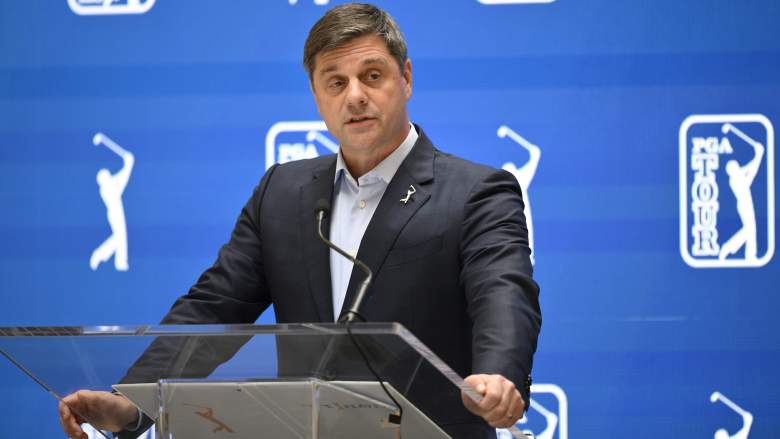
LIV Golf players hoping the league’s recent financial problems would convince the PGA Tour to reopen the door for an expedited return received a pretty clear message from CEO Brian Rolapp: Don’t count on it.
Rolapp reiterated Tuesday that the PGA Tour is not currently considering another version of the Returning Member Program that helped Brooks Koepka make his way back earlier this year. Instead, the Tour appears prepared to rely on its existing rules and competitive pathways for players who want to return.
“Before we get to your questions on this announcement, I will briefly address LIV because I know it has been in the news recently, and I expect it may come up today,” Rolapp said on Tuesday.
“As I said a few weeks ago in Atlanta, there are really three things when it comes to anyone who wants to compete on the PGA Tour.”
1. Serve the Suspension and Try to Play Back In
Players leaving LIV generally cannot immediately jump into PGA Tour competition. The Tour has enforced waiting periods tied to participation in unauthorized events, and Patrick Reed provided an example of how that process can work.
Reed resigned his PGA Tour membership before playing LIV events, and the Tour announced in January that he would become eligible to compete as a non-member on Aug. 25, 2026, one year after his final unauthorized event, as long as he did not participate in another unauthorized tournament.
At that point, Reed could accept sponsor exemptions or attempt to open qualify for FedExCup Fall events before playing the 2027 season out of the past champion category.
The specifics could vary depending on an individual player’s membership history and circumstances, but Reed’s situation provides something close to a roadmap.
Koepka returned through the PGA Tour’s one-time Returning Member Program, which was limited to players meeting elite performance criteria and came with substantial financial consequences.
The Tour said Koepka forfeited five years of potential Player Equity Program participation, estimated at $50 million to $85 million depending on performance and Tour growth, and agreed to a $5 million charitable contribution. The program’s window closed Feb. 2.
2. Use the DP World Tour as a Route Back
The DP World Tour remains particularly important because several LIV players have retained ties there. Eight members, including Tyrrell Hatton, Tom McKibbin, Adrian Meronk and David Puig, received conditional releases to compete in LIV events during the 2026 season.
Those conditions included paying outstanding fines, playing additional DP World Tour tournaments and withdrawing pending appeals.
Others are already trying to establish or strengthen their status through DP World Tour Qualifying School. LIV players Josele Ballester, Luis Masaveu, Michael La Sasso and Yosuke Asaji were among those who advanced from first-stage qualifying sites this month.
That route could become even more significant as the PGA Tour prepares for its new competitive structure in 2028.
“From the beginning, we set out to preserve the meritocracy that makes our sport unique by creating a system where performance dictates opportunity,” Rolapp said. “Through new eligibility criteria and supporting pathways into the PGA Tour, the new competitive model is designed to reward excellence and ensure there is always a clear path for top performers at every stage of their career.
“For fans, this means a clear understanding of what is at stake during each PGA Tour competition, whether that is at an event or across a season.”
The PGA Tour is moving toward a two-tier system featuring the PGA Tour Championship Series and PGA Tour Challenger Series. Rolapp said Tuesday that officials are still discussing exactly how the DP World Tour will fit into that model.
3. Start Lower and Earn Their Way Back
The third option is the least glamorous but perhaps the one that most closely matches Rolapp’s repeated emphasis on meritocracy: qualify from below.
The PGA Tour’s new structure will create multiple avenues for players to move upward. Beginning in 2028, the top 20 players on the Challenger Series will be promoted to the Championship Series, while a player who wins twice on the Challenger Series can earn an in-season promotion.
Q-School will also feed players into the Challenger Series, with the top five finishers receiving status for the following season. Select Challenger Series events will have open qualifying positions as well. A separate season-ending “last chance” series will award three Championship Series cards.
The complication for LIV players is timing. PGA Tour rules regarding unauthorized events can also affect eligibility for qualifying competitions, meaning a player cannot necessarily leave LIV one week and enter a PGA Tour-sanctioned qualifier the next.
Once eligible, however, a former LIV player without another exemption could theoretically start lower in the system and earn his way upward.
LIV Golf’s Bankruptcy Adds New Urgency
The discussion has become considerably more important following LIV Golf’s Chapter 11 bankruptcy filing on Sept. 8.
LIV entered a court-supervised restructuring process in New Jersey and announced a restructuring agreement involving BC Partners Credit. The league says the process is intended to allow it to continue operating and emerge with a new ownership and financial model rather than shut down entirely.
Court filings also revealed the size of LIV’s financial problems. Reuters reported assets between $100 million and $500 million against liabilities between $500 million and $1 billion, with prominent players among the league’s unsecured creditors.
CEO Brian Rolapp’s LIV Golf Stance Leaves 3 Paths Back to PGA Tour