
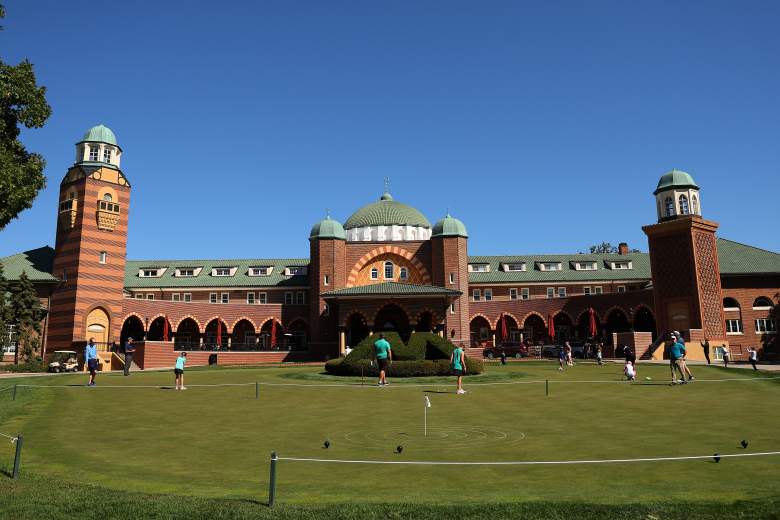
The Presidents Cup returns to the United States this week, but the golf course waiting for the world’s best players outside Chicago is simultaneously one of the most recognizable names in American golf and something almost completely new.
Medinah Country Club’s Course No. 3 will host the 2026 Presidents Cup from Sept. 24-27, adding another chapter to a championship history that includes three U.S. Opens, two PGA Championships, the 1988 U.S. Senior Open, the 2012 Ryder Cup and the 2019 BMW Championship.
The current course measures 7,564 yards from the back tees and plays to a par 72, but those numbers tell only part of the story.
Between 2023 and 2024, Australian design firm OCM – Geoff Ogilvy, Mike Cocking and Ashley Mead – transformed Course No. 3. Trees disappeared. Fairways became wider. Greens grew larger. Bunkers became more expansive and irregular.
Several holes were rerouted or replaced, and Lake Kadijah became a much more strategic part of the closing stretch.
OCM says the goal was to create more scale, openness and strategic variety while reconnecting the course with elements of Tom Bendelow’s original design.
Presidents Cup organizers say fewer than 40 percent of matches historically reach the 17th hole, so moving Medinah’s spectacular new water holes forward makes them much more likely to matter.
Here is how the course could decide this year’s Presidents Cup.
Holes 1-6: An Immediate Test of Aggression
No. 1 (par 5) – Medinah’s regular No. 5
The Presidents Cup begins on a par 5, Medinah’s normal fifth hole. That immediately creates a match-play decision: attack or survive. With four-ball in particular, expect aggressive play because one partner can take on the trouble while the other provides insurance.
An opening par 5 also creates the possibility of an immediate eagle and the kind of momentum swing that simply does not exist on a conventional opening par 4.
No. 2 (par 4) – Medinah’s regular No. 6
The second could provide the first genuine gut check. OCM shifted the sixth fairway toward the property boundary, where out of bounds runs tightly along the left side. The instinct is to aim safely away from the fence, but that brings large bunkers into play. The green also sits close to the boundary.
No. 3 (par 5) – Medinah’s regular No. 7
Another par 5 follows, and this one continues along the property boundary. The hole was formerly Medinah’s 10th before OCM reshuffled the routing. Trees that once restricted the playing corridor were removed, creating considerably more room from the tee.
But the freedom is deceptive. The fairway eventually bends back toward the boundary, with staggered bunkers complicating the second shot. Long hitters will have the opportunity to attack in two, but the angle toward the green brings the out-of-bounds line back into the equation.
No. 4 (par 4) – Medinah’s regular No. 8
This portion of the property was opened up as OCM removed trees and attempted to restore the meadow-like character visible in early photographs of Medinah.
Players will see more of the golf course, more of the hazards and more potential lines from the tee.
No. 5 (par 4) – Medinah’s regular No. 9
The fifth hole of the Presidents Cup routing occupies the same ground as Medinah’s old ninth, but little else is familiar. Previously, the par 4 was squeezed through trees and bent sharply left, often forcing players to hit an iron from the tee simply to find the corner.
OCM cleared the bank of trees on the right and replaced that artificial restriction with strategically placed bunkers, opening the fairway and giving the world’s best drivers considerably more freedom to attack.
No. 6 (par 5) – Medinah’s regular No. 10
The sixth is another par 5 and one of the longest holes on the property from the championship tees. In four-ball, it presents another obvious green light for power players.
Holes 7-11: Positioning Before the Fireworks
No. 7 (par 3) – Medinah’s regular No. 11
The seventh gives the players a par 3 and temporarily removes the driving decisions that dominate the opening stretch. But OCM’s larger greens do not necessarily make the target simple.
Bigger putting surfaces create more potential hole locations and more dramatic differences between simply hitting the green and hitting the correct section.
No. 8 (par 4) – Medinah’s regular No. 12
The eighth returns to brute championship dimensions with a long par 4. This is where the width-versus-angle concept becomes especially important: simply finding short grass may not be enough if the approach comes from the wrong side.
It also represents the transition toward the portion of the property where Lake Kadijah begins to loom over the match. Players who arrive here ahead will know the most volatile section of the course is approaching quickly.
No. 9 (par 3) – Medinah’s regular No. 13
At just over 150 yards on the member championship card, the regular 13th provides a completely different par-3 challenge. The old 13th was a long forced carry across Lake Kadijah. OCM eliminated it and built a shorter hole running parallel to the shoreline instead, with water to the right.
The architects can make it even shorter depending on the setup. Golf Digest reported that the hole can play around 140 or even 120 yards. That makes it a perfect match-play hole: almost everyone should believe birdie is possible, which means an indifferent wedge suddenly feels like a major mistake.
No. 10 (par 4) – Medinah’s regular No. 14
The 10th begins a stretch containing some of the most significant new construction on Course No. 3. Medinah’s former 14th, 15th and 16th disappeared during the OCM project and were replaced by two par 4s leading into the new water-heavy finishing sequence.
The old 16th was the hole where Sergio Garcia famously hit from behind a tree and sprinted up the fairway during his duel with Tiger Woods in the 1999 PGA Championship.
No. 11 (par 4) – Medinah’s regular No. 15
This is the final setup hole before the Presidents Cup reaches its centerpiece.
It represents one of the final chances to apply pressure before Lake Kadijah begins dictating the terms.
Holes 12-14: The New Heart of Medinah
No. 12 (par 4) – Medinah’s regular No. 16
This may become the defining hole of the 2026 Presidents Cup.
OCM replaced the old cross-water 17th with a new par 4 that plays diagonally across Lake Kadijah. Players can choose how much water to challenge from the tee. A conservative line reduces the carry but lengthens the hole; an aggressive line can dramatically shorten the approach.
Golf Digest reports that tournament officials may move the tees forward enough to tempt the longest players into trying to drive the green.
That is match-play architecture in its purest form.
No. 13 (par 3) – Medinah’s regular No. 17
Players immediately cross Lake Kadijah again, this time on a par 3 that can stretch beyond 200 yards. Water sits to the left, the green is elevated and four bunkers surround the target. Aggressive shots toward front hole locations also risk kicking down the slope toward the lake.
Medinah once featured three par 3s that crossed the lake in broadly similar fashion. OCM intentionally diversified them. The new 17th uses the lake diagonally and in the opposite direction, creating a hole where trajectory, wind and nerve all matter.
No. 14 (par 4) – Medinah’s regular No. 18
This is the key to the entire Presidents Cup rerouting. Instead of waiting until the 18th hole of a match, Medinah’s redesigned home hole appears as the 14th.
OCM returned the fairway to a corridor used by Bendelow’s original 18th before changes made in the 1980s. The modern version stretches to roughly 487 yards from the back of the property and completes a three-hole sequence built around Lake Kadijah.
If a match reaches No. 12 all square, the next three holes could feel like their own miniature championship.
Holes 15-18: Old Medinah Returns for the Finish
No. 15 (par 4) – Medinah’s regular No. 1
After the drama around the lake, the Presidents Cup routing loops back to the normal first hole. It is a strange psychological transition. Players effectively arrive at Medinah’s traditional starting point with their match potentially hanging in the balance.
The first four holes were among the portions of Course No. 3 that retained their basic places in the OCM routing, although greens, bunkers and playing corridors were altered as part of the broader transformation.
No. 16 (par 3) – Medinah’s regular No. 2
The regular second is the one classic cross-water par 3 OCM retained. It plays south across Lake Kadijah and is regarded as one of the sternest short holes on the property.
Golf Digest specifically identified it as perhaps Medinah’s hardest par 3.
No. 17 (par 4) – Medinah’s regular No. 3
Anyone reaching 17 has already survived the most strategically volatile section of Medinah, but the pressure only increases. At this stage, conventional stroke-play thinking becomes almost irrelevant. Players know precisely what their opponent has done and exactly what they need.
That can make a straightforward par 4 fascinating. Fairways suddenly appear smaller when a player must make birdie, and tucked hole locations become far more inviting when par is no longer enough.
No. 18 (par 4) – Medinah’s regular No. 4
The matches that go the distance finish not at Medinah’s clubhouse hole but on the regular fourth, a substantial par 4 that can stretch close to 480 yards from the back tees on the current member scorecard.
It is an unusual finish, but that is the point. Tournament organizers have sacrificed the traditional clubhouse conclusion to guarantee that more matches encounter the redesigned 16th, 17th and 18th earlier in the round.
A Different Medinah for a Different Era
Medinah opened Course No. 3 in 1928 as the final piece of Tom Bendelow’s original three-course vision. Nearly a century later, it remains one of the most historically significant championship venues in American golf.
Cary Middlecoff won the 1949 U.S. Open here. Lou Graham won in 1975. Hale Irwin captured the 1990 U.S. Open. Tiger Woods won PGA Championships here in both 1999 and 2006. Then came the 2012 Ryder Cup and Europe’s famous Sunday comeback.
But history alone was not enough to preserve the old course. The 2019 BMW Championship exposed how vulnerable the previous version had become to modern professionals, with Justin Thomas winning at 25 under.
The Medinah remembered from Woods’ major victories was a muscular, tree-lined championship course built around accuracy, rough and relentless execution. The Medinah awaiting Scottie Scheffler, Hideki Matsuyama, Cameron Young, Tom Kim, Xander Schauffele, Adam Scott and the rest of the 2026 Presidents Cup field is wider, more open and considerably more willing to tempt players into mistakes.
Presidents Cup 2026 : A Hole-by-Hole Guide to the New Medinah Country Club