
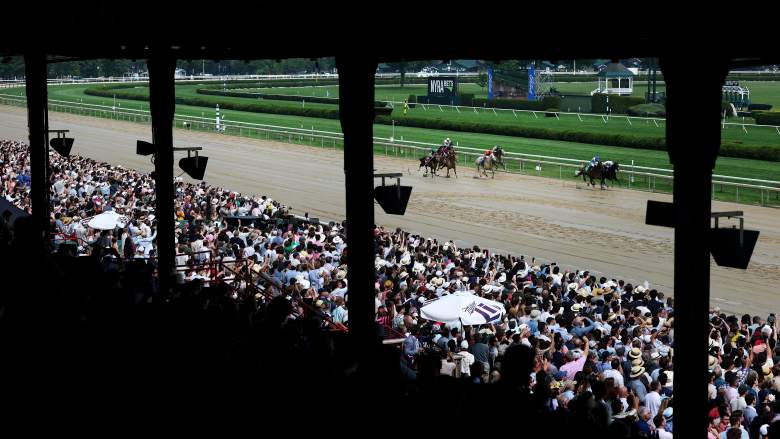
Artificial intelligence is no longer a futuristic concept in professional sports. Across the globe, leagues and governing bodies are increasingly relying on advanced camera systems, computer vision, and real-time tracking technology to assist officials and eliminate avoidable mistakes. What once sounded like science fiction is now part of everyday competition.
Tennis provides perhaps the most visible example. Electronic line-calling systems can determine within fractions of a second whether a ball clipped the line or landed out. Baseball has spent years testing automated strike-zone technology, while soccer uses sophisticated tracking systems to help determine offsides.
Even the NBA has signaled that more objective calls, such as out-of-bounds decisions, will eventually be handled through automated systems rather than relying entirely on human officials.
The growing adoption of AI across major sports raises an obvious question: why hasn’t horse racing embraced similar technology in a meaningful officiating role?
Racing’s Officiating Problem Isn’t Accuracy – It’s Consistency
Horse racing faces a different challenge than most team sports. The issue is not necessarily that stewards get every call wrong. The issue is that similar incidents can receive dramatically different rulings depending on the jurisdiction, racetrack, or officiating crew involved.
Anyone who has followed racing for years has seen controversial inquiries that leave bettors, trainers, and horsemen debating the outcome long after the race is official. Two nearly identical interference incidents can produce completely different results. One horse may be disqualified while another remains untouched despite appearing to commit a comparable infraction.
That inconsistency creates frustration because wagering is at the heart of the sport’s economic model. Bettors are not simply watching a contest unfold; they have a financial stake in the outcome. When rulings appear unpredictable, confidence in the integrity of the process suffers.
The problem becomes even more significant as replay technology improves. Fans can now review incidents from multiple angles in high definition, often reaching conclusions before officials announce their decisions. When the public sees one thing and the ruling suggests another, trust begins to erode.
Where AI Could Help Stewards
AI is not capable of solving every officiating question in horse racing. However, there are several areas where it could immediately improve the process.
According to Past the Wire, modern computer vision systems can track movement with remarkable precision. With enough cameras positioned around a racetrack, AI could identify whether a horse drifted from its path, whether two competitors made contact, or whether a jockey violated a clearly defined riding rule. These are physical events that occur in measurable space and time.
The value of such technology would be consistency. Every race would be evaluated using the same standards and the same measurements. The system would not care whether the race was a maiden claimer on a weekday afternoon or a Grade 1 stakes event worth millions of dollars. It would simply record what happened.
Determining whether interference altered the outcome of a race remains a subjective exercise. A system may identify that contact occurred, but it cannot perfectly predict what a horse would have done had the contact never happened.
That distinction matters. AI should not be viewed as a replacement for stewards. Instead, it should serve as a tool that establishes the facts of an incident. Officials would still be responsible for determining the impact of those facts on the race outcome.
The Future of Integrity in Horse Racing
Every major sport is searching for ways to reduce avoidable controversy. Fans, athletes, and stakeholders want outcomes that feel fair. While no system will ever eliminate every disagreement, technology can dramatically reduce disputes over objective events.
Horse racing has already embraced technological innovation in other areas. Advanced veterinary monitoring systems, biometric analysis, and data-driven handicapping tools are becoming increasingly common. The infrastructure needed for AI-assisted officiating is no longer a distant dream. In many cases, the underlying technology already exists.
The challenge is implementation. Racing’s fragmented structure makes industry-wide change more difficult than it is in centralized leagues such as the NBA or NFL. Different jurisdictions operate under different rules, and adopting a common standard requires cooperation that has often been difficult to achieve.
Still, the direction of sports as a whole is impossible to ignore. As other leagues continue embracing automated systems for objective decisions, horse racing must decide whether it wants to evolve alongside them or continue relying on methods that have changed very little over decades.
Would AI Make Horse Racing Better? A Look at What Other Sports Have Learned