

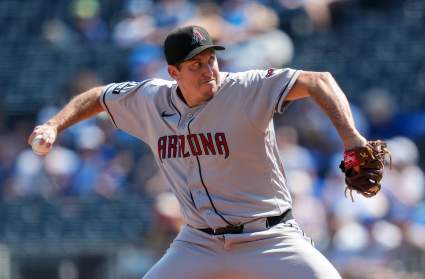
The Arizona Diamondbacks took a gamble on the oft-injured Michael Soroka to fill out their rotation. Soroka, 28, was once the budding ace of the Atlanta Braves, but his career derailed with various injuries. 2025 was his healthiest season, logging 89.2 innings with a 4.52 ERA between the Washington Nationals and Chicago Cubs.
The San Francisco Giants made a similar signing this week, landing right-hander Tyler Mahle. Mahle, 31, is coming off a solid, but injury-plagued, season with the Texas Rangers. He pitched to a 2.18 ERA in 86 innings with the Rangers, but with troubling underlying metrics.
Ultimately, both injury-prone pitchers netted one-year guarantees on the open market. Soroka landed a $7.5 million guarantee from the Diamondbacks, while Mahle got $10 million from the Giants. However, it’s worth noting that Arizona has lower taxes and a lower cost of living compared to San Francisco.
Michael Soroka Holds Edge on Key Statcast Metrics
At first glance, you’d think the Giants got the better deal. Mahle’s 2.18 ERA was better than Soroka’s 4.52 over a similar sample of innings (86 vs. 89.2). With a better ERA, it makes sense as to why Mahle got more guaranteed money, although having to pay less taxes in Arizona could also play a role.
However, ERA also serves as the least useful metric for projecting into the next season. Instead, we should look at their strikeout rate, walk rate, and quality of contact metric to project forward. Fortunately, both are publicly available on their Statcast pages.
Here are some important 2025 metrics to consider when comparing two of the newest National League West starters.
| Metric | Michael Soroka (ARI) | Tyler Mahle (SFG) |
| K% | 25.1 | 19.1 |
| BB% | 7.7 | 8.4 |
| xERA | 3.46 | 4.28 |
| Whiff% | 23.7 | 23.2 |
| Chase% | 23.2 | 27.9 |
The biggest difference between the two starters is K-BB%, with Soroka posting a much stronger strikeout rate. His 25.1% strikeout rate was not only better than any Diamondbacks starter, but it was also 6% better than Mahle’s 19.1% mark. With more strikeouts, that gives Soroka a better floor when it comes to run prevention.
While Soroka holds the edge on whiff rate on a per-swing basis, Mahle has a higher swinging-strike rate. Mahle sits at 10.6% and Soroka 9.4%. So while Mahle gets more whiffs per pitch, he also induces more swings. That is evident in the sizable gap in chase rate.
The expected metrics also heavily favor Soroka. These metrics take into account the opposing hitter’s exit velocity and launch angle data on batted balls. Soroka’s .210 xBA and 3.46 xERA rate are in the 84th and 74th percentiles. Mahle’s .257 xBA and 4.28 xERA rank in the 25th and 35th percentiles.
When it would be easy to point to the strikeout rate as a key difference, Soroka also holds the edge on xwOBA on contact. Soroka posted a .327 xwOBACON in 2025, ranking in the Top 10% of pitchers. Mahle was at .360, which is still better than the MLB average of .368.
What the Projections Say About Soroka and Mahle
While the 2025 underlying metrics favor Soroka, we also need to take a look at next season’s projections. Here are the Steamer projections for both pitchers in 2026.
- Soroka: 49 G, 23 GS, 148.2 innings, 4.23 ERA, 1.5 WAR
- Mahle: 26 GS, 148 innings, 4.17 ERA, 1.4 WAR
While the projections are a bit optimistic in innings, it comes out as a wash between the two pitchers. Because the Diamondbacks are paying $2.5 million less for their starter, it looks better for them in a vacuum. However, factoring in taxes and cost of living between the two cities, it’s probably a wash in take-home pay. Another important distinction is that Soroka lives in the Phoenix area, per Arizona Sports’ Alex Weiner, which means he doesn’t have to find a new place to live.
Soroka appeared on the Foul Territory podcast on December 16, saying he’s “throwing in a manner that’s healthier”. If that leads to him finishing close to that 148.2-inning projection, his highest since 2019, it’s a big win for the Diamondbacks.


Diamondbacks Gamble on Michael Soroka Looks Better After Giants’ Latest Signing