
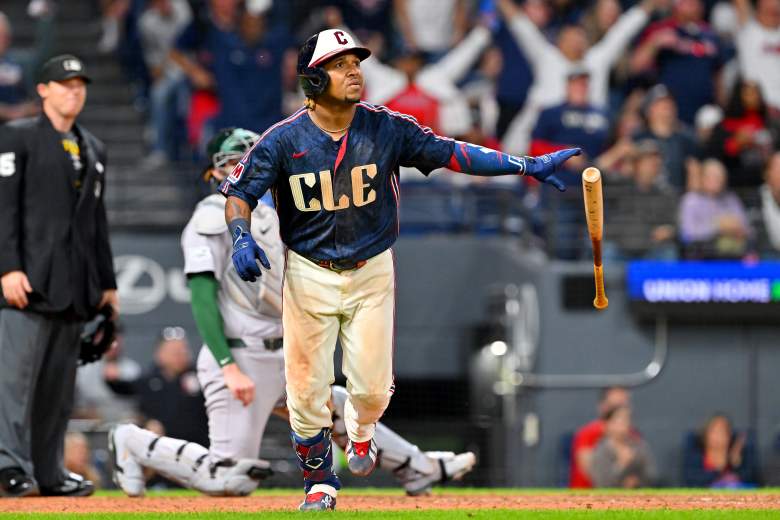
Jose Ramirez is pivotal to everything the Cleveland Guardians do.
It just feels like over the last couple months, the Guardians haven’t gotten the peak version of Ramirez.
That’s not to say Ramirez is slacking. He’s almost certainly giving Cleveland everything he has.
There’s just every indication that Jose isn’t playing as his best self. He’s probably less than 100%.
It’s the kind of thing that’s reflected everywhere — in commentary from ESPN broadcasters, in headlines on The Athletic, and in Ramirez’s stats.
With the Guardians surging toward the postseason, trying to hold onto a division title, and hoping to make noise in October, Ramirez won’t be taking any breaks.
But it’s worth wondering whether there’s a way this can get better.
Jose Ramirez’s Injury
This season, Ramirez sustained a fracture to his left hamate bone.
That’s the bone on the outside part of the hand, kind of extending from the pinky finger and ring finger toward the wrist. It has a hook-like projection, called the humulus, that points toward the palm.
When the hamate bone fractures, it’s often that hook that gets messed up.
Ramirez was injured in June and missed about five weeks before returning to Cleveland’s lineup on July 22.
Because of the location of the hamate bone, though, it can make hitting after an injury there harder. It can impact grip strength or overall force able to be generated in a swing against major league pitching that requires each variable in the swing to be dialed in together.
Ramirez may not be playing hurt in the sense that he needs something fixed. The hamate bone is just historically a difficult injury to regain full strength from. Hitters often aren’t themselves until the following season after the injury.
Jose Ramirez Switch-Hitting Since Injury
It has felt like, anecdotally, Ramirez has been a bit stronger from the right side of the plate versus the left side since returning.
A switch-hitter has double the trouble in this return from injury, because he has to get both his swings feeling good again.
Overall, Ramirez has struggled since his return, with a .234 average and a .685 OPS. But the difference from each side is pronounced.
When Ramirez hits right-handed against lefty pitchers, he has a .705 OPS since his return.
When he hits left-handed against righty pitchers, he has a .599 OPS since his return.
His averages are almost the same (.244 against lefties, .230 against righties). But Ramirez is slugging .422 from the right side and .281 from the left side in that span.
His power has almost entirely vanished from the side of the plate he hits from more often.
Yes, Ramirez did homer last week from the left side, so maybe he’s feeling better — but it’s hard to say.
There’s almost no way he’d give up switch-hitting out of the blue, because it would require then facing righties from the right side, something he hasn’t done his whole career — so there’s no assurance it would go any better.
But something about his left hand injury recovery has mattered. That hand is on the bottom when he hits from the right side, and likely contributes mostly to bat control there.
On the left side, that hand is on the top, and it could have more impact on power and bat speed through the zone.
Ramirez seems to be impacted wherever he stands at the plate since returning from injury, and it’s not going to stop him from playing hard and contributing — but the Guardians might be in slightly better shape the rest of the way when their superstar bats from the right side against southpaw pitching.
Guardians’ Jose Ramirez Injury Raises Switch-Hitting Dilemma