
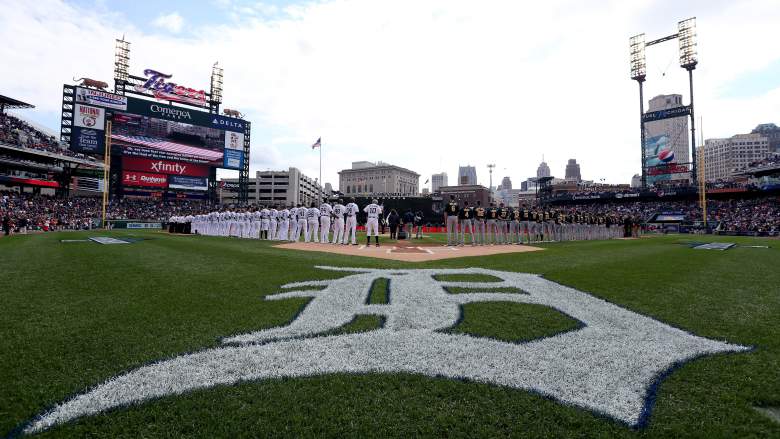
As one of Major League Baseball’s oldest and most recognizable organizations, the Detroit Tigers are marking the franchise’s 125th anniversary with a special celebration at Comerica Park.
The festivities recognize a franchise that has remained remarkably consistent throughout its existence – making the Tigers the oldest American League team to keep the same name while calling only one city home.
From Bennett Park to Tiger Stadium and now Comerica Park, generations of Detroit fans have witnessed Hall of Famers, World Series championships, heartbreaking losses and unforgettable moments.
Here’s a look back at the defining eras that shaped one of baseball’s most historic franchises.
The Early Years (1890s-1910s): Building Baseball in Detroit
The Tigers trace their roots to 1894 as charter members of the Western League before joining the newly formed American League in 1901. After moving into Bennett Park in 1896, Detroit quickly became one of baseball’s cornerstone franchises.
The nickname “Tigers” became synonymous with the club during this period, with many attributing it to Detroit’s famed Light Guard military unit.
The team’s first American League home game on April 25, 1901, immediately became legendary. Trailing the Milwaukee Brewers 13-4 entering the ninth inning, Detroit staged one of baseball’s greatest Opening Day comebacks, scoring 10 runs to claim a stunning 14-13 victory before more than 10,000 fans.
Just four years later, the Tigers acquired a young Ty Cobb, a move that forever altered the franchise’s trajectory. Cobb helped Detroit capture three consecutive American League pennants from 1907-09, while Frank Navin’s vision led to the construction of Navin Field in 1912, laying the foundation for what would later become Tiger Stadium.
The Championship Era (1920s-1940s)
Although the Tigers remained competitive during the 1920s, the franchise reached new heights in the 1930s behind stars Hank Greenberg, Charlie Gehringer, Mickey Cochrane and Schoolboy Rowe.
Detroit won back-to-back American League pennants in 1934 and 1935, finally breaking through by defeating the Chicago Cubs to capture the organization’s first World Series championship.
The timing couldn’t have been more meaningful. With Detroit enduring the hardships of the Great Depression, the 1935 championship provided a city-wide celebration and remains one of the most cherished moments in franchise history.
The Tigers returned to the World Series in 1940 before winning their second championship in 1945 behind Hal Newhouser, whose dominant pitching helped Detroit edge the Chicago Cubs in another seven-game Fall Classic.
During this era, Navin Field evolved into Briggs Stadium, becoming one of baseball’s most iconic venues.
New Heroes and Another Championship (1950s-1980s)
The post-war decades introduced another generation of Tigers legends. Al Kaline emerged as one of baseball’s greatest hitters, while Tiger Stadium officially received its permanent name in 1961.
Detroit’s defining moment came in 1968 when Mickey Lolich won three complete games during the World Series, leading the Tigers past the St. Louis Cardinals for their third championship.
Following several rebuilding seasons, Sparky Anderson transformed the franchise into a powerhouse during the 1980s. The 1984 Tigers opened the season 35-5 and never looked back, finishing with 104 wins before defeating the San Diego Padres to claim what remains the club’s most recent World Series title.
The combination of Alan Trammell, Lou Whitaker, Jack Morris and Kirk Gibson cemented the 1984 club as one of the greatest teams in franchise history.
Comerica Park and a New Generation (1990s-2010s)
The franchise experienced difficult stretches during the late 1990s and early 2000s, including a franchise-record 119 losses in 2003. However, change arrived with the move to Comerica Park in 2000 and the hiring of Jim Leyland before the 2006 season.
Leyland quickly restored the Tigers to contention, leading Detroit to an American League pennant in 2006. The following decade featured some of the most talented rosters in club history, led by Justin Verlander and Miguel Cabrera.
Verlander captured both the American League Cy Young and MVP Awards in 2011, while Cabrera won multiple batting titles before becoming baseball’s first Triple Crown winner in 45 years during the 2012 season.
Detroit also claimed four consecutive American League Central titles from 2011 through 2014, re-establishing itself as one of baseball’s premier organizations.
The 2020s: A New Era Takes Shape
Like every Major League Baseball team, the Tigers entered the new decade facing unprecedented challenges. The Covid-19 pandemic shortened the 2020 season to just 60 games, leaving Comerica Park largely empty as cardboard cutouts and artificial crowd noise replaced the roar of Detroit faithful.
While the season looked vastly different than any before it, it also marked the beginning of a new chapter for the organization, as top prospects such as Casey Mize and Tarik Skubal made their long-awaited Major League debuts and gave fans hope for the future.
That hope has since turned into one of baseball’s brightest success stories. Skubal has developed into the face of Detroit’s pitching staff and one of the game’s premier aces, capturing back-to-back American League Cy Young Awards in 2024 and 2025.
In doing so, he became the first American League pitcher since Pedro Martinez in 1999 and 2000 to win consecutive Cy Young Awards, placing himself alongside franchise legends such as Denny McLain as one of the Tigers’ most decorated pitchers.
Now firmly established as one of baseball’s elite starters, Skubal has become the kind of pitcher every contender covets. Whether discussing trade speculation, free agency or the race for another postseason berth, the left-hander’s name is consistently mentioned among the most valuable players in the sport.
The Tigers’ resurgence extends well beyond the mound. Catcher Dillon Dingler has blossomed into one of the American League’s top two-way players, pairing Gold Glove-caliber defense with emerging power at the plate.
In 2026, Kevin McGonigle recorded his 100th professional hit in just his 95th career game, becoming only the second Tigers player age 21 or younger to collect his first 100 hits in fewer than 100 career games. The only other player to accomplish the feat was Ty Cobb, who reached the milestone in 90 games in 1906 – exactly 120 years earlier.
Alongside these standouts are Riley Greene, Spencer Torkelson, Gleyber Torres, Kerry Carpenter, and a talented young core, representing the next generation of Tigers baseball.
Table 125 Gives a Preview of the Anniversary Celebration
The Tigers have already begun commemorating the milestone with an intimate event called Table 125, welcoming a select group of media members and individuals affiliated with the organization onto the field at Comerica Park for a first look at the club’s 125th anniversary celebration.
Held on the warning track with the Detroit skyline serving as the backdrop, the event featured drinks served in collectible Paws souvenir cups and a creative menu presented as “nine innings” of small-plate samples.
Guests also received an exclusive gift box that included a commemorative T-shirt, a special 125th anniversary cap, a matching logo keychain and magnet.
The evening also showcased pieces of Tigers history, reinforcing the franchise’s connection to its past. Memorabilia on display included a baseball and Tigers cap from the 1934-35 era, Kirk Gibson’s game glove from the 1980s, a game-used bat from the 1940s and an original ticket from the Tigers’ 1945 World Series championship.
During July 23-26, fans can expect commemorative giveaways (including a 1901 replica jersey on the 25th), appearances by Tigers legends and alumni, themed in-game entertainment, and special tributes celebrating the franchise’s rich history.
A Legacy 125 Years in the Making: The Story of the Detroit Tigers