

New York Mets president of baseball operations David Stearns spent the offseason touting a need for run prevention. In essence, he felt as though the team’s defense hurt them in games where they failed to execute defensively. As a result, mundane innings were prolonged. After the first couple of weeks, some of the same issues from a year ago started to surface. Will Sammon of The Athletic details the Arizona series here.
“The Mets made ‘run prevention’ an offseason mission. They improved greatly up the middle. But a mix of players trying new positions makes them susceptible at the corners. The metrics so far say they are a good defensive team.”
To Sammon’s point, the Mets have committed six errors in thirteen games, for a fielding percentage of .988. In contrast, a year ago, the team boasted a .986 fielding percentage. While the team makes fewer errors, mistakes aren’t the only determining factor when judging a team’s defense.
What is Range Factor and Why Does It Matter?
Granted, errors are important. However, what happens when the ball gets by you and you never touch it? Baseball Reference invented a statistic called “range factor.” Basically, it is a number that takes assists/putouts/innings played into consideration. Utility player Brett Baty is a prime example.
He possesses a range factor of 4.52, where the league average is 4.53. In other words, the Mets’ infielder/outfielder is a slightly below-average fielder. He doesn’t make all the plays that the average player does. In his defense, Baty moves around a great deal. Sammon detailed a particular incident during the final game of the series against the Arizona Diamondbacks.
“Brett Baty read the ball well. He tracked its flight while quickly going back to the outfield wall. Instead of making the catch, however, the ball sailed over his head. It was a good effort for someone new to right field in the major leagues.
In his defense, Baty owned up to the mistake.
“That was the first one I’ve gotten near the wall,” Baty said. “Still working hard to get some experience with the wall balls and stuff. I think they are extremely hard, but I am going to do everything I can to go catch those—run through the wall if I have to.”
Nolan McLean was magnificent tonight, but he’s not going to come away with a win. After McLean departed, Gabriel Moreno hit an RBI double over Brett Baty’s head, and Alek Thomas knocked in the go-ahead run on an RBI fielder’s choice — both off Luke Weaver.
The Mets now trail. pic.twitter.com/SKuTRPuw8U
— Anthony DiComo (@AnthonyDiComo) April 10, 2026
https://platform.twitter.com/widgets.js
Positional Change Will Never Be Easy
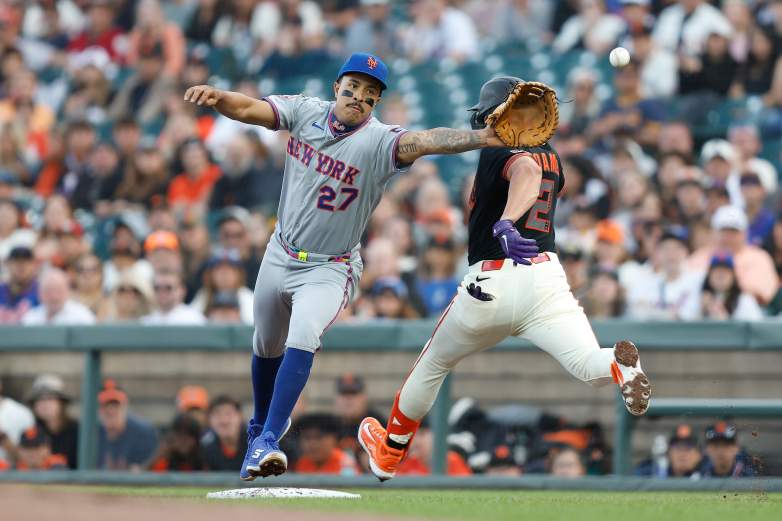
The Mets signed Bo Bichette to play third base, somewhere that he’s never played in the majors. Manager Carlos Mendoza installed Jorge Polanco at first base. As a member of the Seattle Mariners, he played exactly one game. Moreover, the team shifted star outfielder Juan Soto from right to left field. Mark Vientos, normally a third baseman, plays first, shoving Polanco into the everyday designated hitter role.
Pretty impressed with Mark Vientos defensively at 1st thus far pic.twitter.com/H2YQ5Av2K2
— Unbiased Mets Fan (@TheMetsX) April 9, 2026
https://platform.twitter.com/widgets.js
Meanwhile, Stearns did fortify the Mets up the middle. With Francisco Lindor, now paired with second baseman Marcus Semien, the Mets field a strong double play combination. To this point, the duo participated in a combined 13 double plays and just one error in 107 chances. Additionally, Luis Robert Jr. and Francisco Alvarez keep the defense strong with just one error between them in 108 chances.
Overall, the Mets do play better defense. Yet, in order to win the ugly games, the defense needs to improve from a range standpoint.
New York Mets UT Brett Baty’s Defense Emblematic of Early Struggles