
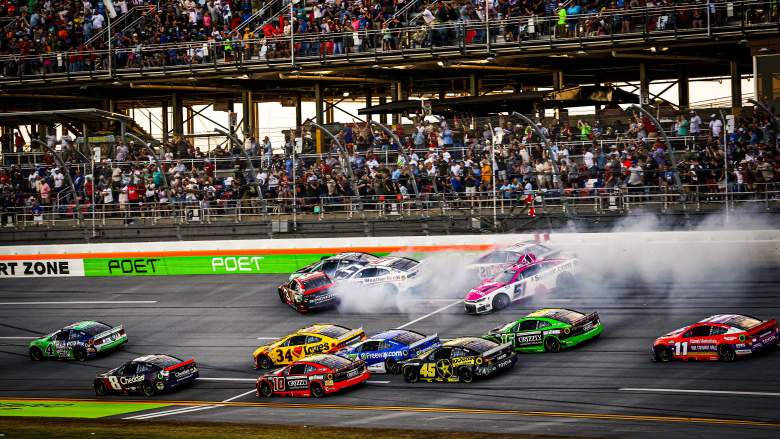
When a NASCAR driver climbs from a battered race car following a major crash, the medical evaluation can begin almost immediately.
But what actually happens after that?
NASCAR has spent years developing its concussion prevention and management procedures, from preseason baseline testing to mandatory evaluations following certain crashes. The system is designed to give physicians information they can use to identify potential head injuries and determine whether a driver is medically fit to compete.
The policies have evolved significantly over time, particularly following high-profile concussions involving drivers such as Dale Earnhardt Jr.
Here’s how NASCAR’s concussion protocol works and what happens when a driver suffers a potential head injury.
Does NASCAR Test Drivers for Concussions?
Yes.
NASCAR has required preseason neurocognitive baseline testing for drivers in its national series since 2014. The requirement was announced in 2013 as part of the sanctioning body’s concussion prevention and management program.
NASCAR originally implemented the requirement using ImPACT, short for Immediate Post-Concussion Assessment and Cognitive Testing.
The test evaluates areas including verbal and visual memory, processing speed and reaction time. Most importantly, it establishes a picture of an individual driver’s normal cognitive function before an injury occurs.
If that driver later suffers a suspected concussion, doctors have baseline information available to help evaluate whether the driver’s cognitive performance has changed.
The baseline test, however, is not by itself a concussion diagnosis.
NASCAR emphasized that distinction when introducing the requirement, describing neurocognitive testing as one of multiple tools doctors can use when evaluating an injured driver.
What Happens After a NASCAR Driver Crashes?
Not every accident automatically means a driver has suffered a concussion, but NASCAR does have a mandatory evaluation rule tied to damaged vehicles.
NASCAR’s concussion protocol states that when a driver’s car sustains damage from an accident or contact and goes behind pit wall or to the garage, the driver is required to report to the Infield Care Center for evaluation.
That requirement was introduced in 2017 alongside a broader expansion of NASCAR’s concussion protocol.
NASCAR also standardized head-injury screening at its tracks, initially requiring Infield Care Center physicians to incorporate the SCAT-3, or Sport Concussion Assessment Tool, into their evaluations. NASCAR simultaneously announced a partnership with American Medical Response to provide neurological consultation at select events and assist with continued development of the protocol.
The Care Center evaluation isn’t simply theoretical. After Christopher Bell’s violent Michigan crash in June 2026, for example, Bell later described undergoing tests in the Infield Care Center while discussing why he believed he had escaped a head injury.
What Happens if a NASCAR Driver Has a Concussion?
A driver cannot simply decide that he or she feels well enough and climb back into the car.
Medical clearance is required before an injured driver can return to competition.
NASCAR’s history provides several prominent examples. Matt DiBenedetto was held out of a Cup Series race in 2016 after he was not medically cleared following a crash the previous day.
Dale Earnhardt Jr.’s experience became an especially important chapter in NASCAR’s approach to head injuries.
Earnhardt missed two races in 2012 after suffering two concussions roughly six weeks apart. He was sidelined again in 2016 because of concussion-related symptoms and ultimately missed the remainder of that season.
His experience helped push the conversation about concussion management further into the open. NASCAR chairman Brian France later acknowledged that Earnhardt’s decision to step away in 2012 contributed to NASCAR’s move toward mandatory baseline testing.
Why Does NASCAR Use Baseline Concussion Testing?
Concussions can be particularly complicated because there isn’t one simple measurement that determines whether an athlete is ready to return.
That’s where baseline testing becomes valuable.
Because drivers establish their normal cognitive performance before competing, physicians have individualized information available for comparison following a suspected injury.
As NASCAR explained when it instituted mandatory testing, the baseline provides doctors with a snapshot of healthy brain function that can later help them evaluate an injury and make return-to-competition decisions.
It is one piece of a broader medical evaluation, rather than a pass-or-fail test that determines a driver’s status by itself.
That distinction is important.
NASCAR racing regularly produces impacts that would be extraordinary in most other sports. Its concussion policies are designed not merely to respond when a driver says something feels wrong, but to give medical professionals multiple tools for evaluating what happened and whether that driver is ready to race again.
What Is NASCAR’s Concussion Protocol? Everything You Need to Know