
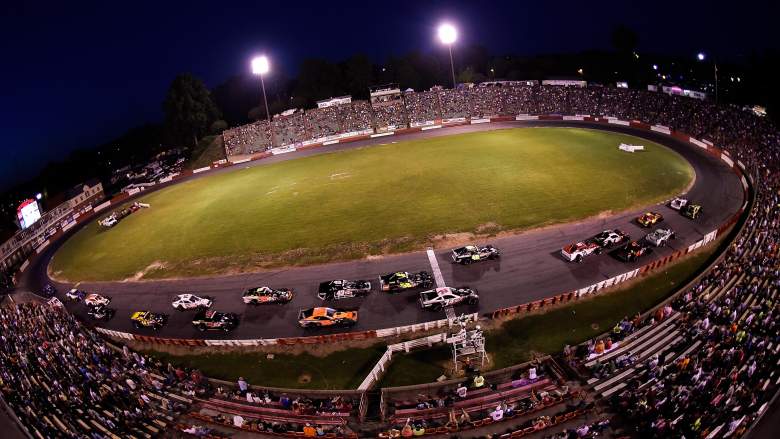
As an arctic blast threatens to turn the historic “Madhouse” into an icebox, fans have spent the week pushing a familiar idea. If the weather gets bad enough, why not move the Clash back to Daytona?
In a recent appearance on SiriusXM NASCAR Radio, John Probst explained why that popular theory doesn’t hold up. Despite forecasts calling for snow and temperatures in the 20s, NASCAR is effectively locked into Bowman Gray Stadium because of how the cars are built, how engines are allocated, and where the sport is on the calendar.
Why a Move to Daytona Isn’t as Simple as It Sounds
“When you look at how the cars are configured for a short track with the new 750-horsepower engines, and you say, ‘Let’s just pivot to Daytona,’ you really only have two options. You can run the oval, or you can run the road course.”
At first glance, the road course might seem like the easiest solution. Probst pointed to last weekend’s Rolex 24 at Daytona, which drew a record crowd and showcased the facility at its best.
“The Rolex 24 just put on a fantastic show down there. It was the most attended Rolex 24 in history, so thumbs up to John Doonan and the whole crew. They’re getting it done.”
Engine Supply and Car Configuration Lock NASCAR In
But that momentum doesn’t carry over to the Clash. With the Daytona 500 approaching, the track has already shifted into race-week mode.
“You could say, ‘Well, we could run the 750 package down there,’ but the Great American Race is coming up real soon. Frank Kelleher and the team are already getting the infield ready for campers.”
That preparation removes the road course from consideration. “The infield is in flux right now, which kind of rules out the road course. Once you get close to the Daytona 500, they’re already starting to move stuff in.”
That leaves the oval at Daytona International Speedway, and that’s where the most significant obstacle appears.
“That leaves you with the oval, and once you go to the oval, now you’re on superspeedway engines. You step back into the transaxles at that point.”
The timing makes that switch unrealistic. NASCAR races at Daytona and then heads to Atlanta Motor Speedway the following week.
“We race Daytona, and then we race Atlanta the week after. There’s a pool of probably 100 or more engines already set aside in the engine shops for the 500 and the Atlanta race that follows the very next week.”
“You run into a supply issue with engines, trying to swap them out with basically no notice. That’s not really all that appealing.”
No Easy Weather Escape as Decision Window Closes
Even the weather offers little relief elsewhere. “When you look at the weather forecast in the Orlando and Daytona area, it’s not spectacular either. It could be 20 degrees in Orlando this weekend.”
As he put it, “There really is no shining oasis in the desert where you can say, ‘Let’s just go here, and everything will be fine.’”
Probst said NASCAR has been in constant contact with engine shops, transaxle suppliers, teams, broadcast partners, fans, and city officials.
“A lot goes into it. We’re talking with the engine shops, the transaxle suppliers, the teams, and the broadcast partners. We’re listening to the fans and the city. There’s just a lot of data coming in.”
NASCAR waited as long as it could for the forecast to improve. “We held out as long as we could on the forecast, hoping it would change, and it didn’t. Weather isn’t always an exact science. We wait as long as we can to make the best decision possible with the data we have at the moment.”
For now, that decision keeps the Clash at Bowman Gray Stadium.
NASCAR Logistically Locked: Why the Clash Can’t Escape the Bowman Gray Deep-Freeze