
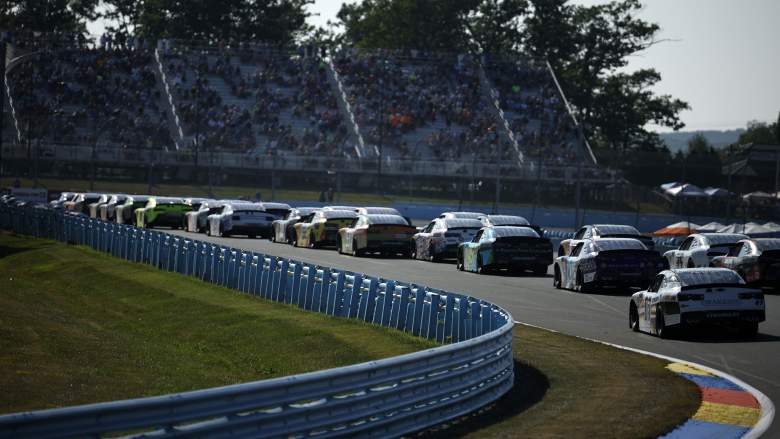
If you watch NASCAR’s race weekend at Watkins Glen International, you are going to hear one phrase over and over again from drivers, spotters and broadcasters:
It is one of the most famous sections in American road course racing, and every year it becomes a major talking point during the NASCAR Cup Series race at The Glen.
The Bus Stop is a high-speed chicane located on the backstretch at Watkins Glen. Officially called the “Inner Loop,” the section was added to the track in 1992 as a safety measure designed to slow cars before they reached the fast downhill section entering Turn 5.
Before the chicane existed, drivers stayed flat-out for much longer down the backstretch, creating significantly higher speeds and a far more dangerous braking zone.
Why Is It Called the Watkins Glen Bus Stop?
The nickname “Bus Stop” comes from the way the section looks and flows.
The left-right-left chicane resembles the pull-off area of a roadside bus stop, and the nickname quickly stuck among drivers and fans. The section sits between Turn 4 and Turn 5 on the layout.
Today, many NASCAR fans know the section simply as “the Bus Stop” instead of the Inner Loop. Television broadcasts, team radios and even drivers frequently use the nickname during race coverage.
Why the Bus Stop Matters in NASCAR
The Bus Stop is one of the most important passing zones at Watkins Glen.
Drivers charge down the long backstretch before aggressively braking entering the chicane. That creates opportunities for overtakes, but it also leads to mistakes, wheel hop, lockups and major crashes.
Because the section forces drivers to attack curbing while changing direction at high speed, it is also one of the most technically difficult areas on the track.
If a driver misses the entry even slightly, it can ruin the entire run through the next section of the course.
That is why broadcasters constantly reference the Bus Stop during NASCAR races. It is often where momentum swings happen, tempers flare and races can be won or lost.
The Bus Stop Has Produced Iconic NASCAR Moments
Over the years, the Bus Stop has become one of Watkins Glen’s signature visuals.
Cars routinely attack the curbing while bouncing through the chicane, and drivers sometimes go airborne while fighting for position. NASCAR fans have seen dramatic last-lap battles, spinouts and heavy contact in the section across Cup, O’Reilly and Truck Series races.
The corner has become even more aggressive in the Next Gen era because drivers are willing to push the limits of the curbing to maximize lap time.
For road course specialists like Shane van Gisbergen, AJ Allmendinger and Michael McDowell, mastering the Bus Stop is one of the keys to winning at Watkins Glen.
Why Fans Search for the Watkins Glen Bus Stop Every Year
Every NASCAR broadcast from Watkins Glen heavily references the Bus Stop, especially during qualifying, restarts and late-race battles.
For newer fans, it is one of those uniquely named track sections that immediately stands out. Between the nickname, the aggressive racing and the constant TV references, the Bus Stop has become one of the defining features of Watkins Glen International.
And once Sunday’s Cup race begins, fans are almost guaranteed to hear about it nonstop.
What Is the Watkins Glen Bus Stop? NASCAR’s Famous Chicane Explained