
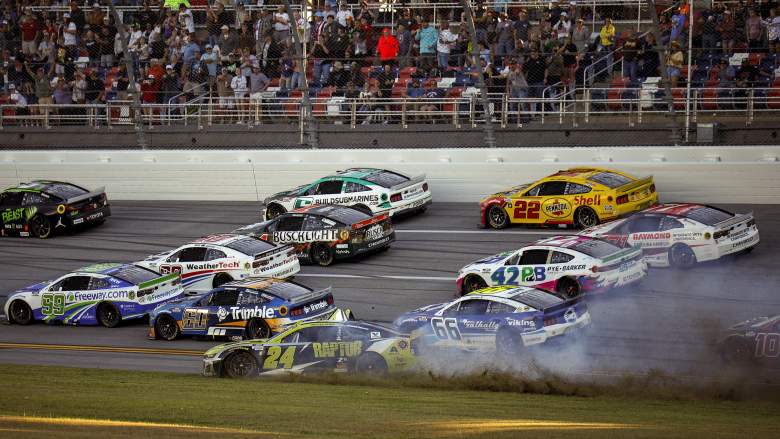
Few tracks in NASCAR carry the same reputation — or risk — as Talladega Superspeedway.
At 2.66 miles, it’s the longest oval in the sport. It’s also one of the fastest tracks NASCAR has ever produced. And year after year, it delivers the kind of multi-car chaos that has made it widely considered the most dangerous track in the sport.
But what exactly makes Talladega so volatile — and why do drivers keep embracing the risk?
Extreme Speeds — Even in a Restricted Era
Talladega’s danger starts with speed — and its history proves it.
In 1987, Bill Elliott set the all-time NASCAR qualifying record at Talladega with a lap of 212.809 mph, a mark that still stands today. While modern rules packages have reduced top speeds, today’s NASCAR Cup Series cars still run in the 190 mph range.
But the real issue isn’t just how fast the cars go — it’s how closely they run together.
NASCAR’s superspeedway package, which evolved from the restrictor plate era into today’s tapered spacer system, is specifically designed to keep the field tightly bunched. The result is pack racing at nearly 200 mph, where cars run inches apart with virtually no margin for error.
‘The Big One’ Is Always One Mistake Away
At most tracks, incidents involve a handful of cars.
At Talladega, one mistake can take out half the field.
“The Big One” — the term used to describe a massive multi-car crash — has become synonymous with superspeedway racing. Because the field runs in tight drafting packs, a single bump gone wrong or a mistimed block can trigger a chain-reaction crash involving 15, 20, or more cars.
Drivers in the middle or back of the pack often have no time — and nowhere — to escape.
Closing Speeds Create Split-Second Danger
Another overlooked risk at Talladega is closing speed.
Cars in the draft can generate massive runs, rapidly gaining speed on the cars ahead. That creates situations where drivers approach slower traffic at significantly higher speeds with only fractions of a second to react.
Late in races, when every position matters, those closing rates become even more dangerous as drivers aggressively block, push, and fight for track position.
Aerodynamics — Not Grip — Control the Race
At most tracks, performance is dictated by mechanical grip.
At Talladega, it’s dictated by air.
Clean air, drafting lanes, and push dynamics control how cars move through the field. A car that loses the draft can fall backward instantly. A car that gets an aggressive push from behind can surge forward unpredictably.
That dependence on aerodynamics — combined with pack racing — creates an environment where stability can disappear in an instant.
History Has Proven the Risk
Talladega’s reputation is built on decades of violent and unpredictable crashes.
Superspeedway racing has produced some of the most dramatic incidents in NASCAR history, including airborne flips and high-impact collisions that have directly influenced safety innovations such as roof flaps and the SAFER barrier.
More recently, crashes like Ryan Newman’s 2020 Daytona 500 accident — another superspeedway — have reinforced just how dangerous this style of racing can be, even with modern safety advancements.
The cars are safer than ever. The environment remains unforgiving.
Why Drivers Still Embrace Talladega
Despite the risks, Talladega is one of the most anticipated races on the schedule.
Because it’s also one of the most unpredictable.
Superspeedway racing levels the playing field in a way no other track can. Underdogs can win. Favorites can be eliminated in seconds. Strategy, timing, and drafting partners matter as much as raw speed.
It’s chaotic. It’s unpredictable. And for drivers, it’s an adrenaline rush that’s impossible to replicate anywhere else.
The Risk Is the Appeal
Talladega sits at the intersection of danger and opportunity.
It’s a track where control is temporary, outcomes are uncertain, and the margin for error is virtually nonexistent.
That’s exactly why it’s feared. And exactly why it’s revered.
Because at Talladega, there’s one constant:
No lead is safe. No driver is untouchable. And no race is ever fully under control.
Why Talladega Is Widely Considered NASCAR’s Most Dangerous Track