
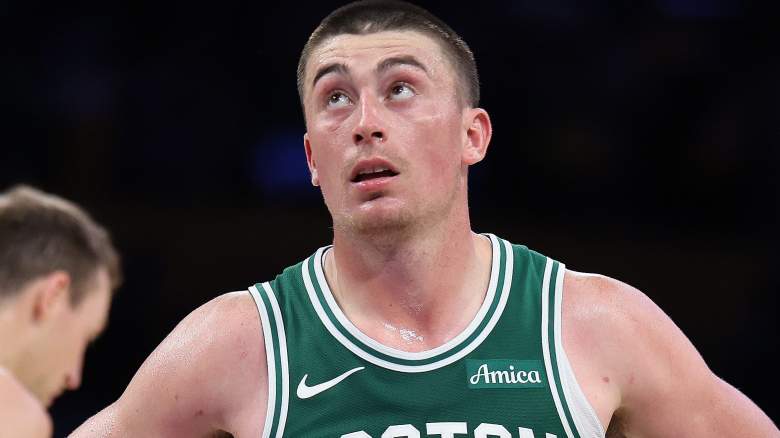
One of the big remaining questions for the Boston Celtics this summer is what will happen with point guard Payton Pritchard, who is entering the third year of a four-year contract that came in at $30 million, making him one of the best values in the NBA. As things stand, Boston can offer Pritchard a max extension that comes in at three years and $67 million, a contract that better reflects his current value.
But then, Pritchard could take another path–he could wait on a contract and push the Celtics to give him more, recouping some of the value he has provided after winning Sixth Man of the Year two seasons ago, and averaging 17.4 points and 5.2 assists last season. If Pritchard did not sign, and waited to hit free agency, he would lose out on some security, but there could be more money for him on the market.
Free agency is a risky business for players these days. That’s why players like to sign extensions before they get there. But more teams are cutting back on salary and keeping room open for free agents–there is expected to be significant cap space next summer, and possibly the same in 2028.
Payton Pritchard Could Play Hardball With Celtics
That’s why Pritchard could wait and rebuff offers on a contract with the Celtics this summer. If he signs a deal now, it is based on 140% of what the average salary will be in 2028. If he waits, he is open to anything up to the max, 30% of the cap. He won’t get that much, of course, but his ceiling would be higher.
Said one exec on Pritchard: “Look, everything is going up in two years–salary cap, tax line. There will be more money, there will be more free-agent money, too. So if you’re Pritchard, why would you sign with the Celtics now? Play hardball. Whatever money they offer now is going to be there later. Security and injury, those are good reasons to take the money. He can make more though, by waiting. And there is only the slimmest chance he would make less.”
Or Celtics Could Play Hardball With Payton Pritchard
At SI.com, veteran Celtics beat writer Jon Karalis presents the options differently, seeing the Pritchard situation through the lens of the Celtics’ leverage in the situation, which is considerable especially if the free-agent money does dry up.
Karalis points out that Pritchard will be 30 in 2028, and the 30s are harder on small guards than most other players. He says it would be “fine” to give Pritchard three years and $70-ish million, but after the Celtics traded Jaylen Brown in the name of “optionality,” maybe it is the Celtics who should play hardball with Pritchard.
He writes: “I’m looking at a great regular season player who is less effective in the playoffs, who is smaller, and getting older. I would prefer Boston give him a contract starting at the projected MLE for the 2028-29 season. A three-year deal that pays him $16.6 million in the first year is a better representation of what he could get on the open market.”
Maybe the Answer Is in the Middle
That is, indeed, a tough line for the Celtics to take on Pritchard and tosses aside the sentimental notion that they should make up for how underpaid he has been in recent years. Which is reasonable–it’s a business.
But an extension starting at $16.6 million would be about $54 million over three years. Even with his age and size, and even putting aside the salary make-up factor, that is light for Pritchard.
Maybe the Celtics will take that hardball route. Maybe Pritchard will hold out and take his own hardball route. Or maybe–and most likely–he’s going to be offered the $67 million and take it.
Celtics Could Play Hardball on Payton Pritchard Extension