
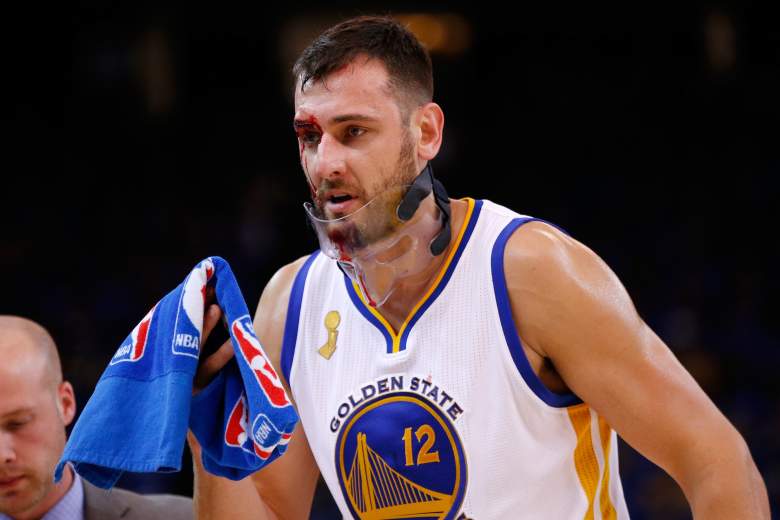
More than a decade ago, Andrew Bogut – then of the Golden State Warriors – spoke in an interview with an Australian newspaper about his dislike of the way in which NBA player salaries were so widely publicized. Bogut specifically alluded to the bad actors – particularly the well-known and yet barely-ever-mentioned NBA groupie scene – who would use this information to try and exploit players, a vulnerability that Bogut did not see the need for:
What do you think of your salary being made public?
I disagree with the publishing of figures. The big paper in the States, The USA Today, actually has a lift-out every three or four months which has every professional athlete’s salary in every sport in America. You have a bunch of women cutting that out and following guys around at night clubs. It just creates a plethora of problems.
– c/o Courier Mail, 7th June 2014
Last week, Denver Nuggets guard Spencer Jones arrived at the same sort of conclusion, via a very different methodology. Jones – who openly positions himself as an investor, prominent LinkedIn user and financial influencer guy type thing – used his favorite platform of choice and an excess of line breaks to express his views on why, if player salaries are going to be published, executive and coaching ones should be too.
One of the most common questions I get: “How does it feel having everyone know your salary?”
Honest answer? I don’t mind it. I actually think it’s a good thing.
During free agency, every negotiation is built on comparison. You know what the guy ahead of you got paid, what the market looks like, and you use that information to advocate for yourself. That transparency is what gives players real leverage at the table.
And I think the same should apply in the corporate world. Most people negotiate compensation in the dark. Not knowing what their peers make, what the range actually is, or whether they’re being underpaid. If they had the same visibility, they’d have the same power.
But here’s the part I find interesting.
Everyone can tell you what I make, what my teammates make, or what the max contract looks like this year.
But ask someone to name a single GMs salary, or even a head coach, and they’d shrug.
The transparency mostly exists on one side, and I’ve never heard a good explanation for why that is.
And maybe that’s the bigger lesson.
The people negotiating their compensation should have access to the same information as the people deciding it.
That’s true in the NBA. And I think it’s just as true in the corporate world.
Viewed through that lens, there does seem to be an inherent unfairness to only having one of the sides in the collective bargaining process have all their cards on the table. The reasons, though, are specifically because of the unique nature of team sports. The author of this article was a proprietor of a leading NBA salary data and analysis website, until it both it and he became washed-up old relics. So allow him to try and answer both Bogut and Jones.

The Media Report/Salary Database Feedback Loop
There are valid reasons why salary information is published in this way. And to understand them means to come at the issue from a very different viewpoint to either of those two – the fan’s viewpoint.
When an NBA player signs a new contract, the numbers are immediately part of the story. A five-year, $250 million extension will be reported alongside the signing itself, not officially (press releases invariably have some variation of the phrase “per team policy, terms of the deal were not disclosed” within them), but in the concurrent news cycle. Salary databases subsequently list it season by season, which are then referred back to by the news cycle, creating a data loop that anyone can look at at any time. Fans can therefore find out a player’s precise base salary, options, incentives and the amount of money his contract will count for against his team’s salary cap.
For most employees, that would be an extraordinary amount of financial information to have publicly available. In any other employment context, this would be strange, and there is no law requiring an NBA player’s salary to be publicly disclosed simply because he is a professional athlete. NBA teams are privately owned businesses, and their players are not public employees whose salaries can necessarily be obtained through government records.
Instead, NBA salaries have become public because knowing them is necessary to understand how the league works. The private companies nevertheless produce a very public product that said public needs to know some of the private details of in order to understand the public product better.

Explain That Slightly Better Please, Grandad
The NBA operates under a salary-cap system negotiated between the league and the National Basketball Players Association. Contained in there is the cap itself, the exceptions, the maximums and the minimums, and all manner of NBA financial arcana. Each figure affects what teams are permitted to do when signing, trading and retaining players, and that structure makes a player’s salary not merely his level of actual compensation – it is also, effectively, a roster-building number.
Knowing these numbers is key to knowing how and why rosters are built. For example, if a team trades a player for a considerably lesser player, it was likely due to salary cap reasons. And only by knowing the salaries of the players involved can the NBA fan understand both the ramifications and the reasons.
Trades are one obvious example. NBA teams cannot simply exchange whichever players they like. Depending on their payroll position, teams are subject to rules governing how much salary they can take back compared with the amount they send out. The current Collective Bargaining Agreement imposes even more restrictions on teams above the first and second aprons, making salary management under the present system as more important than ever because crossing those thresholds can massively restrict how teams construct their rosters.
Without knowing salaries, therefore, it would frequently be impossible for anybody outside the league to determine whether a proposed trade was even legal. And the same applies to free agency. The amount already committed to a team’s roster determines whether it has cap room, which exceptions it can use, whether a sign-and-trade is feasible and whether another transaction would trigger an apron restriction. A player’s contract is therefore both an employment agreement and one of the pieces in a complicated accounting system.
As Jones described, players and player representatives do use public salary info as a point of comparison in negotiations, but the common fan is and will never be in said negotiations. They instead want – and I would argue, need – the salary info of players in order to understand roster machinations. Coaching and executive salaries are not subject to the same salary cap rules, and therefore do not really matter to the NBA fanbase – if they did, the NBA fanbase would know those too. Salary data is therefore not distributed to screw over players, but to make the NBA make sense to those who are paying to watch it. NBA roster decisions do not make much sense at all without this info.

Salary Information Does Not Equal Wealth
For all the perks and riches of being an NBA player, it must be horrible to have one’s playing contract treated as a commodity in this way. It must be doubly horrible to have the world be able to find out how rich you are, because with money comes the greed of others, and with their greed often comes exploitation. However, since this is the collectively-bargained situation as it is today, then it behooves those of us who cannot play basketball whatsoever but who still love the thing to have the player salary data available, as a means of evaluating, understanding and enjoying the product that we love. The salary databases are not done to offend, only inform. And those who use it in bad faith, the database proprietors cannot control.
That does not mean players have surrendered all financial privacy by entering the NBA. Their endorsement income, investments, bank accounts and other personal financial information remain exactly that: personal. Even their NBA contracts are not uploaded for fans to inspect in their entirety – the salary info ecosphere has basically perfect accuracy in the modern day, but “salary cap number” and “actual cash taken home” are not even remotely the same thing, and a salary cap number should not be taken as an indicator of a player’s financial status.
NBA salaries are therefore publicized not because professional athletes are legally required to tell everybody what they earn, but because the league has built a sport in which salary is itself part of the rules. A player’s salary determines far more than the size of his paycheck. In the NBA, it also determines what his team can do next. Sorry, Spencer and Andrew. We’re just playing the hands we were dealt.

Why are NBA Player Salaries Published?