
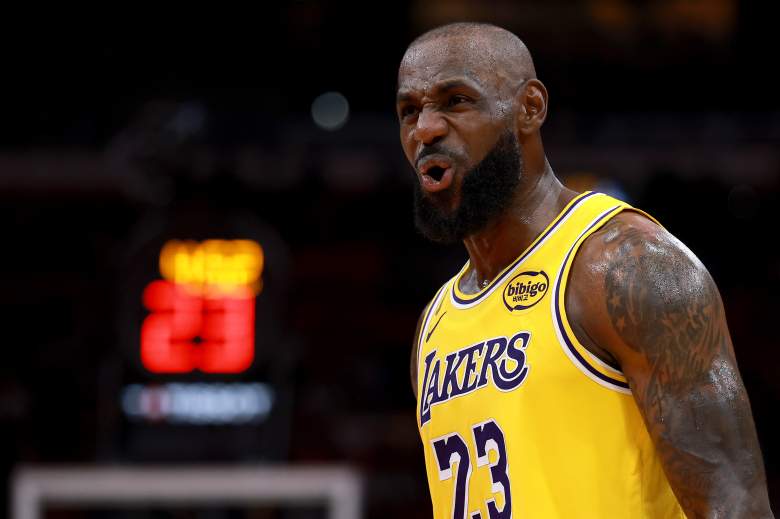
LeBron James knew his Los Angeles Lakers role was supposed to change.
With Luka Doncic and Austin Reaves positioned to carry major offensive responsibility, James was preparing for a different version of playoff basketball, one that did not require him to be the Lakers’ No. 1 option deep into his 22nd NBA season.
Then the Lakers’ plan changed fast.
During an appearance on a recent episode of “Mind the Game,” James was asked about previously adjusting to being a third option before Doncic and Reaves’ injuries forced him back into a lead role.
“We got to walk that back quick, man,” James said.
James made it clear he was not complaining about the responsibility. But he also did not pretend the situation was ideal.
“It’s definitely not the situation that I would want to be in under the circumstances,” James said. “Obviously, I understand that I can always tap back into this role, and it’s something I’ve done for the majority, if not my entire career. But I wouldn’t want to do it under the circumstances that we’re in when we’re losing an MVP-caliber player in Luka to start the playoffs and we’re losing a 25-plus point scorer, rising player in Austin Reaves, to start a series.”
The Lakers survived the Houston Rockets anyway, winning their first-round series in six games. Now they enter a second-round matchup with the Oklahoma City Thunder still dealing with the same central question: how long can James keep carrying this much of the burden?
Luka Doncic’s Lakers Return Timeline Remains Unclear
Doncic has not played during the postseason because of a left hamstring strain, and the Lakers ruled him out for Game 1 against the Thunder. Reuters reported on May 5 that Doncic remains on a “slow path” in his recovery and is still considered week-to-week, with no full-contact workouts yet.
That uncertainty is why James’ comments matter.
The Lakers did not merely lose a high-usage scorer. They lost the player James described as “MVP-caliber,” which forced the franchise to reorganize its offensive identity in the middle of the postseason.
James said the Lakers had been playing some of their best basketball before the injuries changed the picture.
“We were rolling,” James said. “We were playing great ball. I think we were 13-2 or something like that. We had made some strides. We were playing exceptional basketball. Everybody kind of knew their role. We were starting to finally get healthy.”
Then, in James’ words, “all the momentum” the Lakers had built “quickly shifted in three weeks.”
The Lakers already got Reaves back during the Rockets series, but James described how difficult it is for a player to miss four or five weeks and then jump straight into playoff intensity. He said there is “no substitution for game fatigue,” especially against a physical team such as Houston.
Doncic’s situation remains the larger concern because his timeline is not set. Until that changes, the Lakers’ offense has to keep operating through a version of James that was supposed to be less necessary by this point in the season.
LeBron James Is Still Carrying the Lakers at 41
James did not expect this version of his Lakers career.
He arrived in Los Angeles in 2018 at age 33. Even then, he said, he would not have known how to answer if someone told him he would still be playing postseason basketball in 2026, much less leading a playoff team as its primary option.
“To say that eight years later, at 41, I would be leading the team into the postseason and then coming out with a series win, I wouldn’t have guessed that and I wouldn’t have bet on that,” James said.
The production backs up the burden. James averaged 20.9 points, 7.2 assists and 6.1 rebounds during the 2025-26 regular season, according to Basketball Reference. In the Lakers’ Game 6 clincher against Houston, James had 28 points and eight assists in a 98-78 win.
James acknowledged that his game has had to evolve. He said there are times when he has to get off the ball more than he would have earlier in his career, rather than running “10, 12 straight pick-and-rolls” and expecting to have the same energy late in games.
That has made the Lakers’ current version of James different from the younger one, but not necessarily less influential. He is still controlling possessions, creating advantages, manipulating defenders and organizing the Lakers’ offense — just with more calculation.
“I understand the threat that I still possess on the floor,” James said.
The challenge only gets harder against Oklahoma City.
James called the Thunder “one of the most historic basketball teams offensively and defensively that our league has seen,” adding that the Lakers are “underman” and “the underdog.”
That is the Lakers’ reality until Doncic returns: James remains the organizer, closer and emotional center of a team trying to extend its season long enough to get whole again.
At 41, that was not supposed to be the plan. But the Lakers are still alive because James can still make it work.
LeBron James Gets Honest on Lakers Amid Luka Doncic Injury News