

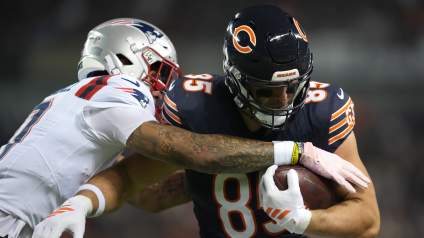
Cole Kmet has spent much of the past year being mentioned as a potential trade candidate for the Chicago Bears.
That conversation made sense on the surface… The Chicago Bears drafted Colston Loveland 10th overall in 2025, watched him immediately emerge as one of their best offensive weapons, and then saw Kmet’s production fall to 30 catches for 347 yards and two touchdowns.
Add Kmet’s contract into the equation and it became easy to wonder whether Chicago would eventually decide it made more sense to move on.
Ben Johnson doesn’t sound like a coach who sees Kmet that way: “He’s phenomenal. He’s Chicago through and through. He loves this place and the people here and that radiates in how he goes about his business and how he comes to work every morning,” Johnson said.
Johnson has never treated Kmet like an expendable piece

The Colston Loveland pick immediately created questions about Cole Kmet’s future with the Chicago Bears.
Kmet himself admitted he was initially “taken aback” by the decision, but Johnson called him immediately after the draft and explained the vision. Kmet eventually bought into it, saying the goal was for him and Loveland to become the best 12-personnel tandem in the league. That vision has carried into 2026…
During training camp, Ben Johnson called Kmet “a little bit of a unicorn” because of his ability to line up all over the formation. Kmet can play inline, outside the numbers or in the slot, giving Johnson another way to create favorable matchups. That is a pretty important detail when discussing whether a player should be traded.
Now Kmet’s 2025 receiving numbers weren’t great. Nobody needs to pretend they were. But his value to this offense isn’t going to be measured entirely by catches and yards.
Johnson clearly sees him as someone who can do multiple jobs. And that makes him much harder to replace than his box score would suggest.
The Bears have a reason to keep both tight ends

There is also a bigger reason the trade conversation feels increasingly unnecessary. Ben Johnson likes multiple tight end personnel.
In fact, the Chicago Bears used 12 personnel on 32.5% of their offensive plays in 2025, which ranked sixth in the NFL, according to NFL.com.
Chicago is also expected to continue leaning into that philosophy with Cole Kmet, Colston Loveland and rookie Sam Roush.
If Chicago were running a traditional offense that only needed one tight end on the field most of the time, there would be a much stronger argument for moving Kmet and using the money elsewhere. That’s not the offense Johnson is building.
Loveland can be the explosive receiving threat. Kmet can move around the formation, block, catch passes and create matchup problems of his own. Roush can develop behind both of them.
And if the Bears are serious about building one of the NFL’s most versatile offenses, getting rid of a player Johnson considers “phenomenal” would make very little sense.
For now, the trade candidate label can probably stay in the rumor pile. Johnson appears to have a much different view of Cole Kmet.









Bears Coach Ben Johnson Makes Cole Kmet Trade Stance Clear