
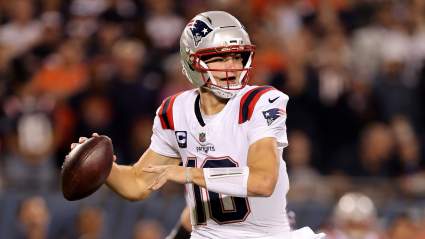
The New England Patriots spent the offseason adding more talent around Drake Maye, though lingering concerns about his protection loom.
New England’s blocking did improve considerably during the 2025 regular season.
But the dependable nature sank when the competition strengthened in the playoffs, and the concern extends beyond the guards and tackles.
Tight end Hunter Henry remains one of Maye’s most reliable receivers. However, the Patriots lost the tight end they signed to improve their run blocking and may have to rely on a rookie sooner than expected.
For a team trying to return to the Super Bowl, protecting Maye and creating an efficient running game from heavier personnel are key training camp questions.
Patriots’ Offensive Line Improved Before Playoff Breakdown
Patriots.com noted that New England climbed from last in Pro Football Network’s offensive line impact score in 2024 to 12th last season. The unit also finished 12th in run-blocking win rate and 13th in pass-blocking win rate.
Those numbers look great, but the postseason shows a narrative that is the complete opposite.
Maye was pressured on 37.9% of his dropbacks and sacked five times during the AFC Championship Game against the Denver Broncos.
Will Campbell allowed five pressures while facing one of the league’s best defensive fronts.
The problems grew during New England’s 29-13 loss to the Seattle Seahawks in Super Bowl LX.
Seattle sacked Maye six times, and the Seahawks generated pressure on 85.7% of their blitzes and recorded five sacks while rushing only four defenders.
Campbell’s season also changed after he injured his MCL.
He carried a 71.4 Pro Football Focus grade before the injury, but that number dropped to 50.1 during the playoff run.
New England responded by signing Alijah Vera-Tucker and drafting Caleb Lomu in the first round. Vera-Tucker is expected to play left guard, allowing Jared Wilson to move to his natural position at center.
Still, Vera-Tucker has missed 42 career games because of injuries, while Lomu could begin his rookie season as a backup. The Patriots improved their options but may have chipped away at risk too little.
Henry Is Reliable, But Tight End Blocking Raises Concern
Henry’s production helped McDaniels’ offense blossom.
The veteran caught 60 passes for a career-high 768 yards and seven touchdowns last season. He ranked seventh among tight ends in receiving yards and generated the position’s second-most total expected points added.
Those numbers made Henry’s complete omission from ESPN’s top tight end rankings difficult to defend.
His value as a receiver does not erase New England’s blocking concerns at the position.
Henry earned a 53.4 PFF run-blocking grade last season, while former Patriots tight end Austin Hooper finished at 56.8. Both ranked in the bottom half of the league.
The Patriots also ranked 29th in rushing EPA from 12 personnel, which places two tight ends on the field. New England signed Julian Hill to strengthen that part of the offense, but he suffered a season-ending injury during organized team activities.
Fullback Reggie Gilliam gives McDaniels another way to build heavier formations.
Then comes third-round pick Eli Raridon.
The rookie offers intriguing receiving upside after averaging 15.1 yards per catch during his final season at Notre Dame, but tight ends often need time to adjust to the NFL’s blocking demands.
New England finished second in scoring and led the NFL in EPA per play during the 2025 regular season, showing that the offense can function at an elite level.
The question is whether its blocking can hold up against the type of defensive fronts that slowed them down throughout the postseason.

New England Patriots’ Offensive Weakness Comes Into Focus