
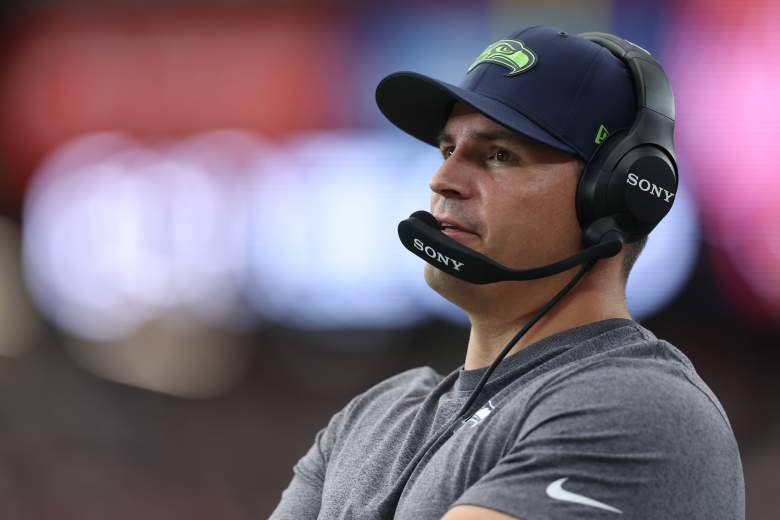
They’re defending the run with relatively light boxes. They’re preventing explosive plays. And through two games, Mike Macdonald’s defense has barely given opponents room to breathe.
A reporter told Macdonald on September 21 that Seattle leads the NFL in rushing success rate allowed and is producing a tackle for loss once every 5.4 opponent carries despite putting fewer defensive backs near the line of scrimmage than most teams. Another statistic was even harder to ignore: Seattle is the first NFL team since 2006 to go through its first two games without allowing a play of at least 20 yards.
Macdonald’s explanation was more interesting than the numbers.
Mike Macdonald Explains Why Seahawks Can Survive With Light Boxes
“If you want to play with light boxes, you need to constrict space and you need to win one-on-one matchups,” Macdonald told reporters.
That sounds simple. It isn’t.
Playing fewer defenders near the line can leave a defense vulnerable if the front loses individual matchups or the second level arrives late. Seattle is effectively demanding that its defensive linemen and linebackers handle more territory so the rest of the defense doesn’t have to surrender numbers elsewhere.
Macdonald pointed to all three levels.
The front has to win. Second-level defenders must understand run fits, pace the ball and defeat blocks. And if a runner escapes, the secondary has to tackle.
“It’s a three-level thing,” Macdonald said.
The approach isn’t new. Seattle regularly played with light boxes in 2025 and still allowed an NFL-low 3.7 yards per carry. The Seahawks also finished third in rushing yards allowed, second in rushing touchdowns allowed and tied for the league lead by permitting only five runs of 20-plus yards.
Two games into 2026, the formula is holding.
Seahawks Have Eliminated Explosive Plays Without Relying on Pressure
The more unusual part of Seattle’s start may be what hasn’t happened.
No opponent has produced a 20-yard play through two games, according to a statistic presented to Macdonald on Monday. And the Seahawks have accomplished it even though their pressure rate has not yet matched last season’s level.
That matters because pressure is one of the most obvious ways to erase explosive passes. Make a quarterback throw early and the downfield route never develops.
Seattle has found another route.
The Seahawks held Arizona to 151 total yards in Sunday’s 31-7 win, including only 44 yards in the second half before two meaningless late runs. After Arizona’s touchdown early in the second quarter, its next six full possessions produced five punts and a Julian Love interception.
Through two games, New England and Arizona have combined for 382 yards, 29 first downs and 17 points against Seattle.
And Macdonald still wasn’t particularly interested in admiring it.
“It’s early,” he said, adding that Seattle has plenty it can improve in its front structures, personnel packages and execution.
Seattle’s Defensive Formula Gets Another Test Against Washington
There is a useful distinction between an early-season hot streak and something built into a team’s architecture.
Seattle increasingly looks like the latter.
The Seahawks were already defending the run this way last season. The personnel returned largely intact. Now they’re combining that run efficiency with a secondary that hasn’t surrendered a 20-yard play.
Washington gets the next attempt to crack it on September 27. The Commanders fell to 0-2 with a 37-20 loss to Dallas and are expected to turn to Marcus Mariota after Jayden Daniels suffered an elbow injury.
Macdonald would rather talk about the flaws than the streaks. He dismissed Seattle’s franchise-record 12-game winning run in much the same way Monday.
The defense, though, is becoming difficult to dismiss.
Seattle is taking bodies out of the box without giving up the run. It isn’t generating pressure at last year’s rate, yet opponents still can’t find explosives.
That’s not merely dominance. That’s a defense forcing offenses to search for an answer that, through two weeks, hasn’t been there.
Seahawks Are Breaking a Defensive Rule — Mike Macdonald Explains Why It Works