
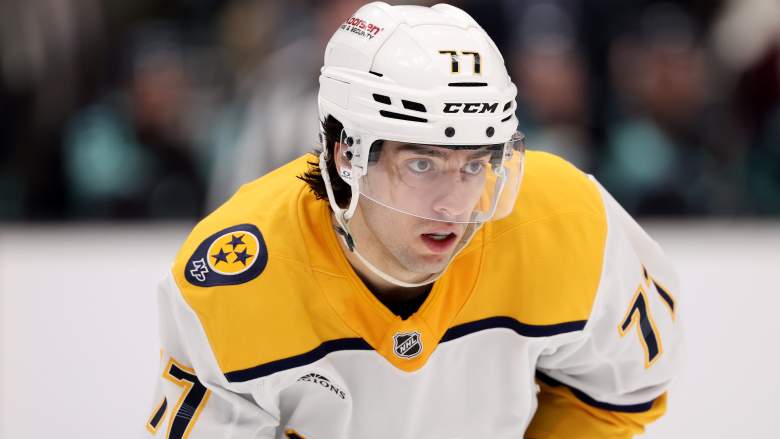
The Nashville Predators pulled off a bit of a puzzling trade with the New Jersey Devils.
The Preds sent winger Luke Evangelista to the Devils in exchange for a 2028 first-round pick and a 2028 second-rounder.
As Nashville GM Chris MacFarland explained, the organization moved on from Evangelista, given the team’s abundance of depth on right wing.
While that may be true, the bottom line is that the deal itself doesn’t pass the sniff test.
Trading the 24-year-old for futures raises one question: Could the Predators have begun a much bigger sell-off?
At face value, that hypothesis doesn’t hold water. The Predators have been loading up all summer, in hopes of making a run at a playoff spot this season.
But why move Evangelista now? Was the move just the start of a sell-off that could come later this season?
It’s possible. If the Preds fall out of the playoff race early enough, the club has several flippable assets it could use to retool on the fly.
Otherwise, why would a team trying to make the playoffs trade a rising star like Evangelista?
Well, there may be another answer to that question.
The Evangelista Contract Dispute May Have Mattered
There may be more to the Predators’ decision than simply having too many right-handed wingers.
Remember what happened with Luke Evangelista last season.
The 24-year-old was a restricted free agent and the two sides couldn’t agree on a contract before training camp. Evangelista held out while the Predators and his camp went back and forth, and the dispute wasn’t resolved until Oct. 3, just days before Nashville’s regular-season opener.
That’s not exactly an ideal relationship between a young player and his organization.
To Evangelista’s credit, he put the entire thing behind him and proceeded to have his best NHL season, finishing with 56 points in 81 games.
But there is no way of knowing whether the previous contract dispute left any lingering feelings on either side.
Maybe the Predators simply decided this was the right time to move on.
Evangelista’s value was high, Nashville had plenty of winger depth and the organization managed to turn him into a conditional first-round pick and a second-rounder.
Those picks could ultimately be even more valuable if MacFarland uses them as ammunition in another trade.
Suddenly, the Evangelista deal looks less like a strange move and more like the first piece of a larger plan.
What to read next:
The Predators May Have Wanted to Avoid Another Contract Fight
There’s another reason the Predators may have decided to move Evangelista now rather than wait.
He’s entering the final season of that two-year, $6 million contract and can become an RFA again next summer.
That means Nashville was potentially heading right back toward another negotiation.
If the Predators weren’t convinced Evangelista would sign a long-term extension, why wait?
The club could have kept him through the season, watched his value fluctuate and then tried to trade him at the deadline. But that comes with risk. An injury or a disappointing first half could have reduced his value considerably.
Instead, the Predators sold high.
And they didn’t exactly receive spare change. Nashville now has another first-round pick and a second-rounder to work with, giving MacFarland considerably more flexibility. The GM himself described the picks as another “bullet in the holster” for future moves.
That’s what makes this trade so fascinating.
The Predators insist the decision was about roster construction and their abundance of wingers. Fair enough.
But if Nashville doesn’t meet expectations, those draft picks could become the foundation for an entirely different roster.
Maybe Evangelista wasn’t the beginning of a sell-off.
But the Predators just gave themselves the tools to start one.
Predators May Have Started a Much Bigger Sell-Off