

Olympic Skeleton is a high adrenaline sliding event which is a combination of speed, navigational skill, and pure daredevil courage. Though the discipline is similar to luge and bobsleigh with athletes sliding down icy tracks, the sport of skeleton sees competitors race down at thrillingly high speeds in a face-first position.
Skeleton is a sport in the Winter Olympics with growing popularity for both spectators and participants. Here’s what to know about this speed-driven sport.
How Fast Do Skeleton Competitors Actually Go?
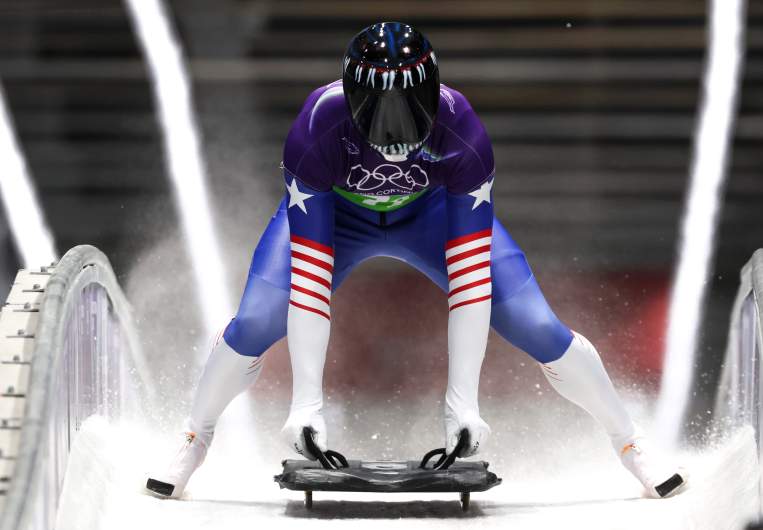
Skeleton athletes compete by laying complete flat, a position called prone, on their sleds. They begin with a sprint start by running down the track at first, and then launch themselves onto their sleds to zoom down the track.
Using subtle body shifts, athletes competing in skeleton are able to control the sleds on which they race as they speed down the ice. But even the smallest error can lead to dangerous crashes and injuries on the ice.
The sleds used in skeleton are made of steel and fiberglass. They have a regulation size minimum of 31.5 inches and a maximum of 47 inches for the length, and height regulations ranging from 3.1 inches to 7.8 inches. Each sled weighs approximately 77 to 95 lbs. This means that competitors must be able lift and carry the weight of their sleds, making them exceptionally strong athletes.
On Olympic tracks, including the one at the Cortina Sliding Centre, the speeds skeleton competitors can reach exceed 85 mph. Due to skeleton being an individual sport with only one athlete on the sled at a time, the maximum speeds reached aren’t quite as high as those of bobsleigh team events with heavier sleds. However, the speeds reached in skeleton are made even more terrifying by the headfirst position that isn’t present in other ice discliplines.
Skeleton Events at the 2026 Winter Olympics

At the 2026 Winter Olympics in Milan-Cortina, there are three skeleton events taking place. Two of those events have been present at past Olympic games, while one event is brand new to the premier international stage.
The traditional skeleton events which have been held in Milan-Cortina include the men’s single skeleton event and the women’s single skeleton event. In these events, Matt Weston of Great Britain and Austria’s Janine Flock claimed the gold medals.
While all skeleton events involve only one athlete on the sled at a time, this year’s Winter Olympics have seen the introduction of a team event that combines the scores of both competitors. The new mixed team event in skeleton pairs one male competitor and one female competitor from each competing country together for Olympic Gold.
At the 2026 Winter Olympics, the gold medal in the new mixed team race went to the pair of Matt Weston and Tabitha Stoecker of Great Britain when they competed in the inaugural event on February 15, 2026.
As skeleton continues to evolve, the convergence of raw speed with fine motor skill make the sport thrilling to watch. And the sport will continue to captivate audiences for many Olympic games to come as the ever-expanding discipline continues to grow and add more events to the skeleton roster.
What Exactly is Skeleton? The Sport of Speed Explained