
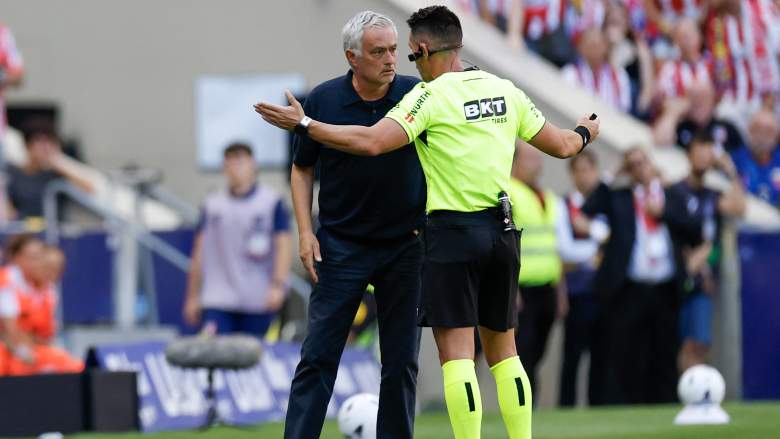
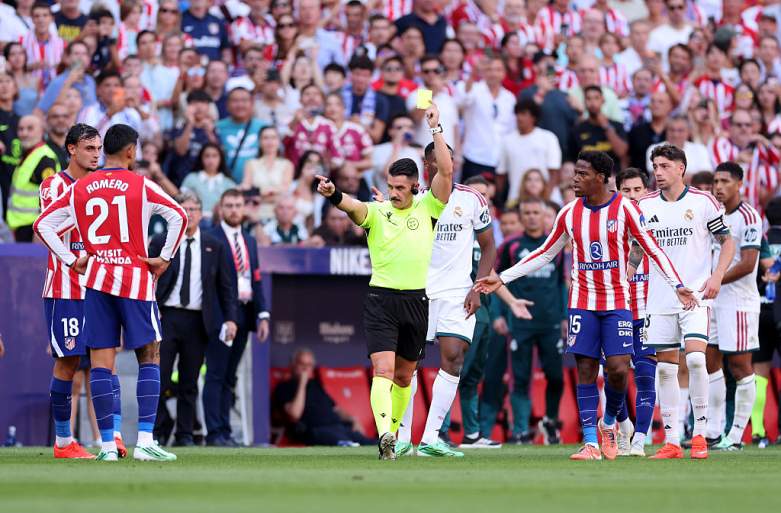
Real Madrid have once again chosen the path of least resistance. After a 2-1 derby defeat to Atlético Madrid in La Liga over the weekend, the club’s official channels didn’t focus on their own shortcomings. Instead, they published a match report under the headline “A dreadful refereeing performance decides the derby,” accusing the officials of deciding the outcome.
This isn’t analysis. It’s institutional excuse-making, and it’s becoming a pattern that damages the club’s reputation more than any single result.
Real Madrid Are Undermining the Game Itself
When a club of Real Madrid’s stature publicly declares that refereeing “decided” a match, it crosses a line. It’s one thing for a frustrated coach to vent in the heat of the moment. It’s another entirely for the institution itself to publish an official narrative that the result was illegitimate. José Mourinho arrived at his press conference holding up printed screenshots of two incidents, telling reporters, “We could skip the press conference because the story of the match is right here.” The club then amplified the message through its own channels. That’s not protecting the players. That’s undermining the competition itself.
Here’s the part Real Madrid’s version conveniently leaves out: Spain’s own refereeing technical committee reviewed the game afterward and upheld the red card shown to Dean Huijsen — the incident that actually decided the match, since it gave away the penalty Alejandro Grimaldo converted to open the scoring. Huijsen pulled back Giuliano Simeone’s arm as the last defender inside the box. That’s not a soft call. That’s a clear, correct decision, confirmed independently by the people whose actual job is to review it. The committee did side with Mourinho on one separate incident, a challenge from Lee Kang-in on Fede Valverde that went unpunished, but that’s a far cry from the sweeping “the referee decided the derby” narrative the club chose to run with.
Football relies on acceptance of official decisions, even the imperfect ones. By framing every setback as external sabotage, Real Madrid contribute to the erosion of trust in the sport. This is also the same club whose broadcast network, RMTV, ran a near-identical “three refereeing blunders” segment after a 2023 derby loss to this same opponent, and it’s the same club Atlético’s own leadership has long accused of benefiting from favorable officiating over the years. The irony writes itself.
The Numbers Tell a Different Story
Look past the outrage and examine the actual performance. Atlético dominated the key metrics: 61% possession and 9 shots on target to Real Madrid’s 3, out of 18 shots to 8 overall. This wasn’t a case of a superior side robbed by the referee. It was a side that failed to impose itself in open play and then reached for an external explanation once the result went against them.
And this isn’t even Mourinho’s first theatrical blame session of the season. He staged a similarly combative press conference after a 1-0 loss to Real Betis back on September 4. Two losses, two performances built around grievance instead of accountability.
Accountability Is Optional at the Bernabéu
What’s most striking is the absence of internal criticism. There’s little discussion of tactical rigidity, individual errors, or the failure to adapt once reduced to ten men. Instead, the club’s narrative centers on two challenges that weren’t punished, one of which an independent review specifically disagreed with Mourinho on. Even accepting the Lee Kang-in incident as a legitimate miss, it doesn’t erase the fact that Real Madrid were second-best for long stretches and struggled to create clear openings against a well-organized Atlético side missing two of its starting centre-forwards.
This is the behavior of a club that’s grown accustomed to winning and now treats any deviation from that as an injustice rather than a reflection of its current limitations. Barcelona sit clear at the top of the table playing progressive, high-intensity football. Atlético just took three points in the derby through structure and opportunism, scoring through a converted penalty and a well-worked second. Real Madrid’s response was to point fingers at the officials, one of whom was subsequently vindicated.
Enough Is Enough
There’s nothing wrong with disagreeing with a refereeing decision. There’s everything wrong with an official club account framing a result as illegitimate and cultivating a culture of perpetual grievance, especially when the sport’s own review process disagrees with the central claim. It sounds less like a superpower and more like a club that can’t accept it’s no longer automatically entitled to favorable outcomes.
If Real Madrid want to close the gap on Barcelona and reclaim the initiative in Spanish football, the solution is straightforward: improve on the pitch. Until they do, the excuses will only grow louder, and more embarrassing.
Real Madrid’s Victim Complex: Blame the Refs, Never the Mirror