
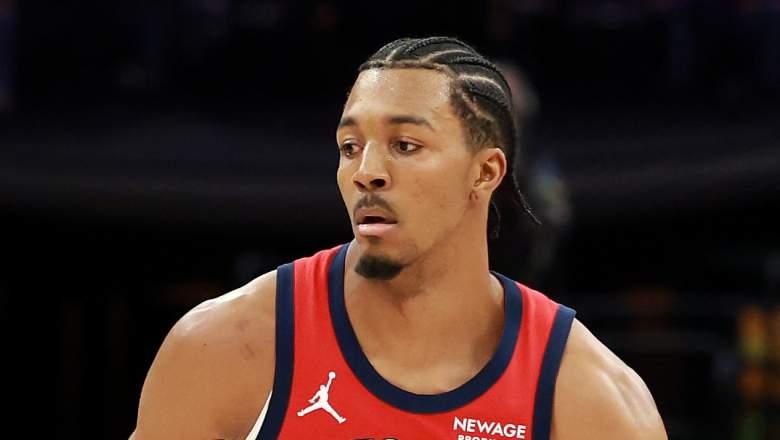
The New Orleans Pelicans’ pursuit of a lottery pick has pushed Trey Murphy III back into the center of NBA trade chatter.
The question now is not whether teams want Murphy. They do. The harder question for New Orleans is whether the chance to move into the lottery is valuable enough to put one of its best young players into real draft-night trade talks.
HoopsHype’s Michael Scotto reported that the Golden State Warriors have been one of several teams interested in Murphy, and that the Warriors and Pelicans have discussed trade concepts involving Golden State’s No. 11 pick. Scotto also reported that New Orleans has searched for a trade into the lottery and is targeting a player, with Nate Ament mentioned as one possible candidate.
That creates a complicated decision for the Pelicans. Murphy is not an aging veteran on an expiring deal. He is a 25-year-old wing coming off a breakout season in which he averaged 21.5 points, 5.7 rebounds and 3.8 assists while shooting 47% from the field, according to ESPN.
He is also already under long-term team control. Murphy agreed to a four-year, $112 million rookie extension with the Pelicans in October 2024, according to NBA.com.
That is what makes this more than a normal trade rumor.
Pelicans’ Lottery Push Puts Trey Murphy III in a Different Light
The Pelicans do not have a simple path into the lottery. If New Orleans wants to jump into that range, especially for a player it values highly, the price is unlikely to be built around spare parts.
That is where Murphy becomes the obvious name.
He is young enough to appeal to teams that are not strictly win-now. He is productive enough to help a contender immediately. He plays the kind of position every team needs. And unlike some other Pelicans players, his value does not require a long explanation.
That does not mean New Orleans should move him.
In fact, the strongest argument against a trade is the same reason Murphy has a market. Wings who can shoot, score and scale into different lineup types are among the hardest players to replace. If the Pelicans trade him, they are not just moving a name. They are moving one of the cleanest bridges between their current roster and whatever comes next.
No. 11 Pick Would Need to Be More Than Just a Pick
Golden State’s No. 11 pick is the most concrete piece in Scotto’s report, but it should not be treated as an automatic match.
For New Orleans, the value of No. 11 depends heavily on who is still available when the Warriors are on the clock. Scotto reported that the Pelicans have been targeting a player and that Ament has been mentioned as one possible candidate.
That conditional element matters.
If the targeted player is gone, the urgency changes. If he is available, New Orleans has to decide whether that prospect’s upside is worth sacrificing a proven NBA wing entering his prime.
That is a dangerous bet. Draft picks are cheaper and carry upside, but Murphy is already what many lottery teams hope their pick becomes: a big wing who can score efficiently, space the floor and fit next to higher-usage players.
Trey Murphy III’s Market Extends Beyond the Warriors
The Warriors are the team tied most directly to the No. 11 pick concept, but Murphy’s market is not limited to Golden State.
Scotto reported that several teams called before the trade deadline to express interest in Murphy, including the Warriors, Pistons, Pacers, Hawks, Trail Blazers, Spurs and Lakers.
That list is important for the Pelicans. If New Orleans is seriously considering moving Murphy, the front office does not have to treat one offer as the market. It can compare Golden State’s lottery pick against other paths, including future draft capital, younger players or packages that better match the Pelicans’ roster needs.
It also gives New Orleans leverage. A team like Golden State may value Murphy as a ready-made wing next to Stephen Curry, but the Pelicans can point to broader league interest and resist treating No. 11 alone as the finish line.
Pelicans’ Decision Is About Direction, Not Just Value
This is ultimately a direction-setting decision.
Keeping Murphy would signal that New Orleans still values proven young talent around its core and does not want to reset too aggressively. Trading him for a lottery-centered package would suggest the Pelicans are willing to reshape the roster around a different timeline.
That is why the draft-night clock matters. The No. 11 pick only becomes truly relevant if the Pelicans’ preferred target is available and the Warriors are willing to attach enough value to make New Orleans uncomfortable saying no.
Until then, Murphy’s name will keep coming up for the same reason the decision is so difficult.
He is exactly the kind of player other teams want — and exactly the kind of player the Pelicans have to be careful about giving away.
Pelicans Face Trey Murphy III Trade Decision as Lottery Push Intensifies