
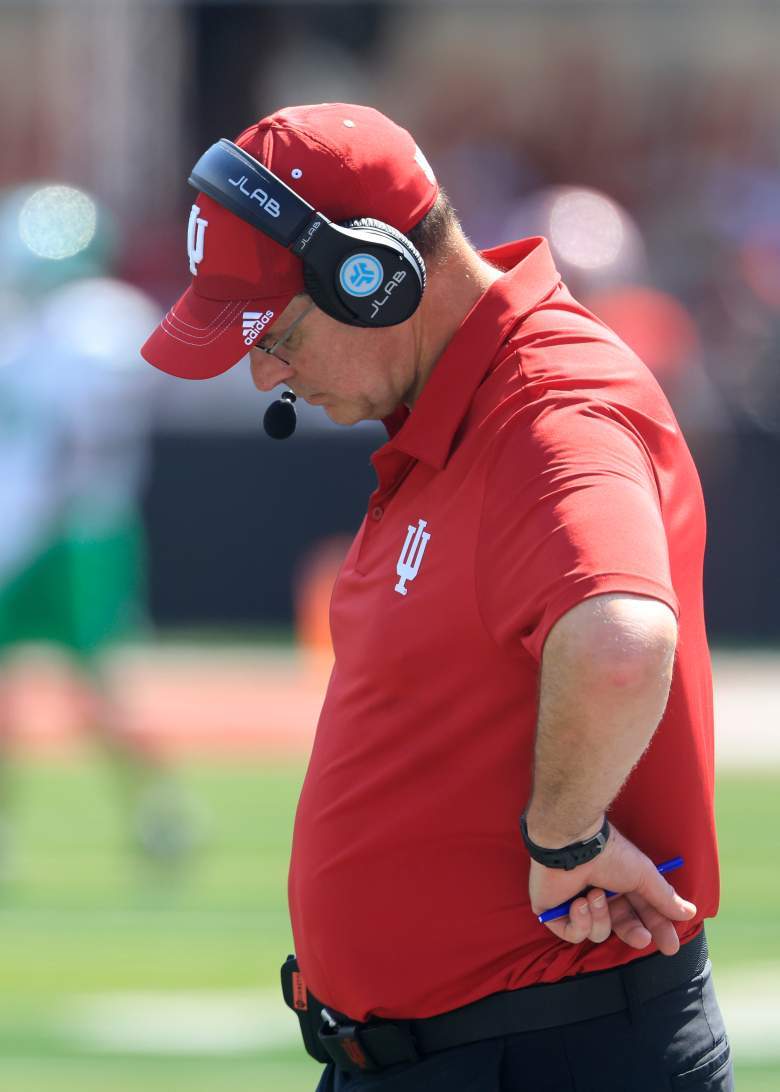
Indiana opened its national championship defense with the type of final score expected from one of college football’s most talented teams. The Hoosiers beat North Texas 52-16, Josh Hoover threw four touchdown passes in his debut, and Curt Cignetti’s offense scored on seven of its eight possessions.
Buried beneath that 36-point victory, however, was a box-score result few would expect.
North Texas actually outgained Indiana 367-365. The Mean Green also possessed the football for 37 minutes, 22 seconds, compared with just 22:38 for the defending national champions, and finished with 19 first downs to Indiana’s 18.
Those numbers are eye-catching, but they do not suddenly mean Indiana is overrated. In fact, there is an argument the time-of-possession disparity says almost as much about how efficiently Hoover operated the offense as it does about anything Indiana did wrong.
Still, Cignetti saw enough defensively to know there is work to do.
Curt Cignetti Identifies Indiana’s Week 1 Problem
Indiana’s defense struggled to consistently get North Texas off the field, something Cignetti addressed directly two days after the victory.
“Defense had a hard time getting off the field,” Cignetti said Monday, pointing to critical missed assignments and poor tackling as contributing factors.
North Texas converted six of its 15 third-down opportunities and ran 67 offensive plays compared with only 46 for Indiana. Cignetti also said after the game that he did not believe his defense played particularly well, specifically highlighting tackling on the perimeter.
That is the real concern hiding underneath the 52-16 score.
Indiana does not need to panic because an opponent accumulated two more yards in a game the Hoosiers won by five touchdowns. North Texas entered the season with 70 newcomers under new coach Neal Brown, making it particularly difficult for Indiana to know exactly what it would see schematically in Week 1.
There were also reasons for the lopsided possession numbers that had nothing to do with Indiana struggling offensively. The Hoosiers simply did not need the ball very long to score.
Indiana scored six offensive touchdowns while going 4-for-4 in the red zone. Hoover completed 13 of 16 passes for 231 yards, four touchdowns and no interceptions, repeatedly punishing North Texas when the Mean Green committed extra resources to slowing the running game.
When an offense is scoring that efficiently, winning time of possession becomes considerably less important.
Josh Hoover Gives Indiana Reason for Optimism
That is why Indiana’s hidden Week 1 numbers should be viewed as a checklist rather than an indictment.
Hoover arrived from TCU facing the unenviable task of replacing Fernando Mendoza, the Heisman Trophy winner who became the No. 1 overall pick in the NFL draft. Yet Hoover already had 9,629 career passing yards and 71 touchdowns before transferring to Bloomington, the most among returning FBS quarterbacks entering 2026.
His arm talent was apparent immediately.
ESPN’s transfer evaluation noted Hoover has enough velocity to attack tight throwing windows, and the North Texas game showed why. He pushed the football vertically, consistently gave his receivers opportunities in one-on-one coverage and finished with more touchdown passes than incompletions.
Pure arm talent is subjective, but it is not hyperbolic to believe Hoover possesses physical passing traits capable of keeping Indiana’s offense among the best in the country. Mendoza was more polished and ultimately proved himself on the sport’s biggest stage, but Hoover did not arrive in Bloomington as some dramatic downgrade at quarterback.
Cignetti was still quick to point out areas that need improvement. He said Hoover got away with one throw that he will not get away with during Big Ten play and referenced other smaller details the quarterback can correct.
That fits the larger theme surrounding Indiana after Week 1.
Indiana’s Red Flag Is Fixable, Not Fatal
The defending champions scored 52 points, won by 36 and received an excellent debut from their new quarterback. At the same time, their opponent controlled too many extended possessions, Indiana missed assignments defensively and the tackling did not meet Cignetti’s standard.
Both things can be true.
Indiana can be one of the best teams in college football while still having issues to correct. If anything, finding those problems during a 36-point victory is preferable to discovering them later when the margin for error disappears.
The 367-365 yardage total makes for a stunning statistic because the final score suggests the game should have been far more lopsided statistically. It should not erase what Indiana accomplished offensively, nor should it be interpreted as evidence that the defending champions are suddenly vulnerable.
Cignetti has built Indiana around improvement and demanding a higher standard even after victories. His reaction to Week 1 suggests the Hoosiers know exactly where the problems were.
For a team trying to win another national championship, that matters considerably more than winning the yardage column in September.
Indiana’s 36-Point Week 1 Win Hid a Stunning Red Flag