
West Virginia did not spend the offseason making minor adjustments.
Rich Rodriguez effectively rebuilt the roster.
The Mountaineers entered the 2026 season with 88 new players, an extraordinary amount of turnover even in college football’s transfer-portal era. Calling that approach aggressive would be fair. Calling it unnecessary would be much harder after West Virginia went 4-8 during Rodriguez’s first season back in Morgantown.
Rodriguez did not return to West Virginia to preserve the status quo.
His second tenure has been about trying to push a program that has spent years outside the national spotlight back toward the level it reached during his first run. If that required changing almost everything quickly, Rodriguez appeared willing to do it.
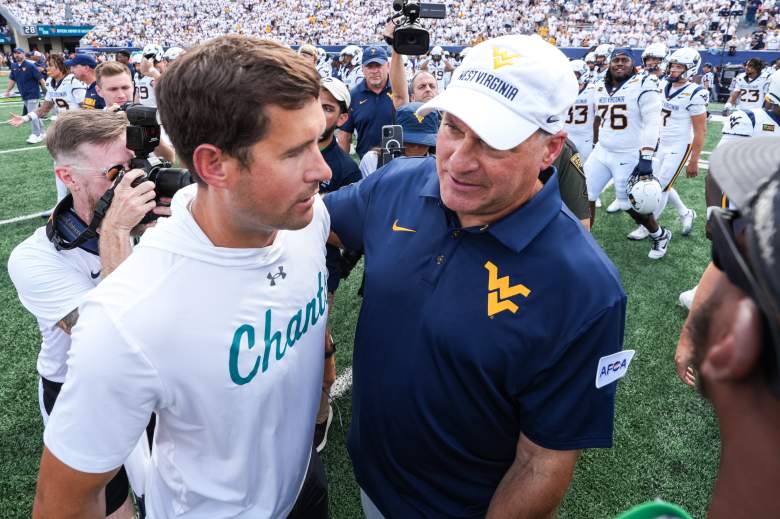
West Virginia’s 31-24 season-opening victory over Coastal Carolina provided the first indication that some of those changes may already be paying off.
Two of Rodriguez’s most important newcomers, running back Cam Cook and quarterback Michael Hawkins Jr., combined for 245 rushing yards.
That accounted for approximately 87% of West Virginia’s entire rushing output.
Cam Cook, Michael Hawkins Give Rich Rodriguez Early Return
Cook rushed for 142 yards and two touchdowns in his West Virginia debut after transferring from Jacksonville State.
Hawkins, who arrived from Oklahoma, added 103 rushing yards on 20 attempts while completing 11 of 14 passes for 132 yards and a touchdown.
West Virginia finished with 281 rushing yards on 61 carries.
One game against Coastal Carolina cannot validate an 88-player overhaul by itself. The Mountaineers still have to prove their new roster can produce consistently when the competition improves.
But if a program is going to replace such a significant percentage of its roster, the newcomers playing the most important offensive positions need to make an immediate difference.
Cook and Hawkins did exactly that.
Their performance also fits the offensive formula that has historically made Rodriguez dangerous.
Rodriguez helped popularize the no-huddle, zone-read spread offense, and some of his best West Virginia teams were built around forcing defenses to account for multiple rushing threats on every snap. During his first tenure, Rodriguez eventually tailored the offense around the running ability of Pat White while pairing him with backs including Steve Slaton, Noel Devine and Owen Schmitt.
Across Rodriguez’s original 86 games at West Virginia, the Mountaineers averaged 258.2 rushing yards per game.
The formula was not complicated in theory. The difficulty was stopping it.
A quarterback capable of becoming a legitimate rushing threat changes the numbers a defense must account for, while an effective running back can punish teams for overcommitting to the quarterback.
Cook and Hawkins offered an early glimpse of that same stress against Coastal Carolina.
Michael Hawkins Adds Fitting Pat White Connection
The timing made Hawkins’ performance even more interesting.
West Virginia honored White’s No. 5 before the season opener, recognizing the quarterback who helped lead one of the greatest stretches in program history. White went 35-8 as West Virginia’s starting quarterback and finished his college career with 4,480 rushing yards.
Hours after White was honored, Hawkins surpassed 100 rushing yards in his first start for the Mountaineers.
It would be irresponsible to suggest one performance makes Hawkins the next Pat White. White earned his place in West Virginia history over four seasons, four bowl victories and thousands of yards of production.
The symbolism is still difficult to ignore.
Hawkins was classified as a dual-threat quarterback coming out of high school, and his ability to affect a defense with his legs is precisely the type of trait Rodriguez has historically maximized.
West Virginia football reached remarkable heights when Rodriguez had a dangerous runner at quarterback working alongside a productive back.
Now Cook and Hawkins have given him another version of that combination.
The larger test begins from here. West Virginia hosts UT Martin before facing Virginia and then opening Big 12 play against Oklahoma State. Producing against Coastal Carolina is different from sustaining the same success against stronger opponents.
Still, Rodriguez’s approach to this rebuild has been clear.
If something is not working, change it quickly. If the roster is not good enough, rebuild it quickly.
That philosophy can look ruthless from the outside, but patience was never the point of Rodriguez’s return to Morgantown.
The Mountaineers brought in 88 new players because Rodriguez believed West Virginia needed substantial change.
After one game, two of those newcomers just accounted for 87% of the team’s rushing yards.
That does not prove the rebuild has worked.
It does give Rodriguez one compelling early reason to believe his gamble was worth taking. Those numbers are easy for WVU fans to quantify.
West Virginia’s Massive Roster Gamble Already Produced a 245-Yard Answer