
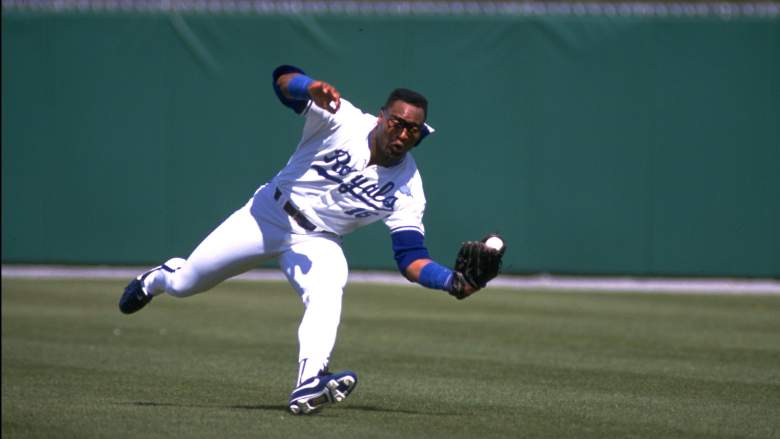
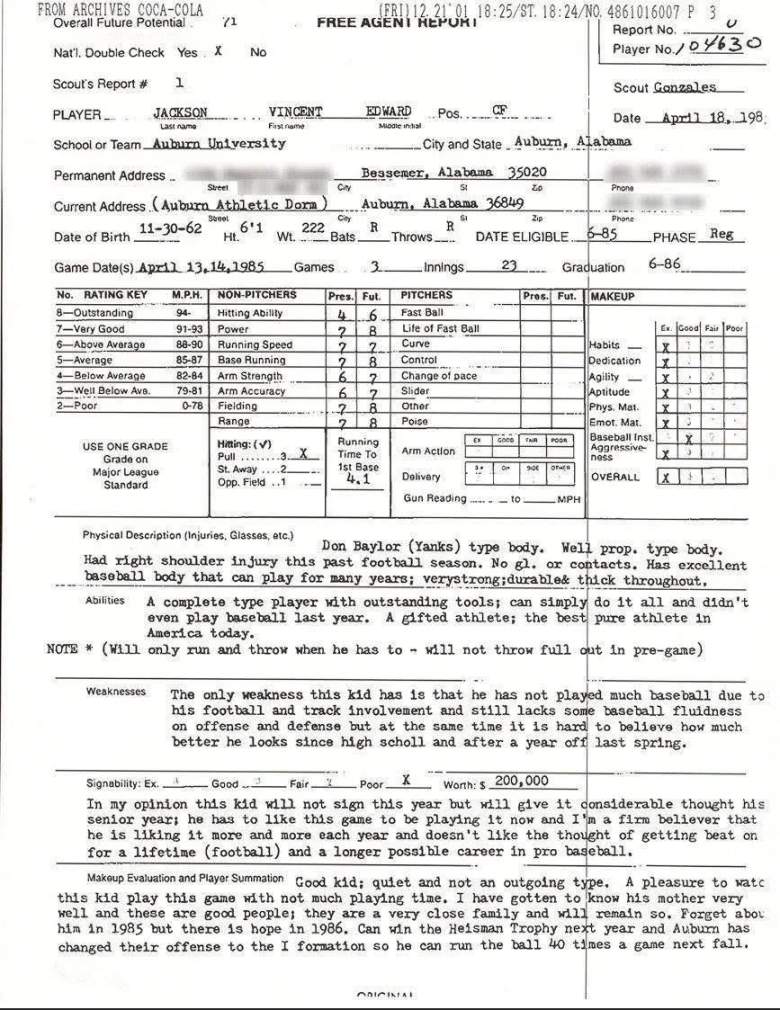
An old scouting report on Bo Jackson – dual sport legend and former Kansas City Royals All-Star – has resurfaced online this week. And more than four decades later, what stands out is not how optimistic it was, but how accurate it proved to be.
The report, written while Jackson was still at Auburn, described him at the time (April 1985) as the “best pure athlete in America today”, and someone who projected to have above-average to outstanding grades across virtually every aspect of baseball. The scout who wrote it – identified only as “Gonzales” – praised Jackson’s power, speed, arm strength, range, athleticism and overall potential, while noting that he had barely devoted full attention to baseball because of his football commitments.
Said football commitments famously led to Jackson being one of the most, if not the most, successful two-sport star in American history. And fans of the 1989 Nintendo game Tecmo Bowl will certainly not dispute the idea that Jackson was the best athlete in the country at the time. Nevertheless, looking back now, the report reads less like a bold prediction and more like a review. Jackson really was it, for a short while.

Bo Knew
Jackson’s revered place in sports history comes from his rare two-sport success. He won the Heisman Trophy while at Auburn, became a Pro Bowl running back in the NFL, and simultaneously developed into an MLB All-Star. He is the only professional athlete in history to have been named an All-Star in two major American sports, and that is even before the anecdotal evidence of his athletic prowess (such as stories about him winning high school decathlons by such large margins that he did not even enter certain events, such was his lead).
Few athletes have ever performed at the top level in two major professional sports, let alone become stars. Yet this report shows that baseball evaluators were not merely captivated by Jackson’s athletic reputation. They believed not only that he could become a good Major League Baseball player. They believed he could become a great one.
Gonzales projected elite power potential from Jackson’s powerful frame, and viewed him as someone who could affect games in multiple ways. This proved remarkably accurate. Across eight major league seasons, Jackson hit 141 home runs and was an All-Star in 1990 despite never playing a full baseball schedule for much of his prime, because football occupied the second half of every year. He possessed rare power, game-changing speed and one of the strongest outfield arms of his era, and he was doing it as a de facto side hustle.
The report also highlighted something that is easy to forget in hindsight: Jackson, at that time, was still relatively inexperienced as a baseball player compared to the other top prospects. The Gonz – in addition to nothing that Jackson was “thick throughout”, a line which has aged particularly well in modern parlance – repeatedly noted that his athletic gifts were exceptional, even though Jackson had not devoted himself entirely to the sport; he was a complete player who “can simply do it all,” while emphasizing that he had not even played baseball the previous year because football was his primary focus.
It is hard to fathom being so much better than everyone else at something when it is only your second job. But Jackson managed it. Briefly.

Jackson’s Prime Cut Short
For all the praise, though, Jackson remains one of baseball’s enduring “what if” stories. He was improving as a hitter when a devastating hip injury suffered during the 1990 NFL playoffs drastically the trajectory of his career. Before that injury – in which Jackson reportedly fractured his hip so badly that some of the bone died through a loss of blood, leading to a hip replacement – he had developed into a legitimate middle-of-the-order threat with increasing offensive production. It has long been wondered what his baseball numbers might have looked like had he focused exclusively on the sport, or simply remained healthy through his early 30s. As it is, Jackson’s tremendous powers burned out before they faded away.
The scouting report cannot answer that hypothetical, of course. But its value as a historical record does reinforce something that can get lost amid the mythology surrounding Jackson. Bo’s legend was not created solely by highlight reels, Tecmo or the whole “Bo Knows” thing. Professional scouts legitimately saw an extraordinary baseball player before he had even played much of it. They recognized the power, speed and athleticism that would later make Jackson one of the most magnetic figures in sports of the late 1980s. And more than 40 years later, Gonzales’ lavish praise holds up remarkably well.

Old 80s Bo Jackson Report Re-Emerges, Is Stunningly Accurate