
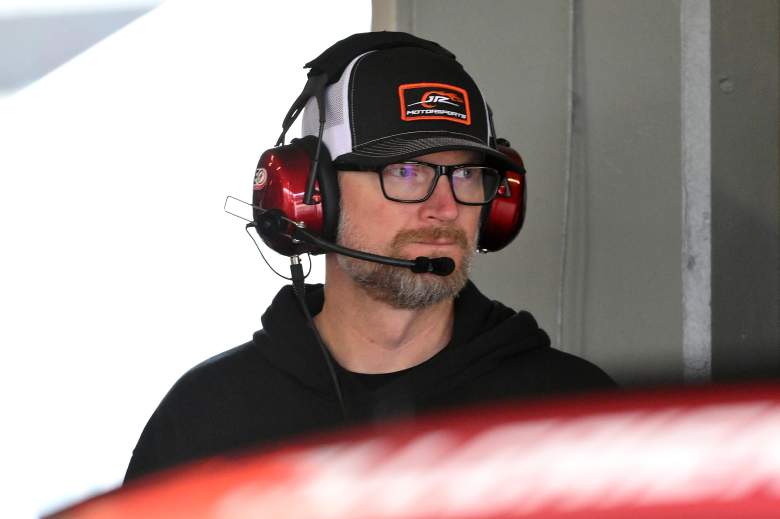
Dale Earnhardt Jr. says the NASCAR splitter change has reduced Toyota’s edge in the NASCAR Cup Series, with Kansas Speedway clearly testing the change. On Tuesday’s Dirty Air, Earnhardt pointed to Denny Hamlin’s recent comments and Toyota’s results before and after NASCAR changed the front splitter struts.
Hamlin had earlier spoken with confidence about Toyota’s strength on tracks where drivers turn left. His tone has since become more measured. Earnhardt said the change has affected how Toyota cars perform over a full race.
Toyota remains competitive and continues to place cars inside the top 10, but its control at the front of the field has dropped. The numbers also show a clear change in wins, top-five finishes and laps led.
NASCAR Splitter Change Changed Toyota’s Advantage
Earnhardt focused on how Hamlin’s comments changed after the NASCAR splitter change. Earlier in the season, Hamlin had said, “if you turn left, we’re the favorite, if we go to a racetrack and there ain’t no right turns in it, I’m the favorite to win this race.”
Earnhardt said Hamlin now speaks in more measured terms. After Kansas, Hamlin explained the team’s position by saying, “Hey man, this is the speed we got. That’s where we’re going to run. That’s how fast our cars are. We got to get more front-end speed. We got to do better.”
Earnhardt said Hamlin had struggled with fire-off speed throughout the season, but Toyota’s long-run pace had helped offset that weakness. He said Toyota still has strong long-run speed, but it is no longer as strong as before the NASCAR splitter change.
NASCAR Splitter Change Explained Before North Wilkesboro
The NASCAR splitter change came shortly before North Wilkesboro. Earnhardt explained that teams worked on flexible splitter setups that let the front of the car drop closer to the track during a race.
“And so when you look at it, we’ve talked a lot about the splitter change that they made in NASCAR. So at Wilkesboro, the teams added new struts to the front of the splitter. And what the teams want to do with this car is make the underside kind of like a banana. They want to arch the bottom of the car. They want the nose to drop down.”
Earnhardt said teams wanted the splitter to remain within NASCAR’s inspection limits in the garage while allowing more movement on track. That created an aerodynamic benefit for some teams.
NASCAR responded by making the struts more rigid. Earnhardt said the NASCAR splitter change reduced the advantage some teams gained from how the front of their cars changed during races.
NASCAR Toyota Results Show the Difference
Earnhardt compared Toyota’s NASCAR results before and after the NASCAR splitter change. Toyota led 47.9% of laps before the change, compared with 34% afterward. Its top-10 rate moved from 38.5% to 35%, while its top-five rate fell from 50% to 42%.
The biggest change came in wins. Toyota won 60% of the races before the change and 33% afterward.
Earnhardt stressed that Toyota remains competitive. “They are still top 10,” he said, but added that Toyota cars are no longer “at the front of the field dominating Ford and Chevrolet” since NASCAR introduced the splitter change.
Kansas therefore provided another example of the change. Toyota remained in contention, but its earlier level of control at the front of NASCAR races had declined.
NASCAR Splitter Change Hurts Toyota as Dale Earnhardt Jr. Reveals What Changed