
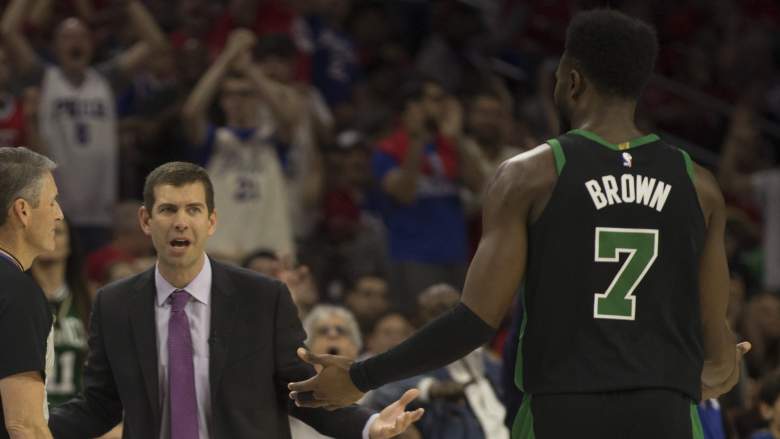
The trade that ended Jaylen Brown’s decade with the Boston Celtics began with four words from Brad Stevens.
“What are you offering?”
Bob Myers, president of sports for the Philadelphia 76ers’ parent company, revealed how Stevens’ response transformed Philadelphia’s inquiry from information-gathering into serious negotiations.
“When Brad Stevens responded with, ‘What are you offering?’ then you knew that there was a shot,” Myers said during an appearance on Cousins with Vince Carter and Tracy McGrady.
The 76ers eventually acquired Brown for Paul George, two first-round picks and two second-round selections. The blockbuster sent a five-time All-Star and the 2024 NBA Finals MVP to one of Boston’s oldest rivals.
According to Myers, Philadelphia did not enter the offseason targeting Brown as a reaction to its playoff sweep by the New York Knicks.
“That’s not what happened,” Myers said. “Then you start hearing there was a possibility, and the job then became, ‘Is this a real thing with Jaylen Brown?’”
Brad Stevens’ Answer Changed Negotiations
Myers’ history with Stevens helped him interpret the response.
After building four championship teams as Golden State’s general manager, Myers learned which executives were willing to explore deals and which ones used conversations to create leverage. He described Stevens as “one of the most straight shooters in the league.”
Once Stevens asked for an offer, Myers understood that Boston would genuinely consider moving Brown.
What followed were approximately 50 conversations, Myers said, with both organizations protecting the negotiations from becoming public. That secrecy mattered to Boston because rumors involving a franchise cornerstone could have damaged its relationship with Brown if the talks collapsed.
“Both organizations did a great job not leaking that, which is impossible,” Myers said.
The Celtics ultimately received George, an unprotected 2031 first-round pick, a top-16-protected 2028 first-rounder tied to the Clippers and second-round selections in 2028 and 2030.
Stevens Explains Why Celtics Traded Brown
Myers declined to speculate about Boston’s motivation. Stevens had already supplied his explanation during the Celtics’ post-trade news conference.
Stevens said maintaining two high-usage stars on supermax contracts made building sufficient depth increasingly difficult under the NBA’s restrictive collective bargaining agreement.
“The path looked a little bit more challenging to me with 70% of our cap and such high usage into two players,” Stevens said. “The reality in this era and in this day and age in the NBA, you have to do a great job in building depth.”
The trade did not provide Boston with immediate salary relief. Instead, Stevens repeatedly emphasized “optionality” — George’s shorter contract and draft picks that can be retained or included in future trades.
“We did the deal because we got Paul George and we got draft assets,” Stevens said.
He also acknowledged the emotional cost of trading a homegrown champion after Brown averaged a career-high 28.7 points and finished sixth in MVP voting.
“I lost sleep over the fan part of this,” Stevens said. “I get it. There’s a bunch of No. 7 jerseys around. I’m pretty sure I bought a couple of them.”
Philadelphia saw Brown as the younger player, leader and championship-tested presence its roster lacked.
“We needed an edge,” Myers said. “I think Jaylen Brown sets an edge.”
After the trade, Myers gave Brown a direct mandate: “Don’t ever underestimate that you’re a champion and there’s power in that. We need you to lead.”
Boston now must prove that George, greater depth and future flexibility were worth creating that leadership opportunity for a division rival.
Celtics’ Jaylen Brown Trade Began With Brad Stevens’ 4-Word Response