
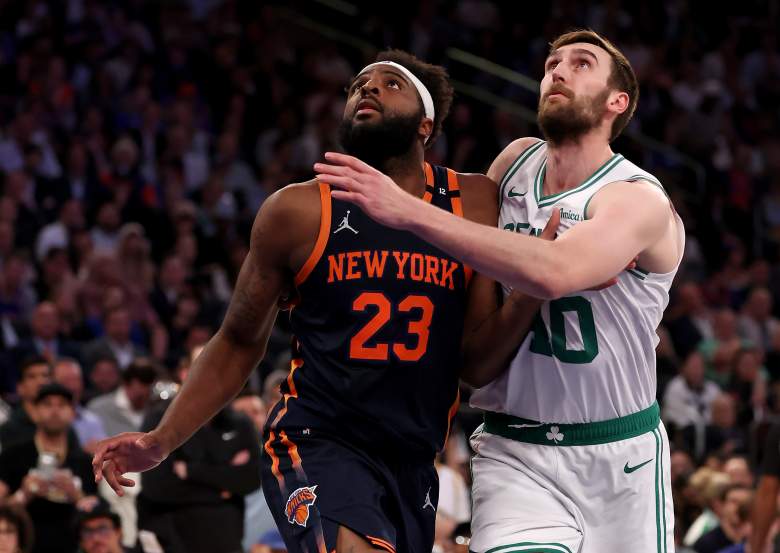
Before the Boston Celtics committed to Mitchell Robinson and doubled down on Neemias Queta, they considered a dramatically different solution at center.
Boston had at least one phone call with the Sacramento Kings about three-time All-Star Domantas Sabonis before the NBA draft, ESPN’s Anthony Slater reported. The conversation did not produce substantive negotiations, but it revealed the contrasting paths Celtics president of basketball operations Brad Stevens evaluated before rebuilding the frontcourt.
“There were predraft conversations about Sabonis with the Charlotte Hornets, who held pick Nos. 14 and 18, and at least one phone call with the Boston Celtics,” Slater wrote, citing team and league sources. “But nothing materialized.”
Boston subsequently selected Houston center Chris Cenac Jr. with the No. 27 pick, signed Robinson to a three-year, $47.4 million contract and extended Queta for four years and $56 million.
Rather than investing heavily in one offensive centerpiece, the Celtics built a deeper center rotation around defense, rebounding and rim protection.
Domantas Sabonis Offered Celtics a Different Direction
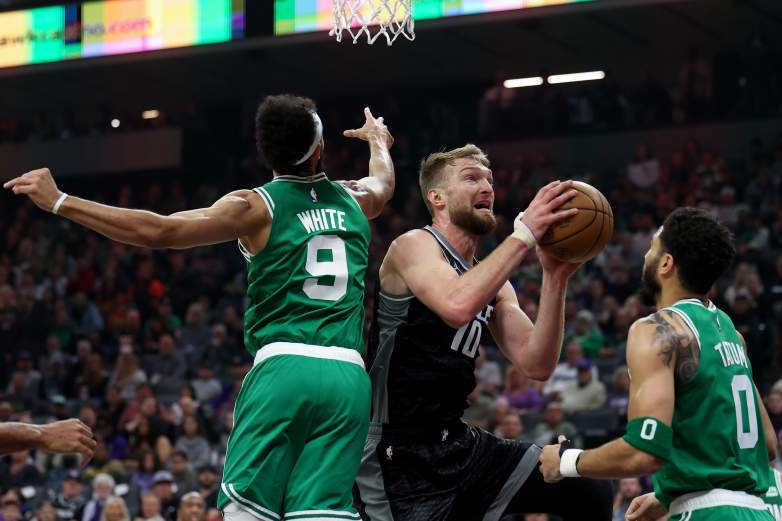
Sabonis would have changed how Boston played.
The 6-foot-10 center averaged 15.8 points, 11.4 rebounds and 4.1 assists while shooting 54.3% during an injury-shortened season. He underwent surgery in February to repair a partially torn meniscus but remains one of the NBA’s premier passing and rebounding big men.
Sabonis is owed approximately $94 million over the next two seasons. Acquiring him would have required Boston to send significant salary to Sacramento while likely sacrificing additional assets.
The appeal was evident. Sabonis could have operated as an offensive hub from the elbows, creating handoffs, screening actions and backdoor opportunities for Jayson Tatum and Derrick White.
That skill set would be especially useful after Boston traded Jaylen Brown to Philadelphia for Paul George, two first-round picks and two second-rounders. The Celtics also signed veteran point guard Mike Conley, but neither move gave them a frontcourt playmaker comparable to Sabonis.
The potential drawbacks were just as clear. Sabonis is not an imposing rim protector, and concentrating so much salary in another star would have reduced Boston’s flexibility after an expensive roster overhaul.
Mitchell Robinson, Neemias Queta Give Boston Defensive Identity
Robinson and Queta offer less offensive creation but more of what Boston lacked around the basket last season.
Queta averaged 10.2 points, 8.4 rebounds and 1.3 blocks across 76 games, including 75 starts. He shot 65.3% from the field and finished fourth in Most Improved Player voting.
Robinson averaged 5.7 points, 8.8 rebounds and 1.2 blocks in only 19.6 minutes per game for the champion New York Knicks. His offensive rebounding, physicality and ability to protect the rim give coach Joe Mazzulla an experienced alternative to Queta.
Cenac supplies a developmental option behind them. The 6-foot-11 rookie averaged 9.5 points and 7.9 rebounds at Houston and owns a 7-foot-5 wingspan. Two-way center Amari Williams provides additional depth.
Those additions followed Nikola Vučević’s departure for Orlando and completed a clear philosophical shift. Boston will enter the season with multiple defensive centers instead of one expensive offensive star.
The Celtics’ phone call with Sacramento shows that structure was not predetermined. They examined the possibility of making Sabonis their frontcourt centerpiece before choosing Robinson, Queta and depth instead.
Celtics Made Trade Call on 3-Time All-Star Center Before Mitchell Robinson Deal