
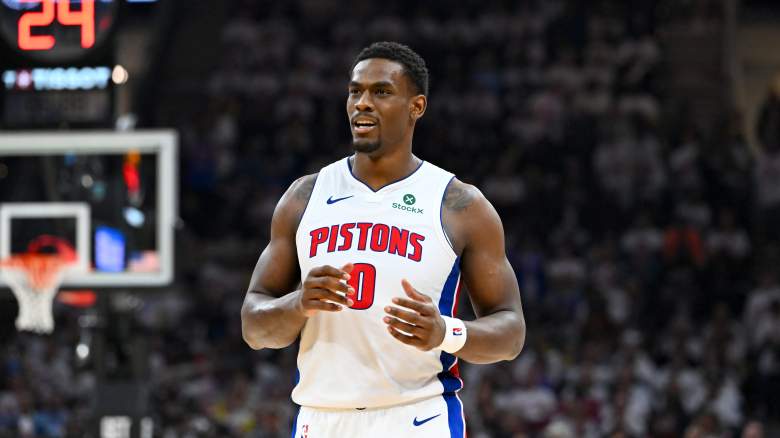
The Detroit Pistons just had an excellent year by anyone’s standards, and a truly great one by theirs. But with good times come tough questions. And heading into this offseason, management and ownership have a decision to make about Jalen Duren.
It is not as easy of a question to answer as it looked to be just two months ago.

Poor Pistons Postseason Performance
When the regular season ended, Duren’s next contract was more palatable. He had just finished the best season of his career, averaging 19.5 points, 10.5 rebounds, 2.0 assists, 0.8 steals and 0.8 blocks per game in 70 starts, shooting 65.0% from the field and 74.7% from the line in a breakout offensive season. For a 22-year-old center on a 60-win team, that is a very strong contract-year performance, with more to come.
It was not just the raw production, either. Duren looked more controlled than he had earlier in his career and demonstrated a higher level of offensive skill – his hands were better, his finishing was more decisive, and the Cade Cunningham-Duren two-man game had become one of Detroit’s most reliable sources of easy offence. He was not just catching lobs and cleaning the glass; he was getting touches, making short-roll passes, drawing fouls and punishing smaller line-ups, while also still catching lobs and cleaning the glass. His was high-level center production, even allowing for the limitations in his game.
Then the playoffs came. And Duren’s struggles within them have complicated everything the Pistons are looking to do this summer.
Across Detroit’s 14 postseason games, Duren averaged only 10.2 points, 8.5 rebounds, 2.1 assists, 0.6 steals and 1.2 blocks in 30.2 minutes. His shooting percentage dropped to 51.4%, his free-throw percentage fell to 67.4%, and he committed 3.4 fouls per game. Duren was still useful, and there were stretches where his rebounding and rim pressure mattered, but he was not the same player who had spent the regular season as a reliable and skilled interior scorer with a great rebounding rate.
The playoff performance matters because Duren is – or was – on track to get paid among the game’s best. He made All-NBA Third Team this season, and is – or was – widely expected to land somewhere in the range of five years and $200 million to $220 million.
That is not just keep-the-core-together money. That is franchise-foundation money. The Pistons need to decide whether Duren is now actually going to be that.

Good, But Not Elite
The question is not whether the Pistons still want to keep Jalen Duren. Of course they do. The question is whether they want to keep him at a price point either at or near the maximum salary, in the belief that he will go on to develop in such a way (and to such a level) that the poor postseason performance was an aberration and not a forewarning. Basically, how much risk do they take?
Duren is only 22, but he has already played 276 regular-season games, with career averages of 13.5 points, 10.3 rebounds and 2.1 assists per game. He has improved every season, and his physical profile remains rare. There are not many players with his size, strength, vertical pop and touch around the basket. Detroit also does not have an obvious replacement; Isaiah Stewart will be traded to the Memphis Grizzlies for pennies on the dollar purely to free up some money, and letting Duren walk would create a major hole in the middle of a team that will not be replaced.
That said, Duren is not the complete player. He is still not a floor-spacer. He does not shoot threes. His defensive impact is inconsistent for someone with his tools. He can be late in coverage, vulnerable in space and prone to fouling when opponents force him into repeated decisions. In the playoffs, when opponents game-planned more specifically for him, his scoring efficiency and overall influence both dipped hard. That is not enough to say he cannot ever be a playoff center – of course he can – but it is enough to have some doubts as to whether he should be paid like a top-tier one, before he is one.

Pistons Have A Poser
The Pistons also have to think about roster and payroll balance. Cunningham is the clear franchise player and paid accordingly, and Ausar Thompson is another major piece whose inevitable extension day looms later this summer. Detroit has added shooting around them, including Isaiah Joe just this week, and has been aggressive in clearing and reshaping salary, as evidence by the Stewart trade. Paying Duren does not stop them from building, but overpaying any non-superstar can quickly make team-building tighter than it needs to be.
To be sure, Duren has earned a major deal. His regular season was too good, his age too favourable and his importance to Detroit too obvious for the Pistons to play hardball to the point of alienating him. But the postseason gave them a reason not to go all the way to the biggest possible number, and a five-year deal of around $40 million a year – which Duren is said to be seeking – is already a massive bet. Anything beyond that should require Detroit to be convinced that the regular-season version is the real baseline, and that the playoff version was a blip, not a warning.
The Pistons probably still pay Jalen Duren. They almost have to. But they should do it with some trepidation. He looked like a future cornerstone for six months, then like a work in progress when the games got harder. Both things are true, and the contract has to account for both.

Do the Pistons Still Pay Jalen Duren?