

Every NFL offseason is defined by tough decisions and personnel turnover because standing still often means moving backwards, even for a young team like the Chicago Bears.
Case in point, the Bears’ two priciest pass-catchers in DJ Moore and Cole Kmet. Moore is a strong trade candidate, as he is starting a $110 million contract extension in 2026 that spans four years and his $28.5 million salary cap hit is the largest on the roster next season.
Meanwhile, Kmet was just on the receiving end of what would have instantly become among the highest-profile playoff touchdown passes of all time had Chicago not lost to the Los Angeles Rams in overtime of the Divisional Round last weekend at Soldier Field.
Kmet is still young — he turns 27 in March — and serves a high function as the team’s TE2 behind rookie star Colston Loveland in an offense under head coach Ben Johnson that runs a ton of 12 personnel (offensive sets that include two tight ends).
But Kmet is also on a $50 million contract and represents $10 million in savings in both 2026 and 2027 if the Bears cut him with a post-June 1 designation. The same savings would come in a trade, and Kmet probably has enough value to pull back a mid-to-late-round draft pick in a deal.
Jacob Infante of Windy City Gridiron listed Kmet among a handful of trade/cut candidates in Chicago on Friday, January 23.
Cole Kmet’s Usage, Production Not Living Up to Value of Contract
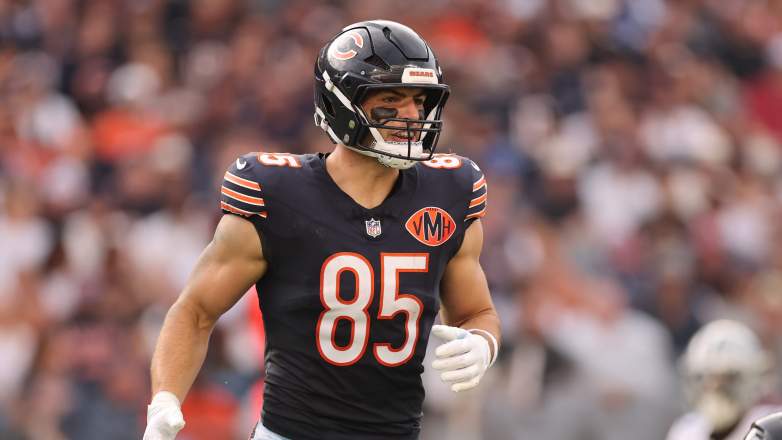
Bill Belichick proved over more than two decades with the New England Patriots that it is better to move on from a player a year too early than a year too late. Chicago doesn’t need to dump Kmet and shouldn’t if team brass doesn’t think it can find a player who is close to equally productive while also playing on a significantly less expensive deal.
But Kmet just put up the least productive campaign of his career behind Loveland, who finished the year as the No. 5 tight end in the NFL based on Pro Football Focus’s grading system and is on a rookie contract for the next three seasons followed by a team option in 2029.
Kmet caught 30 passes for 347 yards and two TDs, which is solid output but doesn’t constitute a $12.5 million annual average salary. He could certainly do more offensively if Johnson asked him to, but Loveland is there now.
Thus, if the Bears can find 80-90 percent of Kmet’s production from a young player who is also a better blocker and making a fraction of the annual salary, those are the types of dispassionate financial decisions that help up-and-coming teams win in the margins.
DJ Moore Trade May Be Only Matter of Time in Chicago
Chicago isn’t in dire straits financially, but the franchise is currently $17.4 million in the red with regards to the upcoming salary cap.
Furthermore, the team needs to add talent to the pass-rush and at cornerback, while safeties Kevin Byard, a first-team All-Pro, and Jaquan Brisker will both become free agents in March.
The decision to move or not move Kmet this offseason could go either way, and it will probably come down to whether Chicago can find a suitable replacement who offers real financial savings.
However, a Moore trade feels like merely a matter of time. He put up legitimately the least productive campaign of his career in 2025 and makes too much many for too many years to make sense in a Bears uniform moving forward.
Moore also has mid-round trade value, so all the incentives are there.
Bears $50 Million Playmaker Makes List of Top Cut/Trade Candidates