
The Chicago Bears entered the spring with considerable needs at two of the three or four most important positions in football, pass-rusher and left tackle, and team brass has essentially ignored them both to this point in the offseason.
Not adding an edge defender alongside Montez Sweat is more defensible given Austin Booker’s production down the stretch in Year 2 of his NFL career, as well as Dayo Odeyingbo’s likely return to health before/sometime early in the upcoming campaign after suffering an Achilles tear in Week 9.
Harder to explain, however, is the Bears’ decision not to add at least an average starter on the left side of the offensive line with Ozzy Trapilo likely out until near the end of 2026. Seven offensive tackles came off the board in Round 1 of April’s draft, six of them before Chicago selected at No. 25. Thus, the value wasn’t really there for the Bears late on opening night to go with a tackle.
But that doesn’t explain why head coach Ben Johnson has yet to convince the front office to make an offer to former Detroit Lions left tackle Taylor Decker, a stalwart starter on three different offensive lines that helped the Lions field top-five units across Johnson’s three campaigns as offensive coordinator in Detroit (2022-24).
The biggest reason for Chicago’s immediate and impressive turnaround from 2024 to 2025 was the franchise’s ability to turn the O-line from the No. 24-ranked group two years ago into the No. 3-ranked outfit last season, per Pro Football Focus.
Should the Bears decide to cheap out on the crucial position and allow Decker — by far the best free agent tackle still available — to land elsewhere, it will likely prove the most costly mistake of the team’s offseason.
Protecting Caleb Williams Crucial to Bears’ Success Last Year, This Season
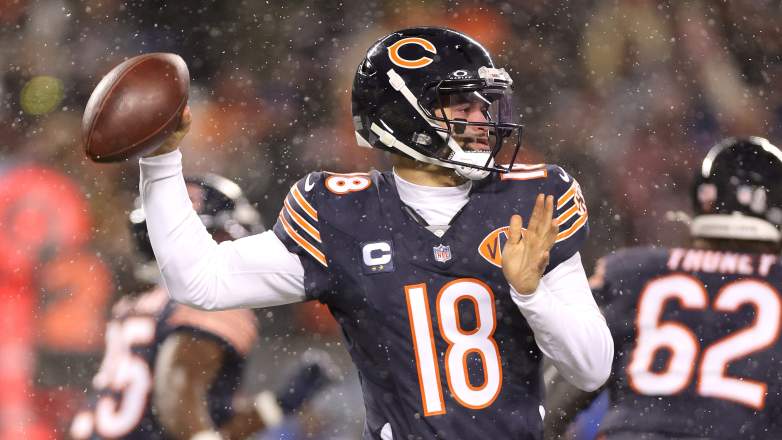
The arguments for Decker are two-fold. The first layer of the discussion involves what Chicago’s improved offensive line translated into last year.
Quarterback Caleb Williams took 68 sacks during his rookie campaign in 2024, losing 466 yards from scrimmage in the process. Both of those terrifying statistics led the league.
Williams’ awareness and decision-making improved under Johnson last year, which is part of why the sack numbers improved so much. But he took just 24 sacks in 2025 and was near the top of the NFL in pressure-sack ratio. Combined with just seven interceptions, Williams helped Chicago’s offense avoid negative pass plays at among the highest rates.
The Bears were also the No. 3-ranked rushing attack, and sixth-ranked offense, in 2025. And Chicago’s run game was about more than total yardage gained (144.5 yards per game). That facet of the offense was also among the most explosive in the league, finishing the campaign with the second-most rushes of 10 yards or more.
Bears Currently Looking to Braxton Jones as Starting Left Tackle After Benching, Injury Issues in 2025

The second part of the argument for Decker, beyond how well the O-line played last year and how important it will be to Chicago replicating its success in 2026, is who the Bears have on the depth chart as of mid-June.
After benching Braxton Jones, who suffered through injury concerns last year, Chicago brought him back on a one-year contract worth just $4.3 million. Theo Benedet, who replaced Jones at one point before eventually losing the job to Trapilo, is also back in the locker room this offseason.
The one addition the Bears have made is former first-round pick Jedrick Wills Jr., a bonafide bust with the Cleveland Browns who sat out all of 2025 rehabilitating from injury. He signed in Chicago for the league minimum of less than $1.1 million.
Nate Tice of Yahoo Sports and NFL Network ranked Chicago’s offense inside of his top 10 heading into 2026 on the June 17 edition of “The Mina Kimes Show featuring Lenny.” However, his biggest knock on the Bears was the uncertainty at left tackle.
“Who’s starting at left tackle? Is it Braxton Jones? That’s the guy that you guys were going, ‘No way! He’s not playing for us anymore,'” Tice said. “So yeah, left tackle is a big … question mark.”
Tice noted the Bears survived more than half the season with Jones and Benedet starting at left tackle before making the switch to Trapilo, who was a second-round rookie in 2025. But Trapilo was the starter across much of a strong run down the stretch of the year.
“The biggest changes are on the offensive line, and that’s why I pushed them down,” said Kimes, who also ranked the Bears in her top 10. “It was the offensive line for me.”
Taylor Decker Would Be Expensive, but Worth Cost to Bears
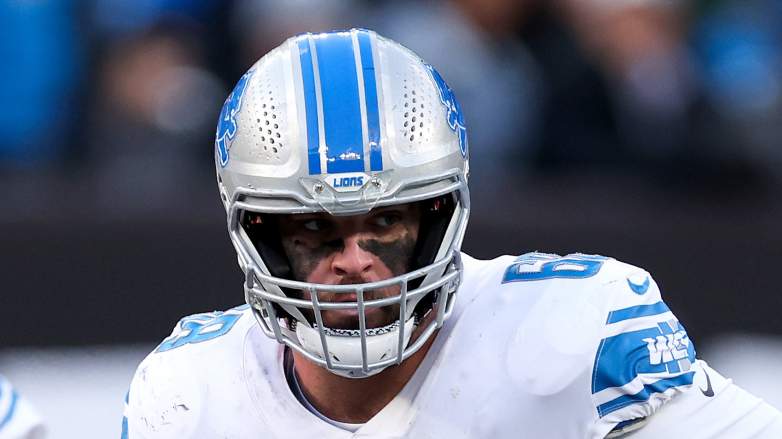
Chicago needs just a one-year fix at left tackle, with Trapilo likely to return from his torn patellar tendon late this season. Meanwhile, Decker is liable to ask for two years.
He will play the upcoming campaign at age 33 following the Lions’ decision to release him in March well before his three-year, $60 million contract actually expired. Spotrac projects Decker’s market value at approximately $42.7 million total over a new two-year deal.
That would be a high price for the Bears to pay, even despite Decker’s 10 years of starting experience and 2024 Pro-Bowl honors. He finished last season as the 41st-ranked tackle out of 89 players who saw enough snaps to qualify at the position, per Pro Football Focus.
All that said, Decker plays a premium position that is a major question mark for the Bears. The concerns at LT are made worse by the fact that Chicago also lost Pro Bowl center Drew Dalman to an unexpected retirement and is likely to take a significant step back at that spot in 2026 as well.
Williams has a chance to stage an MVP-level campaign this year from under center, but a well below-average group of tackles on the left side will certainly hinder that possibility. Thus, it is worth it for the Bears to pay Decker for an extra year in 2027, when the team will have expensive depth on the offensive line, so that Chicago can fill the void Trapilo will leave for much, if not all, of this season.
Bears’ Biggest Offseason Mistake: Ignoring $60 Million Free Agent at Position of Need