
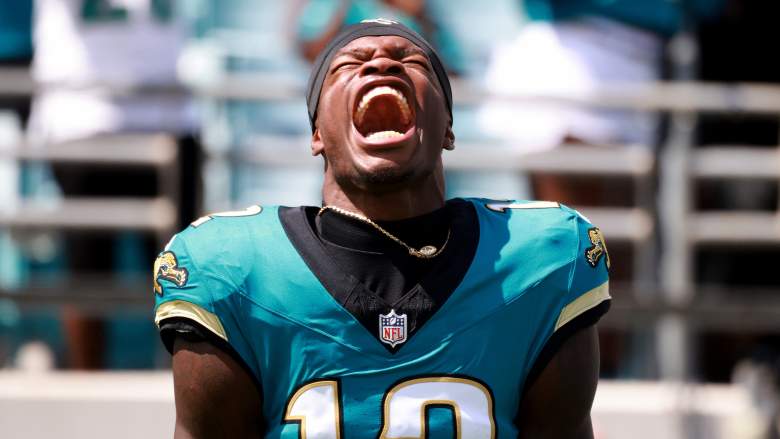
The Jacksonville Jaguars spent most of last season proving they could survive without Travis Hunter.
Their playoff loss showed why having him back matters.
The Athletic selected Hunter as Jacksonville’s breakout candidate for 2026 and placed the emphasis on the side of the ball where his return could have the greatest effect.
Jeff Howe wrote that Hunter will receive opportunities on offense, but the Jaguars “really need him to be special on defense” after their secondary’s vulnerabilities surfaced against the Buffalo Bills.
That assertion creates a new benchmark for Hunter’s second NFL season.
A productive two-way role can generate highlights and key impact at important moments, but developing into Jacksonville’s top cornerback could change the direction of Anthony Campanile’s entire defense.
Hunter Can Change Jaguars’ Defensive Ceiling
Hunter’s rookie season ended before Jacksonville made its strongest run.
He injured his right knee during an Oct. 30 practice and underwent surgery to repair an isolated lateral collateral ligament injury. The Jaguars said there was no additional damage and projected a six-month return to full football activity.
Before the injury, Hunter started two games at cornerback and recorded three passes defensed. His limited sample still gave Jacksonville reasons to believe the No. 2 overall pick could become the matchup defender the secondary lacked late in the season.
The Jaguars reached the postseason without him and carried a 24-20 lead into the final four minutes of their wild-card game.
Josh Allen then led the Bills on a nine-play, 66-yard touchdown drive. He completed 28 of 35 passes for 273 yards without an interception in Buffalo’s 27-24 victory.
Jacksonville received solid work from Montaric Brown and Jarrian Jones during the season. Brown finished with 12 passes defensed and two interceptions, while Jones had eight passes defensed and three interceptions.
Hunter offers a different upper limit.
His length, recovery speed and ball skills give Campanile the option to place him against an opponent’s leading receiver. That assignment can create more freedom for the safeties and allow the rest of the coverage to tilt toward other threats.
The secondary already contained useful pieces, and now Hunter can turn that group into a unit with a true centerpiece.
Jacksonville Still Has to Solve the Two-Way Balance
Hunter’s recovery kept him out of Jacksonville’s offseason practices, leaving his exact workload as one of the team’s largest training camp questions.
The Jaguars have continued to describe him as a two-way player.
Their own media panel largely expects most of his work to come at cornerback, with selected offensive packages designed to take advantage of his ability with the ball.
That dispersal between offense and defense makes sense.
Hunter already showed his offensive upside with eight catches for 101 yards and a touchdown against the Los Angeles Rams in London. He can create explosive plays without carrying a full-time receiver workload every week.
But his defensive role demands more coherence.
Cornerback requires repeated technique work, route recognition and communication across the secondary. Hunter also has to rebuild football conditioning after losing the final 10 regular-season games and the entire offseason program.
The Athletic’s breakout prediction comes with a considerable footnote.
Jacksonville is asking a 23-year-old returning from knee surgery to become its best cover player while preserving enough energy for an offensive role.
If Hunter handles that balance, the payoff reaches far beyond his individual statistics.
The Jaguars already proved they could win the AFC South and push a playoff opponent into the final minute.
A healthy Hunter could give them the defensive difference-maker they lacked when that game needed one final stop.
Jacksonville Jaguars’ Travis Hunter Faces ‘Special’ 2026 Challenge