
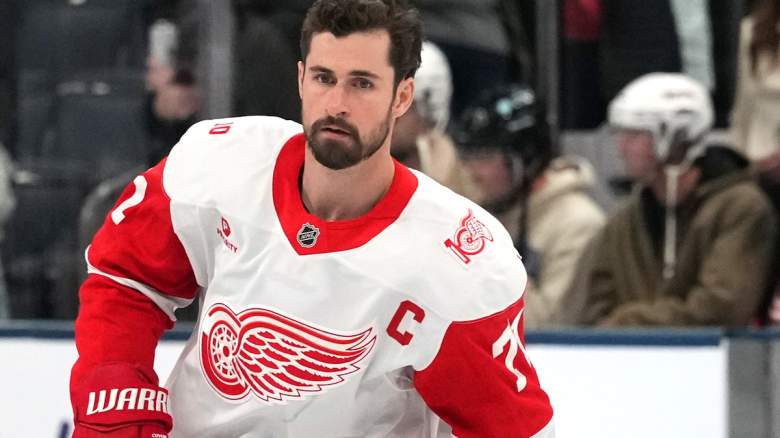
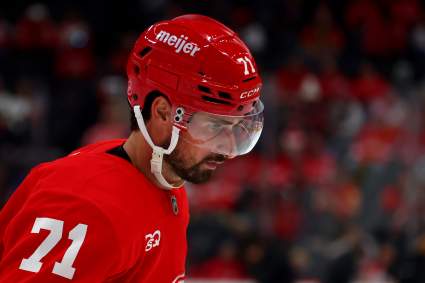
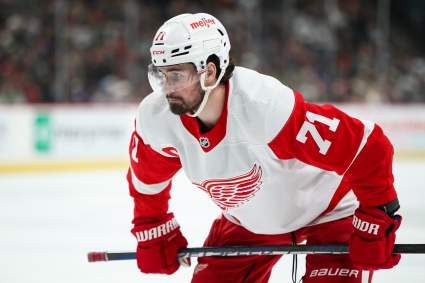
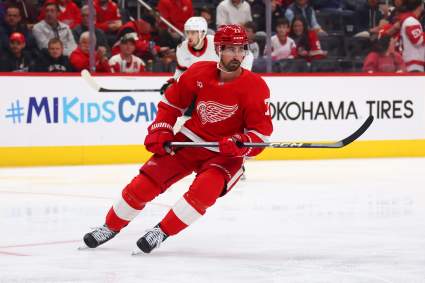
The Dylan Larkin trade situation has officially reached the point where even rival NHL executives are questioning what exactly the Detroit Red Wings are trying to accomplish.
One rival general manager described Detroit’s reported demands as “unrealistic,” according to Frank Seravalli, going so far as to say the Red Wings have “essentially asked for a younger version of Dylan Larkin” in return.
That might explain why the trade request has gone nowhere.
Larkin wants out. Detroit knows he wants out. Other teams are interested.
And yet nobody appears to be able to figure out what the Red Wings actually want in return.
Another NHL general manager involved in trade discussions told Seravalli that Detroit has refused to clearly define what it is seeking for its longtime No. 1 center.
That creates an obvious problem.
If the Red Wings want a player who can immediately replace everything Larkin provides while also being younger, cheaper and under team control, there probably aren’t many teams willing to make that player available.
And if there are, those teams probably aren’t interested in trading him for Larkin.
It is essentially a hockey version of asking someone to trade someone their own asset, only younger.
The Larkin Injury Is Adding Another Layer to the Situation for Red Wings
The trade situation has become even stranger because league executives are now questioning Larkin’s injury status.
Larkin has missed time with an upper-body injury after sustaining an injury during offseason training. Detroit has repeatedly maintained that the injury is legitimate, and the organization reiterated to Seravalli twice this week that Larkin does have an injury.
Still, the fact that executives are even asking whether Larkin is actually on the shelf or simply sitting out because of his trade situation shows how unusual things have become.
There is no evidence that Detroit is lying about the injury.
But perception matters when a player has already requested a trade and remains unavailable while his future with the organization is unresolved.
And there is another reason Detroit doesn’t necessarily need to force the issue.
One NHL executive pointed out that the Red Wings are only about $1.6 million above the salary-cap floor with Larkin on their books.
“Paying him for now works for everyone,” the executive said.
That may be the most important part of this entire situation.
Detroit doesn’t have to move Larkin simply because he requested a trade. The Red Wings can continue paying their star center while waiting for a return they believe is worth giving him up.
Larkin is still a highly productive NHL center, coming off a 34-goal, 67-point season, and he remains under contract for five more years at an $8.7 million average annual value.
So Detroit has leverage.
The problem is that leverage only gets them so far.
If the Red Wings are truly demanding a younger version of Larkin, other teams may simply decide that the price is too high.
And that leaves everyone stuck.
Larkin wants a new team. Detroit wants a return worthy of its best player. Interested teams want Larkin without gutting their own future.
Until someone changes their expectations, this trade situation could remain exactly where it is now: nowhere.




Red Wings Face Major Problem in Dylan Larkin Trade Talks, Insider