
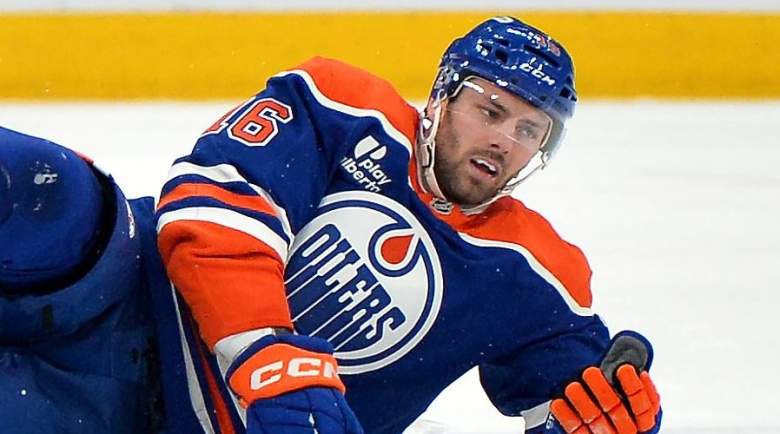
The Edmonton Oilers suddenly have another problem to deal with before the regular season even begins.
Jason Dickinson has re-aggravated the foot injury he originally suffered during last season’s playoffs, and head coach Mike Babcock said Friday that the veteran forward is now unlikely to start the season. There is no firm timetable for his return, although Babcock’s comments suggested the issue could be more short-term than long-term.
If Dickinson misses a few games, Edmonton can probably manage it.
If this turns into something longer, however, the Oilers suddenly have a much bigger problem.
Dickinson signed a five-year, $20 million contract with Edmonton in June and was expected to play an important role in the bottom six while also contributing on the penalty kill. He had seven goals and 10 assists in 64 games between the Chicago Blackhawks and Oilers last season.
Now someone else has to fill those minutes.
Edmonton Has Some Internal Options, But They May Not Be Enough
The good news for the Oilers is that they aren’t completely out of options.
Trent Frederic has already moved into a third-line center role during Dickinson’s absence, while Colton Dach has also taken reps down the middle. Josh Samanski and Owen Michaels are among the other players who have been around the NHL group, with Michaels drawing particular attention from Babcock during camp.
Frederic might be the easiest temporary solution.
He’s already an established NHL forward and can handle the physical side of a bottom-six role. Moving him into the middle also wouldn’t require Edmonton to completely restructure its lineup.
Dach provides another option.
The 23-year-old has some size and versatility, and giving him a chance could allow the Oilers to see whether he is ready for a larger role.
Then there is Michaels, who represents a more intriguing possibility.
He is younger and less proven, but that’s exactly why these situations can become valuable. Injuries create opportunities, and Edmonton now has a chance to find out whether someone unexpected can handle NHL minutes.
But there’s a catch.
None of those players is Dickinson.
The Oilers signed Dickinson because they wanted a reliable two-way center who could handle difficult minutes, kill penalties and provide some physicality. Edmonton wasn’t simply looking for another body for the fourth line.
If Dickinson is gone for a couple of weeks, Edmonton can work around it.
If he’s out for months, that’s different.
And if the Oilers are serious about contending for the Stanley Cup, they may eventually need to find another solution.
Oilers Don’t Have Many Easy Options Outside the Organization
This is where things become complicated.
The Oilers can’t simply go out and trade for another Jason Dickinson.
At least, not without giving something up.
Edmonton already made significant moves to construct its roster, and trading for another established bottom-six forward would require the organization to surrender assets while also finding room under the salary cap.
That’s not an especially attractive proposition for a player who may only be needed temporarily.
The waiver wire could therefore become much more important.
If Dickinson isn’t ready for opening night, Edmonton can monitor the players being placed on waivers as teams finalize their rosters. There could be a veteran forward or depth center available who can provide enough two-way play to stabilize the bottom six until Dickinson returns.
That wouldn’t necessarily have to be a permanent solution.
In fact, that’s probably the ideal scenario.
Find somebody who can give the Oilers competent minutes, keep the bottom six functioning and then move back down the depth chart once Dickinson is healthy.
The problem is that the waiver wire isn’t exactly a department store.
Edmonton can only choose from what other teams are willing to expose.
And if the organization doesn’t find anyone useful, it may have to live with its internal options.
That’s why Dickinson’s recovery is so important.
The Oilers can survive this if we’re talking about a short absence.
They have enough talent at the top of their lineup to absorb some disruption, and there are enough internal candidates to fill a temporary hole.
But the longer Dickinson remains unavailable, the more difficult that becomes.
Edmonton signed him for five years because it believed he could be an important part of the team’s supporting cast.
Now the Oilers have to hope they don’t need to find out how important he really is.
Oilers Suddenly Face Major Problem After Dickinson Setback