
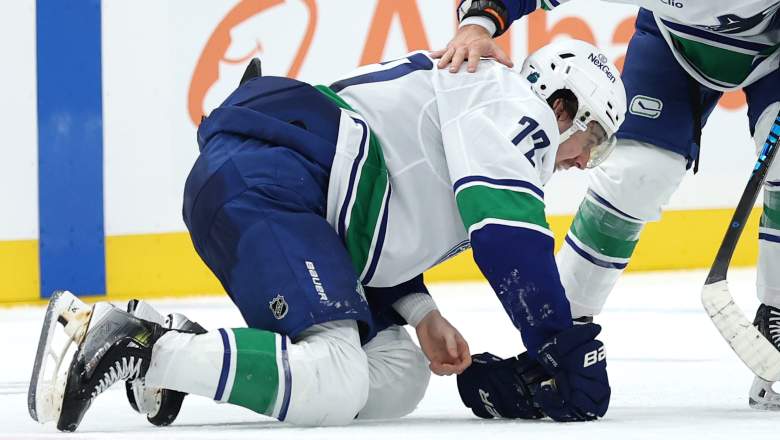
The Vancouver Canucks are now facing a new injury problem with the once-promising Filip Chytil.
The 27-year-old is coming off an injury-plagued 2025-26 season, in which he played just 12 games due to a concussion and other assorted ailments.
Now, he’s landed on injured reserve (IR) and may not be ready for the beginning of the season, the team has announced.

While the prognosis isn’t dire at the moment, the situation could get really dicey if the worst-case fears come to fruition.
According to renowned physician, Dr. Harjas Grewal, Chytil’s injury could pose a major concern for the Canucks.
The expert believes this could be a week-to-week thing for Chytil in the best of cases. But if it turned out to be something devastating like a broken collarbone, all bets will be off regarding his recovery timeline.
Losing Chytil for an extended period for the second season in a row would be a crushing blow to the team and the player. It’s worth noting that Chytil was one of the key pieces in the J.T. Miller trade with the New York Rangers a couple of seasons ago. Unfortunately, the former first-round pick is in the final year of his current contract, and if he can’t stay healthy, serious questions will emerge regarding his future with the organization.
Canucks May Think Twice About Re-Signing Filip Chytil
The Canucks have every reason to like what Filip Chytil can bring when he’s healthy.
That’s precisely what makes this situation so frustrating.
Chytil was one of the key pieces Vancouver received from the New York Rangers in the J.T. Miller trade, and the 27-year-old still has enough talent to be an important part of the Canucks’ future.
But availability has become a serious concern.
Chytil played just 12 games last season because of concussion issues and other injuries, and now he’s already on injured reserve before the 2026-27 season has even begun.
That changes the conversation about his future.
Chytil is entering the final year of his contract, meaning Vancouver will eventually have to decide whether it wants to invest in him again. If he stays healthy and shows that he can consistently contribute, there’s an obvious argument for keeping him around.
If he can’t?
The Canucks may simply decide that the juice just isn’t worth the squeeze.
That doesn’t necessarily mean they would walk away completely. Chytil could still be a useful player, particularly if he can prove that last season was an unfortunate outlier.
But Vancouver would have little reason to give him a long-term commitment.
A short-term contract would make far more sense.
Something in the two-year range could give Chytil an opportunity to rebuild his value while giving the Canucks some protection. If he gets through those seasons healthy, everybody wins.
That’s a very different situation from handing him a lucrative long-term deal based largely on what he might be able to do.
And that’s the uncomfortable part for Chytil.
He needs to stay on the ice.
The talent has never really been the question. The problem is whether the Canucks can reasonably build their plans around him.
Vancouver May Have to Find Another Answer at Center
This is where the Chytil situation could become much more significant.
The Canucks are already trying to figure out what their forward group should look like moving forward, and Chytil was supposed to be an important part of that equation.
If he misses only a short period, Vancouver can probably manage it.
But if this becomes another extended absence, the organization may have to start thinking about life without him.
Chytil brings a combination of size, skill and two-way ability that isn’t necessarily easy to replace internally. He has shown throughout his career that he can play in the middle of the lineup and provide legitimate offensive upside when healthy.
The Canucks don’t necessarily need to replace him immediately.
They do, however, need to know whether they can count on him.
That’s the bigger issue.
If Chytil eventually returns and puts together a strong season, Vancouver can revisit the situation later. The organization would then have actual evidence that he can stay healthy and contribute consistently.
If the injuries continue, though, the Canucks may have to start looking elsewhere.
That could mean promoting one of their younger centers, shifting another forward into a larger role or eventually looking outside the organization.
And none of those options is particularly attractive if Vancouver is trying to take another step forward.
That’s why this injury matters beyond the immediate lineup.
Chytil isn’t simply another player on injured reserve.
He’s a player the Canucks acquired with the expectation that he could become part of their future.
Now they have to wait and see whether his body will allow that future to happen.
If it doesn’t, Vancouver may have no choice but to start making other plans.













Canucks Suddenly Face New Problem After Filip Chytil Injury