
There are still a few months to avoid another disastrous MLB lockout.
The betting markets, however, aren’t exactly showing much confidence that a massive de-escalation can happen before it’s too late.
According to Covers.com, Kalshi is currently giving just a 5% probability that MLB and the MLB Players Association (MLBPA) will agree to a new Collective Bargaining Agreement (CBA) before the December 2 deadline. In other words, the prediction market is effectively pricing in a 95% chance that there will not be a deal in place by the deadline in question.
That does not mean an MLB lockout is guaranteed, of course.
Nevertheless, it does show that the possibility of a work stoppage is already being treated as a highly likely outcome, effectively stoking baseball fans’ worst fears.
And that could have major consequences for baseball long before a single 2027 game is actually threatened.
What an MLB Lockout Would Mean for the Offseason
The immediate impact of an MLB lockout would be palpable in the Hot Stove.
The current CBA expires at 11:59 p.m. ET on December 1, and the precedent from the 2021-22 lockout is pretty clear: major-league transactions stop. That means no free-agent signings, no trades involving major-league players and no normal communication between clubs and players until a new agreement is reached.
That would effectively freeze the offseason. And the impasse could even put the kibosh on the entire offseason.
Teams would no longer have a long runway to sign free agents, pull off trades, and reshape their rosters ahead of the following season.
A lockout would interrupt all of that.
The longer it lasts, the more compressed the offseason would become.
Fans already saw what that can look like in 2022. Once the lockout ended, baseball experienced an extraordinary rush of activity, with more than 30 deals worth over $1.2 billion completed during the first 10 days after the new CBA was reached.
The same sort of madness could happen again.
If an agreement is eventually reached before spring training, teams could suddenly have to accomplish months of roster construction in a matter of weeks.
That could mean a frantic free-agent market, accelerated trade activity and plenty of teams trying to solve problems they normally would have addressed much earlier.
The difference this time is that everyone knows the possibility of an MLB lockout is coming.
Could a Work Stoppage Cost Games in 2027?
This is where the situation becomes much more serious.
An offseason lockout does not automatically mean regular-season games will be missed. The 2021-22 lockout lasted 99 days, but MLB ultimately reached an agreement before the 2022 season was wiped out.
But the longer the current dispute continues, the harder it becomes to guarantee a normal 2027 season.
And there is a major issue sitting at the center of the negotiations.
MLB has proposed a hard salary cap of $245.3 million and a salary floor of $171.2 million for 2027. The league argues the system would address the enormous payroll disparity between teams. The MLBPA has repeatedly opposed a salary-cap system.
That is a fundamental disagreement.
There has already been speculation that the fight over a hard cap could become serious enough to threaten the 2027 schedule. One August report cited an American League source who doubted that MLB would play a complete 162-game season, although that was explicitly presented as an assessment rather than a certainty.
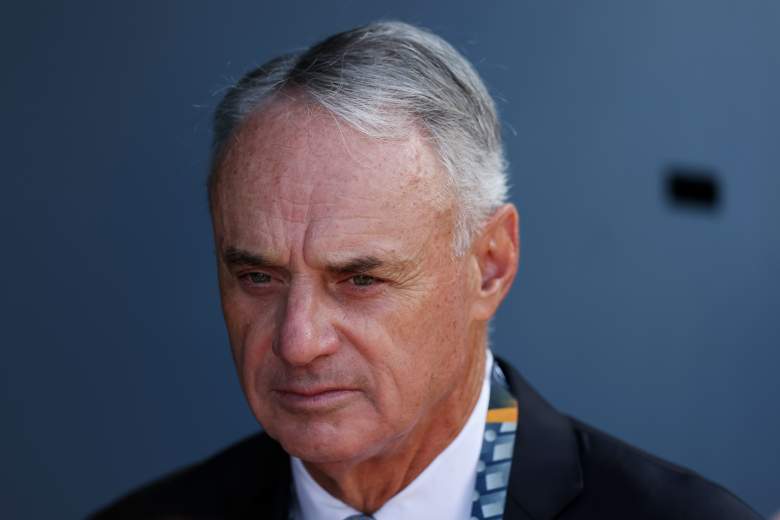
Commissioner Rob Manfred, meanwhile, said in August that MLB is planning to play baseball in 2027. Plus, the Commissioner expressed optimism about reaching an agreement before the season faces any serious threats.
So there is still a long way to go.
But that is exactly why the Kalshi number is so interesting.
The MLB lockout hasn’t happened yet. The 2027 season hasn’t been canceled. But the market is already pricing the possibility as though a work stoppage is the most likely path forward.
There is still time to prevent the sum of all fears from coming to fruition.
MLB Lockout Rumors Already Priced In by Betting Markets