

The New York Yankees got one of the strangest starts of the young season from Ryan Weathers on Tuesday, because almost everything about his outing looked split down the middle.
On one hand, Weathers missed bats at an elite rate. He struck out 10 batters of the Los Angeles Angels in just 5 innings, piling up whiffs with a deep mix that included his sweeper, slider, and changeup.
On the other hand, every major mistake he made got punished in the loudest possible way. Four of the five hits he allowed left the yard, turning what could have looked like a dominant outing into a bizarre five-run line.
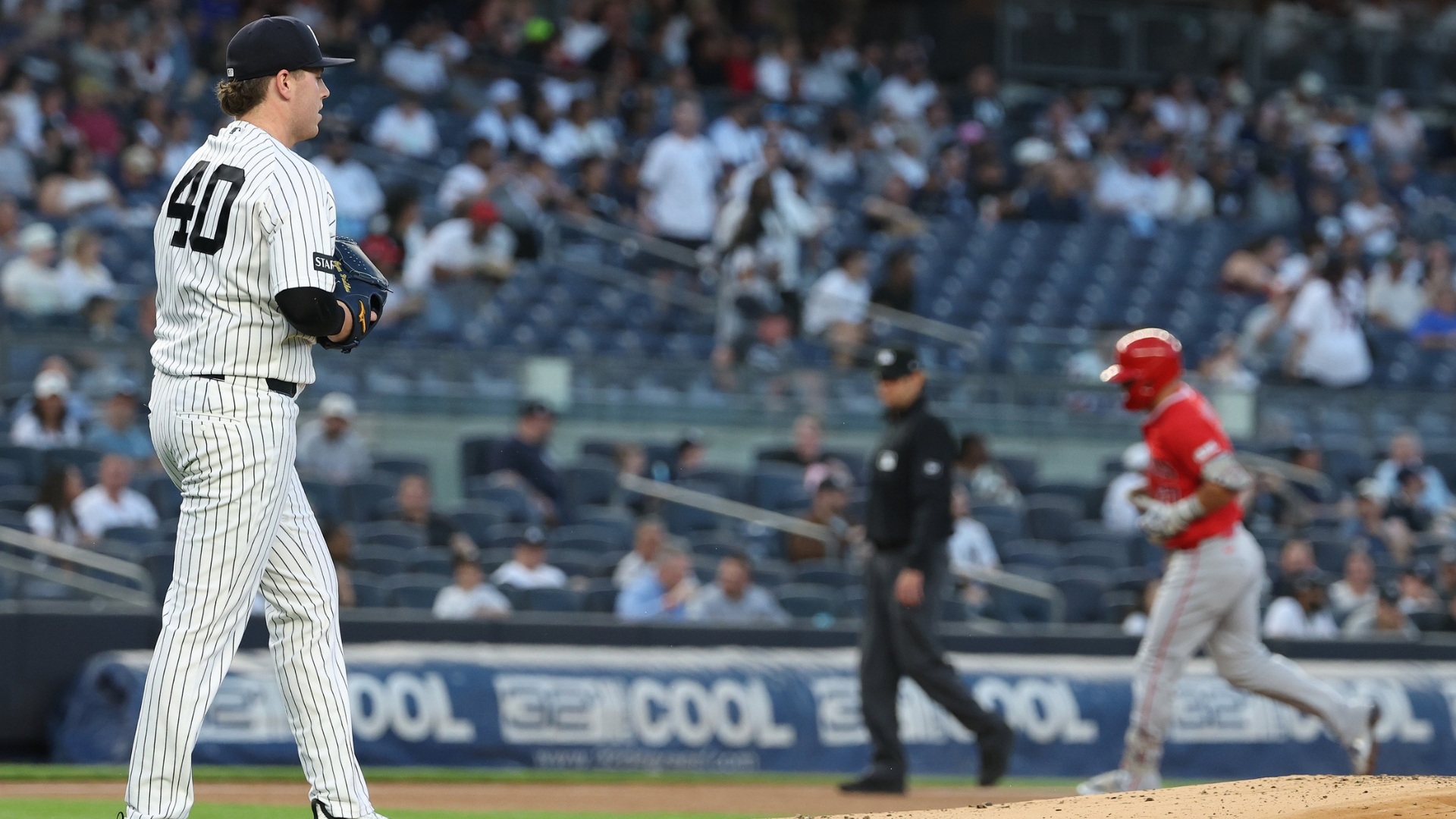
That tension showed up immediately in the first inning, when Mike Trout, Jo Adell, and Jorge Soler went back-to-back-to-back against Weathers. All three home runs came off his four-seam fastball, which sat in the 95 to 96 mph range on those pitches. For a pitcher who had looked like a stabilizing force lately, it was a stunning way to open the night.
What made the outing so unusual was that Weathers did not unravel after that. He kept attacking, kept getting strikeouts, and still finished with one of the highest punchout totals of any Yankees starter this season. His overall line ended at 5 innings, 5 hits, 5 earned runs, 2 walks, 10 strikeouts, and 4 home runs allowed across 94 pitches.
Swing-and-Miss Stuff was Real
Statcast raw pitch data shows this was not a night in which Weathers lacked weapons. His sweeper was especially nasty, generating three strikeouts and a 50 percent whiff rate on swings.
His slider produced four strikeouts, while the changeup added two more. Altogether, he finished with 11 whiffs on 40 swings and a 34 percent called-strike-plus-whiff rate, which is the profile of a pitcher who was fooling hitters for much of the night.
That is what makes the stat line so hard to process. Usually, when a starter gives up four homers in five innings, people assume hitters squared him up all night. That did not really happen here.
The Angels put only 10 balls in play against him, and although they hit six of them hard, they concentrated almost all of their damage into a few swings. It was less a case of constant traffic and more a case of catastrophic mistakes.
The Fastball Was the Problem Pitch
The clearest culprit was the four-seamer. Weathers threw it 28 times, and Angels hitters did their damage when they got it in the air. The pitch allowed four hits on seven balls in play, and all four hits were hard-hit, with a 100.2 mph average exit velocity. That tells the story better than the box score does: the fastball was either getting by hitters or getting crushed. There was very little middle ground.
That kind of outing can actually be useful evaluation material for the Yankees. The strikeout stuff suggests Weathers still has the arsenal to miss bats against dangerous lineups.
But the home run issue is a reminder that his margin for error is thin when the fastball leaks into damage zones, especially against right-handed power. Tuesday’s start was not simply bad, nor exactly good. It was something stranger: a high-whiff, high-damage performance that looked dominant until the baseball left the park.
Yankees See Starter Deliver One of MLB’s Weirdest Starts