
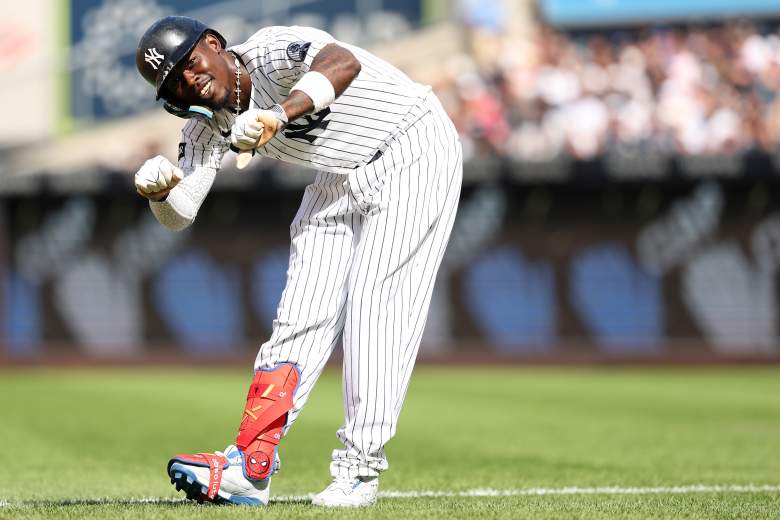
Twelve months ago, the idea of Jazz Chisholm Jr. accepting a one-year contract would have been improbable. Then again, nothing about Jazz is ever all that linear.
Chisholm had just completed the best season of his career, hitting 31 home runs, stealing 31 bases and becoming only the third player in New York Yankees history to produce a 30/30 season. He was entering his final year before free agency at 28 years old, with power, speed, defensive versatility and sufficient star appeal to have been voted an All-Star starter twice.
One disappointing season later, though, and now there is at least a decision to make.
As the 2026 MLB regular season heads into its final stages, Chisholm is batting .227/.308/.400 through 128 games this year, with 18 home runs and 54 RBI. He has struck out 148 times in 440 at-bats, already a career high, and his .708 OPS represents a decline of more than 100 points from the .813 he produced last season. This is not the momentum anyone wants to carry into their first free agency season. And precisely because of that, maybe the failsafe vehicle of the qualifying offer will come into play.

Yankees Have A Say In Chisholm’s Plans
Somewhat mirroring the NBA’s qualifying offer and restricted free agency system, Major League Baseball has had a qualifying offer system since 2012. In essence, a qualifying offer is a base contract that a team gives to a player whilst negotiations for a larger contract take place.
Since its revision in the 2017 Collective Bargaining Agreement, the qualifying offer amount is calculated as being the average salary of MLB’s 125 highest-paid players. The official value will not be established until after the season, but the qualifying offer value for 2026 was set at $22.025 million, and figures to be approximately $23.1 million in 2027. And on account of having spent the entire season with the Yankees and has never previously received a QO, Chisholm is eligible for one this winter.
Despite some reporting to the contrary, the Yankees would seem likely to make the offer. To do so costs them nothing they would not willingly spend anyway – unless they really do not want Chisholm back, at any price.
Chisholm is earning $10.2 million this year, his final season of arbitration eligibility, and even after his offensive regression, there would be little downside for the Yankees in offering him one year at $23 million. If he accepts, they retain a starting second baseman with 20-homer power and elite speed without making a long-term commitment, or are consolidating some trade value on a possible asset. If he declines and signs elsewhere, New York receives draft-pick compensation.
Instead, the hard decision belongs to Chisholm.

Yankees Cannot Act With Impunity
Accepting the qualifying offer would more than double Chisholm’s 2026 salary and give him an opportunity to re-enter free agency a year later after rebuilding his offensive value. At 29, he would still be young enough next winter to pursue a multi-year contract – and the hope would be that a better 2027 season will see him command a better payday in one year’s time, rather than settling for a deflated value multi-year contract this winter based on his sub-par (to date) 2026 performance.
There is precedent for players making that decision. Since the qualifying-offer system was introduced in 2012, 18 players (including Brandon Woodruff, who took the $22.025 million this past winter) have accepted rather than test a market complicated by the draft compensation attached to them. That compensation matters somewhat; another team signing Chisholm after he rejects the offer would have to sacrifice draft capital and, depending on its status, potentially international bonus money as well. The Yankees themselves would face no such penalty if they re-signed him.
Despite the slump and the soap opera, Chisholm would hardly be unwanted. He will be only 29 next season, has 126 career home runs and 170 stolen bases, can play multiple positions and was worth enough during his first full Yankees season to receive down-ballot MVP votes. His 2025 production demonstrated a ceiling well above what he has shown this year.
That said, there are warning signs beyond his batting average.
Chisholm’s career slash line is now down to .244/.314/.444, a decent but not sensational line that tells a different story to his peaks. His excellent 2025 season increasingly looks like the high point rather than his normal offensive level, and he has struck out 795 times in 704 career games. A team considering a four- or five-year commitment would be buying heavily into his athleticism while accepting considerable swing-and-miss risk.
Chisholm’s speed also complicates the long-term calculation. It is currently one of his greatest strengths, but as above, Chisholm will turn 29 in February – this is not usually a problem for a hitter, but it usually is for a base runner. Teams paying for his early thirties must consider how much value remains if the stolen bases decline.

Chisholm’s Market Is Unclear
If Chisholm could secure something in the region of four years and $80 million, declining the qualifying offer would be easy. Guaranteed multi-year security would outweigh the benefit of taking $23 million for one season and assuming the injury and performance risk himself. (Qualifying offer recipients are allowed to assess their markets during the acceptance period.)
Alternatively, Chisholm could accept it, remain in a favourable ballpark for left-handed power and attempt to reproduce his 2025 season. Another 25-to-30 home run campaign accompanied by 30-plus stolen bases would send him back into free agency with a much stronger platform and, importantly, without another qualifying offer attached. A player can receive one only once during his career.
There is an obvious risk. Chisholm could struggle again, get injured or simply discover that the market for a 30-year-old second baseman is less generous than the one available to him at 29. Turning down three or four guaranteed years is not something players do lightly. And there is still September remaining – Chisholm has recently shown signs of improvement, including three hits and a walk against Houston on Wednesday, with a strong final month and productive postseason able to alter the conversation substantially.
Either way, the decision is far less automatic than it once appeared. After his 2025 season, Chisholm seemed positioned to enter free agency seeking the largest contract of his career. Instead, he has followed it with a .708 OPS and an offensive season roughly around league average. As evidenced by the way he plays night in and night out, Chisholm is generally always up for betting on himself; doing so for one more year might now be the most lucrative bet available.

Should Jazz Chisholm Take his $23 Million Qualifying Offer?