
The Los Angeles Lakers went looking for youth, force and upside at power forward. Jonathan Kuminga chose Minnesota, leaving Los Angeles with a familiar problem: The need is obvious, but the clean solutions are gone.
Sacramento Kings forward De’Andre Hunter represents one of the few realistic alternatives.
Khobi Price of the California Post identified Hunter as a potential Lakers trade target following their failed pursuit of Kuminga. No talks between Los Angeles and Sacramento have been reported, but Hunter’s expiring contract, the Kings’ available roster spots and the Lakers’ overloaded roster create the foundation for a deal.
One possible framework:
Lakers receive: De’Andre Hunter
Kings receive: Jarred Vanderbilt, Jaden Hardy, Dalton Knecht and 2032 Wizards second-round pick, top-45 protected
It is an aggressive offer for an imperfect player. It also might be the price of doing business for a Lakers team short on draft capital and running out of credible starting forwards.
De’Andre Hunter Would Balance Lakers’ Starting Five
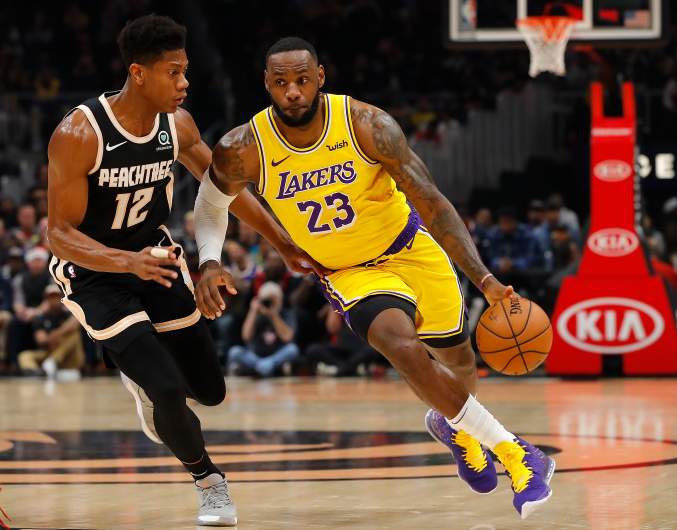
Hunter will earn approximately $24.9 million in the final season of the four-year, $90 million extension he signed in 2022.
The Lakers would not be trading for a star. They would be betting on a 6-foot-8 forward whose best qualities become more useful when he is not asked to create an offense.
Hunter can guard larger wings, space the floor and attack closeouts. Alongside Luka Doncic, he would receive open shots without having to manufacture them. Defensively, he would give Los Angeles another option against the powerful forwards it expects to encounter in the postseason.
The resulting starting lineup would have a logical distribution of responsibilities:
| Position | Player |
|---|---|
| Point guard | Luka Doncic |
| Shooting guard | Austin Reaves |
| Small forward | Quentin Grimes |
| Power forward | De’Andre Hunter |
| Center | Walker Kessler |
Grimes should start over Jake LaRavia in that configuration. A Doncic-Reaves backcourt needs a strong point-of-attack defender, and Grimes is better equipped to chase smaller scorers and fight through screens. Hunter could take the bigger wing assignment, while Kessler protects the rim.
LaRavia would become a multipositional reserve capable of playing beside Hunter or replacing him.
Kessler now anchors the Lakers’ frontcourt, with three-time NBA champion Kevon Looney behind him.
Hunter Trade Comes With Real Risk
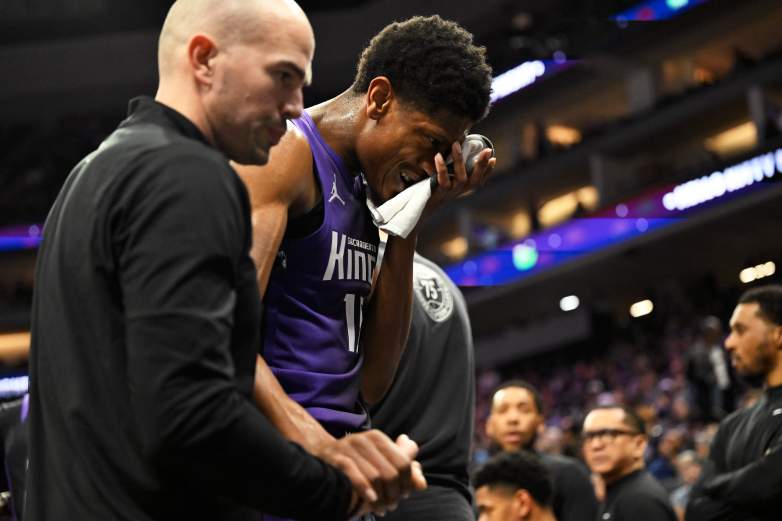
The case for Hunter becomes less comfortable when his recent production and availability are considered.
Hunter averaged 13.7 points, 4.1 rebounds and two assists in 45 games last season, shooting 41.5% from the field and 30.5% from 3-point range while splitting the year between Cleveland and Sacramento.
A year earlier, he averaged 17 points and made 39.7% of his 3-pointers over 64 games. That version of Hunter would be an obvious fit. The Lakers would have to decide how much confidence they have that he can return.
Durability is not a minor concern. Hunter has never played more than 67 games in a season. He underwent procedures on his right knee and wrist earlier in his career and has continued to miss time throughout his NBA tenure.
The Lakers would not be exchanging perfect health for a medical gamble. Vanderbilt has dealt with significant injuries of his own. The greater risk comes from including Hardy and Knecht, two younger players on more affordable contracts, for a forward who could leave as a free agent next summer.
Hunter’s expiring deal creates flexibility, but it also limits how much Los Angeles should surrender.
Trade Would Fix Lakers’ Roster Problem
Price reported that the Lakers are approximately $8.1 million below the NBA’s $209 million first-apron threshold. They are hard-capped and have 16 players on guaranteed contracts, one above the regular-season limit.
A three-for-one trade would reduce that count to 14 and leave Los Angeles with an open roster spot.
The outgoing salaries should be sufficient to match Hunter’s $24.9 million contract. The Lakers would add approximately $2 million to $3 million to their payroll while remaining below the first apron.
Sacramento has two roster openings, making the construction unusually tidy. Sending out Hunter and receiving three players would fill both vacancies without requiring the Kings to waive anyone or find a third team.
Vanderbilt could replace some of Hunter’s defense and rebounding. Hardy would provide another young scorer, and Knecht would give Sacramento a cost-controlled shooter. The protected second-round pick would sweeten the offer.
The Lakers should go no further.
Their only available first-round trade mechanism is a 2032 pick swap. That asset should remain off the table unless Sacramento removes Knecht from the deal or allows Los Angeles to discuss an extension with Hunter.
Kuminga offered greater upside. Hunter would offer size, shooting potential and a cleaner starting lineup—along with enough medical and contractual risk to make restraint essential.
The Lakers need a power forward. They don’t need to negotiate as if Hunter is their last option.
Lakers Trade Proposal Lands $90 Million Starting PF After Jonathan Kuminga Rejection