
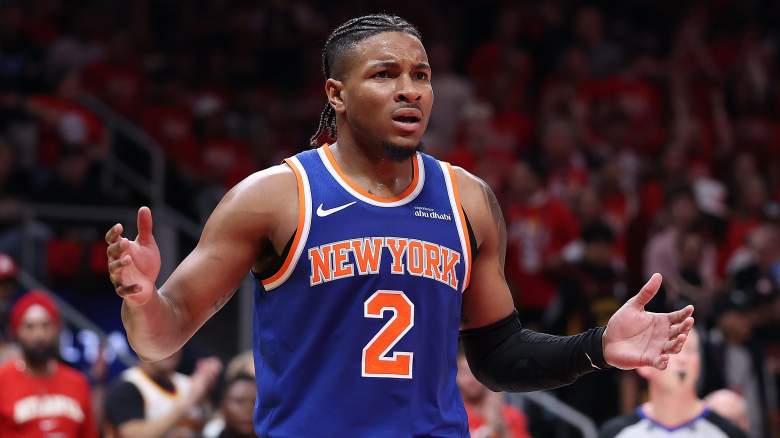
Miles McBride wants to stay with the New York Knicks. After playing through pain during their championship run, he wants to show what he can do with his body cooperating.
The guard addressed his contract situation and recovery as training camp opened, expressing a desire to continue in New York while leaving negotiations to his representatives and the front office.
“Obviously, I love being in New York,” McBride said. “And I want to continue with this team.”
His comments join those of Karl-Anthony Towns and Josh Hart, whose futures have become a recurring subject around the defending champions. McBride offered no indication that an extension was imminent.
Miles McBride’s Production Has Outgrown His Salary

McBride is coming off his best regular season offensively, averaging a career-high 12.0 points with 2.6 assists and 2.4 rebounds in 41 games. He also shot a career-best 41.3% from the 3-point range.
That production has made his contract a bargain. He is entering the final season of a three-year, $13 million agreement and will earn approximately $3.96 million in 2026-27, giving New York an inexpensive contributor as it manages an increasingly expensive roster.
His next deal could reflect how much his role has grown. McBride, however, described the uncertainty as familiar territory.
“I feel like, in a sense, every year you have to prove yourself,” he said.
Asked whether Mitchell Robinson’s departure amid second-apron concerns made him worry about his own future, McBride dismissed the concern.
“No, no,” he said. “I mean, at the end of the day, it’s a business.”
He emphasized his responsibility to give his teammates his best, whoever they might be. His preference remains clear, but the decision involves more than his desire to stay.
McBride Details Pain During Knicks’ Championship Run
The physical uncertainty has eased.
McBride said a summer of recovery helped restore movement that had been difficult during the playoffs following surgery.
“It’s kind of crazy, you know, thinking about how unhealthy I was playing through that playoff run,” he said.
He described the condition broadly as a sports hernia but said the procedure was more complex than the label suggested. In his account, it involved his hip flexor, abdominal and groin areas on both sides.
Even opening a door or reaching for a remote demonstrated how much he relied on the affected muscles.
Returning to competition meant recovering his conditioning and rhythm while managing pain. Keeping pace by the Finals was difficult.
“I mean, I just wanted to go out there and give it my best shot,” McBride said.
He now sees an advantage in returning with familiar teammates and Mike Brown entering his second season. That continuity, he said, should help the Knicks begin ahead of teams still learning one another.
McBride cautioned against taking it for granted.
His immediate task is making that familiarity and improved health count. A stronger season would help New York defend its title while giving the front office another reason to keep him.
Miles McBride Gets Honest About Knicks Future, Reveals Hidden Playoff Toll