
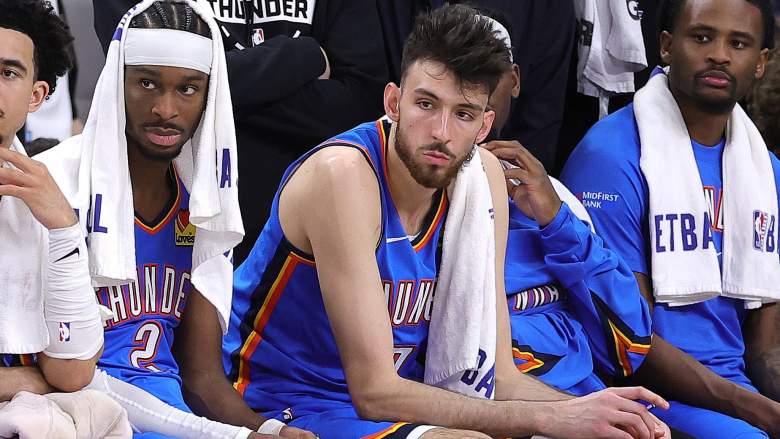
Chet Holmgren’s Game 7 problem was not only that he struggled to score. It was that the Oklahoma City Thunder reached the fourth quarter of their season with Shai Gilgeous-Alexander carrying the offense and Holmgren looking like a player the Spurs were comfortable forcing into decisions.
That made Holmgren one of the most criticized players on the floor during the Thunder’s Western Conference finals Game 7 against the San Antonio Spurs on May 30, as his team fell 111-103 to the Spurs.
Holmgren finished with just 4 points, 4 rebounds and no assists on 1-of-2 shooting. Gilgeous-Alexander had 35 points, but only Cason Wallace provided him any offensive support in the fourth quarter.
Holmgren was benched with 1:23 left and did not return.
The numbers told part of the story. The reaction around the game told the rest.
Kevin O’Connor posted that Holmgren’s “inability to create offense off the dribble is such a limitation for the Thunder,” adding that possessions stalled when Holmgren touched the ball. Barstool’s Big Cat wrote that “Chet wants no part of the ball in his hand.” Erik Slater called Holmgren’s hesitation to shoot and inability to create “glaring,” while Nick Wright wrote that a “long summer” could be coming for Holmgren if Oklahoma City could not turn the game around.
That is strong criticism for any player. It hits harder because of the moment.

Chet Holmgren’s Quiet Game Came at the Worst Possible Time for OKC
The Thunder were not playing Game 7 at full strength.
Jalen Williams was ruled out with a hamstring injury, while Ajay Mitchell and Thomas Sorber were also unavailable for Oklahoma City. Williams had been dealing with a left hamstring injury and that his absence put more responsibility on Gilgeous-Alexander and Oklahoma City’s backcourt.
That context matters for Holmgren.

With Williams unavailable, the Thunder needed more than rim protection, floor spacing and occasional finishing from Holmgren. They needed him to punish switches, make San Antonio pay for defensive attention on Gilgeous-Alexander and at least force the Spurs to guard him as a live scoring threat.
Instead, the public criticism focused on the same theme: Holmgren was not creating pressure with the ball.
Against most opponents, Holmgren’s length, touch and defensive instincts can tilt a game even when his shot volume is modest. Against Victor Wembanyama and the Spurs, the equation is different. San Antonio can challenge Holmgren’s release points, crowd his drives and live with possessions where he hesitates before giving the ball back.

That put Oklahoma City in a difficult place late. If Holmgren was not threatening the defense, the Thunder’s offense became more dependent on Gilgeous-Alexander manufacturing everything.
The Victor Wembanyama Matchup Changed the Conversation
This was always going to be the matchup that defined Holmgren’s night.
Wembanyama had already been the central force of the series. In Game 7 he entered the matchup averaging 28.2 points and 11.5 rebounds in the series. Wembanyama finished with 22 points, 7 rebounds, two assists, 1 steal and a blaock.
Holmgren did not need to outplay Wembanyama possession by possession to be valuable. That is an unrealistic bar. But he does need to keep the matchup from becoming a one-way pressure point.
The frustration from analysts and fans was not simply about Holmgren missing shots. It was about the possessions that never became shots, and a lack of aggression that hurt the Thunder’s flow on offense.
When a big man catches the ball and immediately looks uncomfortable, it affects spacing. Defenders shrink the floor. Driving lanes get tighter. Late-clock possessions become harder. That is especially costly against a Spurs team with Wembanyama behind the play and enough length around him to pressure the ball.
For Oklahoma City, Holmgren’s hesitation made the Thunder easier to guard at the exact point of the season when their margin for error had disappeared.
The Thunder’s Offseason Question Is Bigger Than One Bad Night
One bad Game 7 should not erase what Holmgren already is: a rare two-way frontcourt player with elite length, defensive range and long-term star upside.
But this is the kind of playoff moment teams remember.
Holmgren was not criticized because he is a role player who had a quiet night. He was criticized because the Thunder are built around a championship timeline, and their best version requires Holmgren to be more than a complementary big next to Gilgeous-Alexander.
The Spurs exposed the uncomfortable part of that development curve. Holmgren can protect the rim, finish plays and stretch defenses, but against elite playoff size and length, Oklahoma City still needs him to create more advantages on his own.
That does not mean the Thunder need to overreact. It does mean the offseason conversation around Holmgren will be sharper if Oklahoma City’s season ends with him on the bench or minimized in crunch time.
The Thunder have enough talent to keep this from becoming a referendum on one player. But Game 7 made one thing clear: when Gilgeous-Alexander is carrying the offense and Williams is unavailable, Holmgren cannot be a passenger.
Against Wembanyama and the Spurs, that was the criticism. And late in Game 7, it was hard to ignore.
Thunder Star Chet Holmgren Under Fire After Late Benching During Game 7 vs. Spurs