
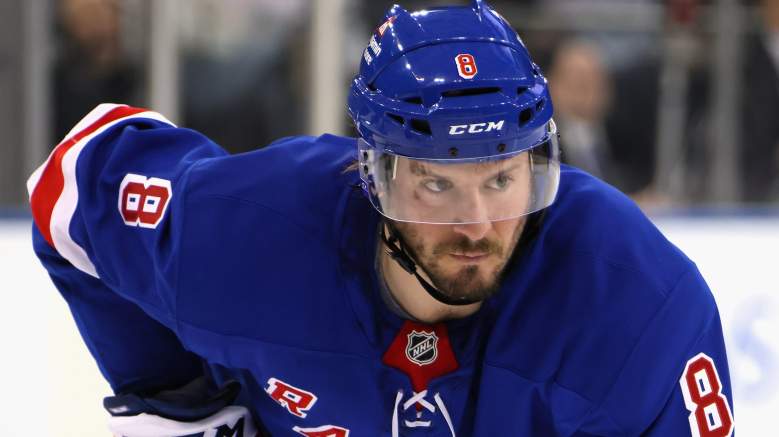
The New York Rangers aggressively retooled a big portion of their disappointing 2025-26 team. They made major additions through free agency, trades and the draft that could result in more goals, a new second pair on defense, improvement behind Igor Shesterkin and a new-look bottom six. None of that will matter long-term if the New York Rangers center situation goes unresolved for too long, according to Vince Mercogliano of The Athletic.
The Rangers center depth chart might not harm them in 2026-27, but the long-term outlook is potentially catastrophic. It will require Drury, whose tenure in New York has been a mixed bag, to carefully navigate dangerous traps he’s laid for himself.
The good news is the Rangers have started to make progress elsewhere. They were recently ranked second behind only Nashville in roster improvement by analytics expert Dom Luszczyszyn of The Athletic.
Mercogliano thinks it’s the most important task Drury and the Rangers face in the next few years.
New York Improved Everywhere Except Center
General Manager Chris Drury used draft capital to acquire a 35-goal scorer with solid two-way impact in winger Pavel Dorofeyev. He made a low-risk bet on a bounce-back campaign for Danish winger Oliver Bjorkstrand. Formerly in Columbus and Seattle, Bjorkstrand failed to replicate similar success in Tampa last season. Bjorkstrand scored at least 20 goals in six of his first eight seasons after becoming a full-time NHL player in 2017-18. Last season, he labored to 12 goals and 20 assists for 32 points in Tampa, his worst full-season scoring output since becoming a full-time player.
The Rangers also added big, strong and speedy defense-first center Joe Veleno. While he won’t chip in much offensively, his defensive impact grades out positively as a fourth-line player.
On the blue line, the Rangers added an entire new second-pair via trade. The Rangers acquired defenseman Marcus Pettersson using premium draft capital. Sean Durzi, a puck-moving two-way defenseman with a history of injury issues, came back as part of the return for center Vincent Trocheck.
In goal, the Rangers have not said they will carry three goalies. They could, though, after acquiring former Bruins backup Joonas Korpisalo to compete with youngster Dylan Garand. Korpisalo didn’t cost much in a trade, but he’s coming off a season where he was underwater in goals saved above expected. Still, the Rangers have a historically strong track record with goalies.
One of their wildcards comes in the form of defenseman Alberts Smits. The exciting two-way defenseman signed his entry-level contract with New York last week. Smits could start the year in the AHL, but he may play a big chunk of time in the NHL.
The New York Rangers Center Situation Could See a Short-Term Boost
An optimist can look at J.T. Miller’s season last year and see he constantly battled injury, starting as early as training camp. He worked hard to stay on the ice so he could represent Team U.S.A. at the Olympics. That seemed to take its toll, as Miller struggled all over the ice.
He was emblematic of the Rangers’ issues, a team that was among the top at possessing the puck in the offensive zone but seemingly incapable of converting that zone time into goals. Miller finished the season minus-15 at five-on-five. He struggled elsewhere, underwater in Corsi, Fenwick and shots at five-on-five.
Late in the season, Miller started to show signs of improvement. Moving back to center, he anchored a third line with journeymen wingers Tye Kartye and Conor Sheary. His chance generation numbers and expected goal numbers were positive for the year, which carried over to this hard-working third line. They finished above-water in every possession metric, while breaking even at five-on-five in goals at eight apiece.
Meanwhile, Mika Zibanejad enjoyed a strong bounce-back season as one of the better centers in the NHL. He found particular success later in the season playing on a line with young wingers Alexis Lafreniere and Gabe Perreault. The latter, who seems to have broken through as an NHL player, drew significant praise from prospect experts for his late-season play.
Miller won’t be tasked with running the third line or playing shotgun to another center this season. The organization traded Vincent Trocheck, who played both second- and third-line center last season in New York. The return, which received mixed reviews, plugs a hole on defense while improving the New York Rangers center situation long-term.
The problem is that it didn’t improve the New York Rangers center situation enough.
Longer View of New York Rangers Center Situation is Messy
The Rangers’ acquisition of center prospect Cole Beaudoin in the Vincent Trocheck trade absolutely helps the long-term outlook of their center depth chart. Their elevation of former fourth-round pick Noah Laba, 22, also helps. These are young centers with the potential to be very important pieces further down the lineup.
The problem for the Rangers is that neither Laba nor Beaudoin project as potential top-six centers, which Mercogliano noted in his report. Even if both Miller and Zibanejad are good this season, that still leaves the Rangers relying on two centers in their mid 30’s with no prospect for a potential replacement in the organization. Miller and Zibanejad were born about a month apart. They’re basically on the same timeline. And while both have had excellent NHL careers, neither has reached a level that makes you think they can be effective top pieces late into their 30’s.
The Rangers’ bet on both these players might pay off. Zibanejad bounced back under Mike Sullivan. Perhaps Miller can regain his form from immediately after his trade to New York, where he scored 35 points in 32 games. If they’re not working to solve the problem, the New York Rangers center situation will cost them dearly.
The Rangers Blueprint to Improving at Center
The New York Rangers could be in a tricky spot. They do have their 2027 first-round pick in what is expected to be a very heavy center draft. The Rangers’ problem is that they likely have improved too much to be at the very top of the draft for a second consecutive season. This will be particularly obvious if they get better injury luck from Adam Fox and Igor Shesterkin. The Rangers went a putrid 2-11-0 in a 13-game stretch before the Olympic break without them in the lineup due to injuries suffered hours apart.
As Mercogliano notes, the Rangers have several landmines to navigate if the team isn’t good by 2028. The Rangers parted with protected first-round picks in 2028 to acquire Dorofeyev and in 2030 to acquire Pettersson. The Rangers won’t have access to those draft picks for in-season trades if they’re good. If they’re bad, the bigger concern is how they can turn it around quickly to avoid giving up unprotected picks in 2029 or 2031. If either pick lands in the top 10, the Rangers can defer the traded pick by one year.
The Rangers’ accumulation of young talent in this retool might be instructive. New York’s prospect pipeline has improved significantly with the addition of Beaudoin. Wingers Liam Greentree, Nathan Aspinall, Malcolm Spence and Jacob Battaglia also likely could provide some value. They can’t all make the team. That’s also true on defense, where the Rangers likely have too many NHL-track defenseman between Smits, Drew Fortescue, E.J Emery and Ben Macbeath.
Positioning Themselves for a Center in the Fox-Shesterkin Era
Dylan Larkin, who played with J.T. Miller at the Olympics and Adam Fox at 4-Nations, didn’t include the Rangers on his trade list. The Rangers, who are coached by the man who led Team U.S.A. to its first Gold Medal in 46 years, weren’t viewed as a destination. That’s a problem if New York wants to solve its long-term center issue.
The retool, in many ways, is like a gutshot straight draw in poker. The team is trying to improve enough to be attractive to potential disgruntled NHL stars, while simultaneously improving the asset pool needed to acquire those stars.
The Rangers can’t rebuild as long as Igor Shesterkin and Adam Fox remain on the team. The Russian netminder quietly had another strong season, finishing sixth in goals saved above expected despite missing 13 games. Fox missed 27 games this season, during which the Rangers went 8-16-3 without him. His numbers in those 57 games were Norris-caliber. That the Rangers were so average with Fox healthy (26-23-6) is indicative of how much help they needed.
It’s a strategy that could look like a grand slam home run if it works. If it fails, the Rangers will be in deep trouble.
If it fails, it will likely mean the premature end of the Fox-Shesterkin era in New York.
Insider Identifies Rangers Top Need Beyond 2026 Season