
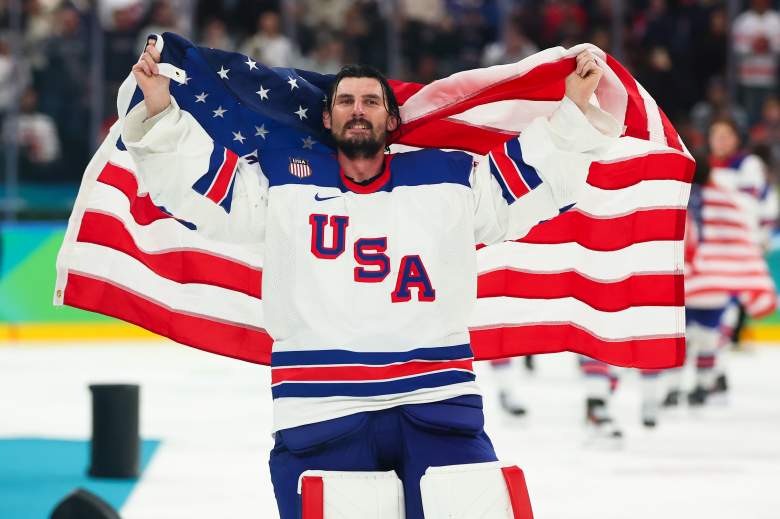
Hockey analytics has naturally evolved over time, but one of the most general positions is that goaltending is very hard to predict, which makes it a riskier investment than other positions.
With the New Jersey Devils acquiring Connor Hellebuyck from the Winnipeg Jets, there is an opportunity to see that evolution. It’s not merely that the Devils finally surrendered the assets that convinced the Jets to make the deal, but consider the other teams that were reported to be suitors for the standout goaltender.
Hurricanes Were Trying to Find Pieces for Connor Hellebuyck Trade
Seeing what the Devils sent to Winnipeg to complete the trade, it’s possible to surmise what the Jets might have wanted from Carolina.
With relatively young forward Dawson Mercer the most valuable NHLer going to Winnipeg, the Hurricanes would have had to consider moving a similar player. Someone the likes of Logan Stankoven or Jackson Blake, perhaps. Neither of those options make a lot of sense considering how critical they were to last season’s Stanley Cup win.
NHL Insider Elliotte Friedman insisted on the 32 Thoughts Podcast that the Hurricanes were very active trying to acquire pieces that might appeal to the Jets in a potential Hellebuyck trade.
Statements on Goaltending and Analytics
Hurricanes General Manager Eric Tulsky summed up his position on goaltending this way in 2024, when save percentages were admittedly higher: “A lot of what makes goaltending hard is that a guy who stops 92% of shots is one of the best goalies in the world,” Tulsky said to ESPN.
“A guy who stops 91% is kind of average. And the difference between those is not very big. You watch a guy face 500 or 1,000 shots, and he might stop 91 or 92% by chance,” Tulsky continued. “It takes a lot of time to know for sure that this is a guy that is going to stop 91 or 92% day after day.”
Similarly, Devils GM Sunny Mehta tempered his enthusiasm for acquiring Hellebuyck. A few weeks before the trade, Mehta said to Daily Faceoff, “The nuances involved at the goaltending position are considerably different than at forward or defense.”
“Relative to the other positions,” Mehta continued, “There tends to be a lot more unpredictability in the results.”
Considering that the Hurricanes and Devils are two teams with general managers with established hockey analytics backgrounds, it’s curious that they would be among those pushing hardest to acquire a star goaltender.
Furthermore, the Buffalo Sabres were widely reported to be in the running for Hellebuyck, especially around the draft. The Sabres are another team with a robust analytics group, led by VP of Hockey Strategy and Research Sam Ventura.
Is Connor Hellebuyck the Exception That Proves the Rule?

The general perception of goaltenders in the hockey analytics community is that their performance is difficult to predict. However, that does not mean that all goaltenders fall under that umbrella.
In the specific case of a three-time Vezina Trophy winner who has won a Hart Trophy and Olympic Gold, the calculation may be different.
Friedman said that Tulsky explained his position on goaltending this way: “If you feel you have one of the best, or access to one of the best, then you adjust accordingly. But if you don’t, what you don’t want to do is pay someone like they are the best even though you don’t believe they are.”
Hellebuyck’s regular season numbers are outstanding. Throughout his career, he has a .916 save percentage and 0.238 Goals Saved Above Expected (GSAx) per game. In the playoffs, he has a .903 save percentage and -0.136 GSAx per game.
Those postseason numbers are essentially the only blemish on Hellebuyck’s track record. The small samples of playoff performance are also reason to believe that GMs like Mehta and Tulsky would be inclined to invest in a goaltender like Hellebuyck because he is legitimately one of the best at the position.
Mehta naturally believes that Hellebuyck represents an upgrade at the position for the Devils, so it was worth paying the assets to acquire him.
Tulsky has shown that a team does not need elite goaltending to win the Stanley Cup. It does not mean that he actively avoids elite goaltending in order to reach that goal.










Pursuit of Connor Hellebuyck Tells a Different Analytics Story