
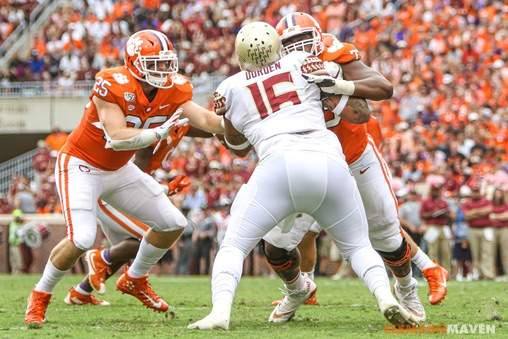
When Florida State hosts Clemson on Saturday night at 7 p.m., the oddsmakers see a clear path for the home team, installing the Seminoles as six-point favorites with an over/under total of 49.5 points. Yet beneath the surface of this Atlantic Coast Conference rivalry lies a matchup defined by stark statistical contrasts, glaring vulnerabilities, and razor-thin margins.
Florida State’s high-powered attack (31.2 points per game, No. 38 nationally) faces a Clemson defense allowing just 24.8 points per contest (No. 63). Meanwhile, Clemson’s sputtering offense (18.8 points per game, No. 121) must find answers against a Seminoles defense surrendering 31.3 points per game (No. 106).
Here are the five keys that will decide which team emerges victorious on Saturday night.
1. Clemson’s Pass Protection vs. Florida State’s Pocket Pressure
Clemson’s most glaring offensive liability this season has been pass protection. The offense has surrendered sacks on 10.50% of dropbacks, ranking No. 131 in the nation. That trend poses an existential threat against a Florida State defense that generates sacks at a 7.77% clip (No. 29).
Clemson manages only 178.5 passing yards per game (No. 116) and a meager 6.0 yards per attempt (No. 127). If Florida State collapses the pocket and puts Clemson behind the sticks, the visiting offense will be hard-pressed to overcome its season-long third-down woes, where it converts at a dismal 29.89% rate (No. 125). Keeping the passer clean on early downs is Clemson’s primary prerequisite for an upset.
2. Can Clemson Exploit Florida State’s Porous Run Defense?
Clemson has operated as a run-first offense, keeping the ball on the ground on 51.92% of snaps (No. 64) with 36.0 rushing attempts per contest. While Clemson averages just 137.2 rushing yards per game (No. 84) and 3.8 yards per carry (No. 91), Saturday offers a prime opportunity to break out.
Florida State’s front has been gashed repeatedly, giving up 190.0 rushing yards per game (No. 117) and 5.3 yards per rush (No. 125). Florida State also surrenders third-down conversions at a 45.12% rate (No. 113). If Clemson can generate steady push at the point of attack, it can shorten the game, control time of possession—where it currently averages 47.55% (No. 110)—and shield its passing game from obvious passing downs.
3. Florida State’s Big-Play Air Attack vs. Clemson’s Lockdown Secondary
Florida State’s passing offense thrives on downfield efficiency rather than volume. Despite throwing on only 43.47% of plays (No. 107) and completing 57.23% of its passes (No. 114), the passing attack generates 8.4 yards per attempt (No. 23) and 233.5 passing yards per game (No. 56).
That vertical aggressiveness collides directly with Clemson’s biggest defensive asset: perimeter coverage. Clemson’s secondary limits opponents to just 6.1 yards per pass attempt (No. 22), a 57.84% completion percentage (No. 27), and 208.3 passing yards per contest (No. 47). If Clemson eliminates deep chunk plays and forces Florida State to execute sustained, multi-play drives, Florida State’s offense could find itself out of rhythm.
4. Red Zone Conversion Efficiency and Elite Kicking
Points will come at a premium inside the 20-yard line, where situational defense could dictate the outcome. Florida State boasts one of the stiffest situational defenses in the country, holding opponents to points on only 77.27% of red zone trips (No. 27) and stonewalling fourth-down tries at an elite 27.27% conversion rate (No. 7).
By contrast, Clemson’s defense has struggled to hold up near the goal line, allowing opponents to score on 93.75% of red zone appearances (No. 119). Both kicking units have been virtually flawless—Florida State is a perfect 100% on field goal attempts (No. 1) and Clemson connects at 93.75% (No. 9). Trading field goals for touchdowns will be decisive, and Clemson cannot afford empty trips against a resilient Florida State red zone unit.
5. Turnover Disasters and Penalty Discipline
Both programs enter the contest with ball-security challenges, each carrying an identical -0.5 turnover margin per game (tied for No. 103) and 1.5 giveaways per game (No. 99). However, Florida State has been particularly reckless through the air, throwing an interception on 4.22% of passes (No. 130), compared to Clemson’s 2.79% interception rate (No. 94).
Where Florida State holds a decided advantage is pre-snap and post-play discipline. Florida State ranks among the nation’s cleanest teams, committing only 5.3 penalties per game (No. 30) for 46.0 penalty yards (No. 28) and 0.04 penalties per play (No. 25). Clemson, on the other hand, commits 7.0 penalties for 64.2 penalty yards per game (No. 97). In a game projected within a single score, an untimely turnover or a drive-extending penalty could easily tip the final outcome.













5 Surprising Keys That Will Decide Saturday’s Clemson-FSU Showdown