

The West Virginia Mountaineers found a way to beat TCU that three decades of Horned Frogs football suggested should not have happened. Despite being outgained by 212 total yards, West Virginia left Fort Worth with a 24-20 victory. A statistic shared afterward by Tony Caridi revealed just how unusual that combination was.
According to Caridi, TCU had outgained 75 opponents by at least 210 yards over the previous 32 seasons. The Horned Frogs won every one of those games. West Virginia became the exception, turning an afternoon of uneven production into a meaningful road victory.
For Mountaineers fans, the number captures both the accomplishment and the warning inside this result. WVU made enough decisive plays to overcome a substantial disadvantage. However, winning this way also means understanding which moments deserve celebration and which problems still require attention.
WVU Football Defies TCU’s Remarkable 75-0 Record
Caridi’s observation provides a better understanding of why this victory felt so difficult to secure. Teams that generate such a large yardage advantage generally create enough opportunities to finish ahead. Over that particular stretch, TCU had done exactly that without exception.
“The Horned Frogs outgained West Virginia by 212 total yards today,” Caridi wrote in a post on X. “In the last 32 seasons, the Frogs had topped 75 opponents by at least 210 yards. They were 75-0 in those games.”
The distinction is important: This was a statistical pattern, rather than a 75-game winning streak across consecutive Saturdays. Those qualifying performances occurred throughout 32 seasons. West Virginia interrupted a remarkably consistent relationship between TCU’s yardage dominance and the final result.
That does not make total yards meaningless. A 212-yard gap is evidence that one team generated considerably more offensive movement. The Mountaineers should not need such an unusual finish every week to survive that kind of imbalance.
What Saturday demonstrated is that yardage does not assign equal value to every possession. Gaining ground matters, but finishing drives and protecting the football determine whether those gains become points. West Virginia made the most consequential defensive play when the remaining opportunities were disappearing.
West Virginia’s Late Defensive Stop Secures TCU Victory
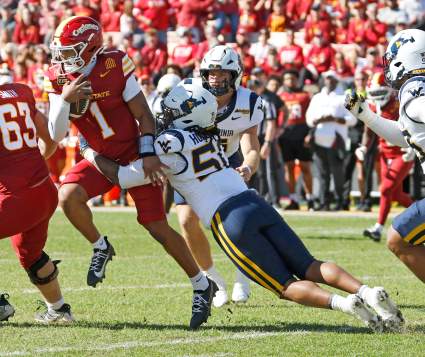
With TCU threatening in the final minute, defensive coordinator Zac Alley called an all-out blitz. David Afogho hit quarterback Jaden Craig and forced a fumble, which Ben Cutter recovered. That sequence protected West Virginia’s four-point lead and ended the Horned Frogs’ scoring threat.
For a defense that had struggled, the finish mattered beyond producing a highlight. The Mountaineers faced a situation in which another breakdown could have overturned the entire afternoon. Instead, they executed the pressure call and secured the loose ball.
That is where WVU fans can find genuine encouragement. Alley’s unit did not need a perfect statistical performance to make a winning contribution. It needed to deliver in the moment that decided whether TCU’s offensive advantage would finally become a winning score.
The next step is reducing how often games require that kind of escape. More consistent stops and better offensive possession management would give West Virginia a healthier formula. Celebrating the finish should coexist with recognizing the work still necessary.
Still, Caridi’s statistic gives this victory a distinctive place in the season. TCU had repeatedly turned overwhelming yardage advantages into wins. West Virginia refused to let the familiar pattern decide its afternoon, and that resilience deserves recognition.






WVU Football Just Handed TCU a Loss It Hadn’t Suffered in 32 Years