
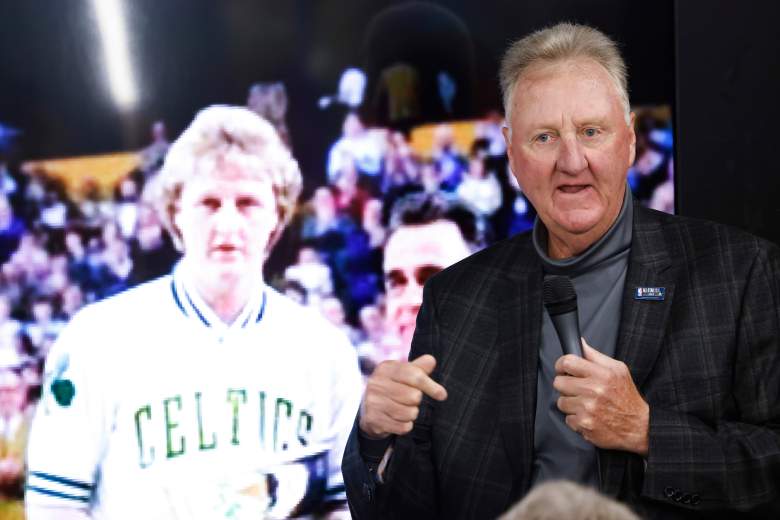
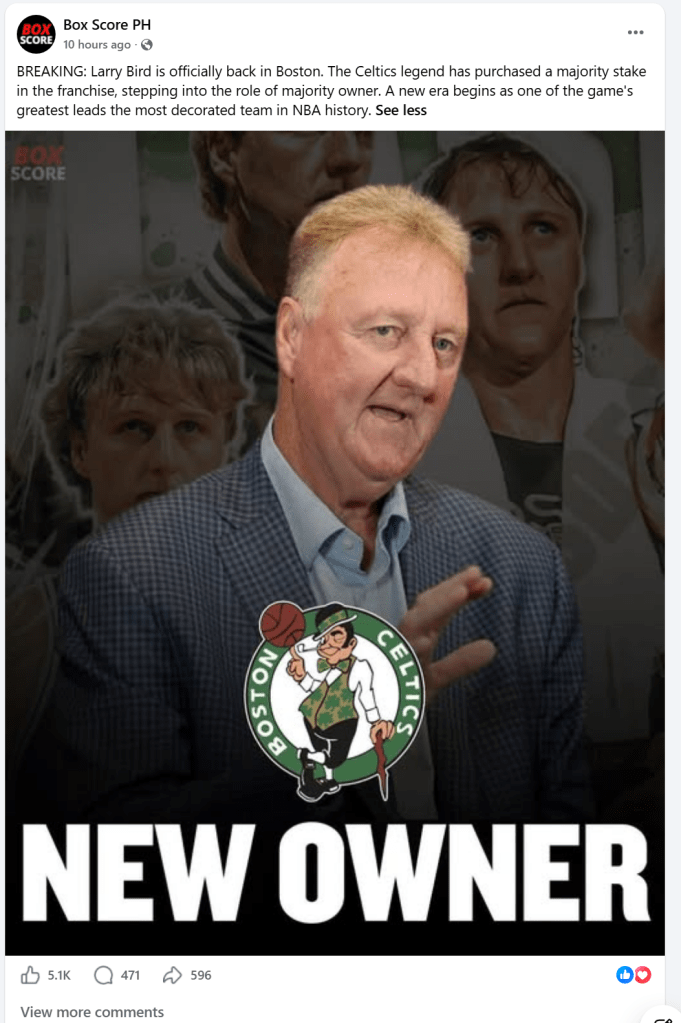
A viral social-media post has Boston Celtics fans asking a question that would have been almost unimaginable during Larry Bird’s playing career: Did Larry Legend just buy the team?
No. Bird has not purchased a majority stake in the Celtics and is not the franchise’s new owner.
The claim circulating online says Bird is “officially back in Boston” after acquiring a majority stake and becoming majority owner. But the Celtics are controlled by an investment group led by Bill Chisholm, which completed its takeover of the franchise in August 2025 following a $6.1 billion deal.
The NBA unanimously approved that transaction, and Chisholm became the Celtics’ governor when the purchase closed.
That makes the Bird post false — although there is a fascinating piece of NBA history behind the idea of Bird becoming an owner.
Bill Chisholm, Not Larry Bird, Controls the Celtics
Chisholm’s group agreed to buy the Celtics from the ownership group led by Wyc Grousbeck after Boston was put up for sale following its 2024 NBA championship.
The deal valued the Celtics at $6.1 billion.
When the transaction closed on August 19, 2025, the NBA announced that Chisholm’s group had taken control of the franchise. Grousbeck remained involved as CEO and alternate governor.
Chisholm also happens to have a strong connection to Bird.
The Massachusetts native has said he became a devoted Celtics fan while watching the 1980s teams led by Bird, Kevin McHale and Robert Parish.
“I became a rabid fan during the Bird, McHale, Parish era,” Chisholm told The Associated Press after the sale.
So there is a Larry Bird connection to Boston’s new ownership — just not the one claimed in the viral post.
Larry Bird Actually Tried to Become an NBA Owner
The notion of Bird owning an NBA franchise is not completely pulled from thin air.
More than two decades ago, Bird was part of a group attempting to acquire an expansion team in Charlotte.
Boston businessman Steve Belkin led the bid, with Bird expected to have a prominent role in the organization. But in December 2002, the NBA instead awarded the franchise to BET founder Robert Johnson.
Bird acknowledged at the time that losing the bid was deeply disappointing.
It remains one of the more intriguing roads not taken in his post-playing career.
Instead of becoming an NBA owner, Bird built an unusual résumé in Indiana. After retiring from the Celtics in 1992, he eventually became head coach of the Indiana Pacers and later ran their basketball operations.
Bird won NBA Coach of the Year in 1998 and Executive of the Year in 2012, making him the only person in league history to win Most Valuable Player, Coach of the Year and Executive of the Year.
Bird’s Celtics Legacy Remains Untouched
Bird does not need an ownership stake to remain inseparable from the Celtics.
Boston selected him sixth overall in the 1978 NBA Draft, and he spent his entire 13-season playing career with the franchise. Bird won three NBA championships, three consecutive MVP awards and two NBA Finals MVPs while becoming one of the defining players in Celtics history.
He retired in 1992 and briefly served as a special assistant in Boston’s front office before eventually moving into coaching and executive work with Indiana.
More than three decades after Bird played his final game, his association with the Celtics is apparently still powerful enough to make a false ownership claim believable to thousands of fans.
But for anyone searching for the answer: Larry Bird is still a Celtics legend.
He is not their majority owner.
Larry Bird Celtics Ownership Claim Is Not What It Seems