
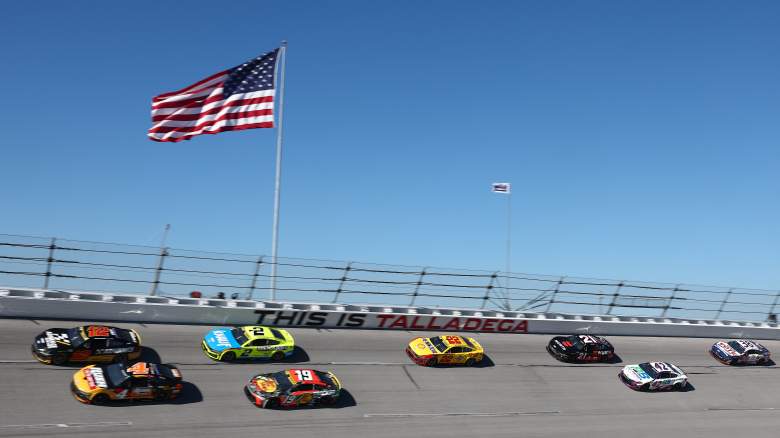
NASCAR’s fuel-saving problem at Talladega Superspeedway got so extreme Sunday that officials had to intervene, warning teams to pick up the pace or risk being black-flagged.
And it wasn’t just a handful of drivers pushing the limits.
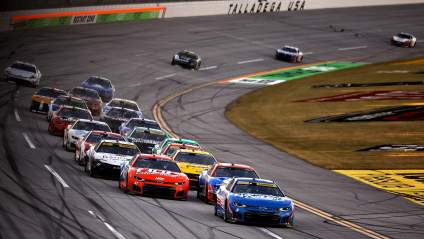
According to NASCAR vice president of racing communications Mike Forde, approximately 75% of the field was running below the required minimum speed at one point during Stage 1 of the YellaWood 500.
Rather than immediately penalizing drivers, NASCAR sent a message to teams through its internal communication system, making it clear that the unusually slow pace would not be tolerated.
The warning worked. Drivers increased their speed, and NASCAR ultimately did not issue any black flags for the violations.
NASCAR Warned Teams to Speed Up or Face Black Flags
Speaking on the latest episode of NASCAR’s “Hauler Talk” podcast, Forde explained that officials were monitoring the field as drivers aggressively conserved fuel during the opening stage.
The strategy has become increasingly common at drafting tracks, where drivers sometimes sacrifice speed early in a fuel run to gain an advantage during pit stops.
But at Talladega, the tactic pushed much of the field below NASCAR’s minimum-speed requirement.
Forde said officials sent an instant message to the teams warning them that penalties could follow.
“We can IM individual teams or the entirety of pit road,” Forde explained.
He then described the message NASCAR delivered.
“Hey, there are X amount of cars that have not reached minimum speed. If you guys don’t pick it up, then we’re going to have to step in.”
The response was immediate enough to avoid further action.
“And soon after, they picked it up,” Forde said. “So that message was delivered, and that’s why we did not black flag anybody.”
The revelation provides a behind-the-scenes look at how close NASCAR came to penalizing a substantial portion of the field during one of the season’s biggest races.
Why NASCAR Has a Minimum-Speed Rule
NASCAR’s minimum-speed requirement exists to keep cars from circulating too slowly relative to the rest of the field.
At Talladega, the threshold is calculated within 12.5% of the pole-winning speed, although NASCAR retains discretion over how the rule is enforced.
Forde explained that officials generally give drivers an opportunity to increase their pace before issuing a black flag. The sanctioning body can also account for changing track conditions, including significant tire wear.
That flexibility matters because minimum-speed enforcement is not limited to fuel-saving situations. It also plays an important role when damaged cars return to the track following an accident.
Still, Sunday’s situation was unusual for its scale.
Fuel conservation is one thing. Having roughly three-quarters of the field fall below minimum speed at the same time is another.
The strategy may have made sense for individual teams trying to gain an advantage, but NASCAR’s intervention showed there was a limit to how far drivers could take it.
And while Kyle Larson ultimately celebrated a thrilling Talladega victory, the opening stage produced a very different kind of NASCAR controversy.
For a brief stretch, the biggest threat to much of the field wasn’t another competitor.
It was a message from race control.

NASCAR Threatened Black Flags for Most of the Field at Talladega