
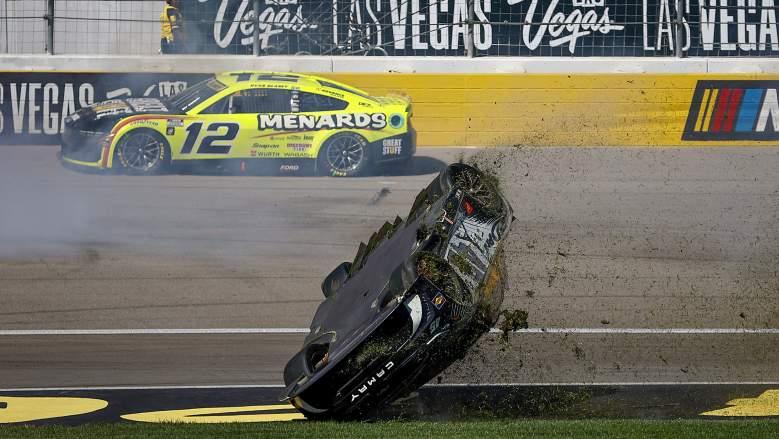
Few moments in NASCAR are more unsettling than watching a race car go airborne.
One second, a driver is battling for position. The next, their car is tumbling across the track, sometimes flipping multiple times before coming to rest upside down.
For fans watching at home, the immediate question is whether the driver is OK. But even after the car stops moving, the danger isn’t necessarily over.
NASCAR has established procedures for responding to serious crashes, including rollovers. Those procedures cover everything from securing the track and communicating with the driver to carefully extracting them from the vehicle.
And while it might seem strange to watch a driver remain strapped into an overturned car, there’s an important safety reason for it.
What Does NASCAR Do Immediately After a Car Flips?
When a NASCAR car flips during a race, officials typically display the caution flag, and a red flag may be necessary if the accident requires extensive cleanup or recovery.
Safety personnel are dispatched to the scene, where their first priorities include assessing the driver’s condition and identifying immediate hazards, such as fire, leaking fluids or unstable wreckage.
Communication is especially important.
Officials and team members attempt to establish contact with the driver, while safety crews assess the situation at the car.
One of the most recognizable signals is the driver’s window net. When a driver is uninjured, lowering the net indicates to officials and safety personnel that they are responsive.
However, a window net remaining up does not automatically mean a driver is seriously injured. It simply means officials cannot rely on that visual signal to determine their condition.
NASCAR’s response also depends on the circumstances of the accident. A car resting on its roof presents different challenges than one that lands upright, particularly when crews must determine how to safely reach the driver.
Why NASCAR Drivers Must Remain in Their Cars After a Rollover
For a driver hanging upside down in a race car, the instinct might be to release the seat belts and climb out immediately.
But doing so could make a dangerous situation worse.
Under NASCAR’s on-track incident procedures, drivers generally must keep their personal safety equipment secured until safety personnel or an official directs them otherwise. Exceptions exist for emergencies, including situations involving fire or smoke.
That requirement becomes particularly important after a rollover.
A driver suspended by their restraints could fall onto their head or neck if they release the belts without support. Moving too quickly could also aggravate an injury sustained during the crash.
Instead, safety workers assess the driver’s condition and determine the safest way to remove them.
Sometimes, that means waiting until the car has been returned to its wheels.
Other situations may require specialized extraction procedures, particularly if the driver is injured or the vehicle cannot be safely repositioned.
There is no single recovery method that applies to every rollover.
How Does NASCAR Turn an Upside-Down Car Back Over?
Returning an overturned stock car to its wheels is more complicated than simply hooking it to a tow truck and pulling.
Recovery crews must account for the vehicle’s weight, damaged components and the possibility of the car shifting unexpectedly.
Specialized wreckers and recovery equipment allow workers to lift and rotate the car in a controlled manner.
The goal is to avoid sudden movements that could endanger the driver or nearby personnel.
That process has received considerable attention within NASCAR’s safety training.
During the 2022 Coca-Cola 600 at Charlotte Motor Speedway, Chris Buescher’s No. 17 Ford flipped multiple times and landed on its roof.
Although Buescher was conscious and ultimately escaped without a serious injury, the process of righting his car took longer than NASCAR officials wanted.
The incident became an important teaching opportunity.
At NASCAR’s annual track safety training in January 2023, personnel practiced recovering overturned cars using specialized equipment and techniques designed to make the process safer and more efficient.
The training included workers from tracks across NASCAR’s national touring schedule, reflecting the importance of having crews prepared before an accident happens.
What Happens to a NASCAR Driver After Being Removed From a Flipped Car?
Getting out of the car is only one part of the response.
After a serious crash, drivers are evaluated by medical personnel, typically at the track’s infield care center. Depending on the circumstances and their condition, additional evaluation or transportation to a hospital may be necessary.
Medical officials assess potential injuries that might not be immediately obvious, particularly following violent impacts or multiple rotations.
A driver being able to walk away does not eliminate the need for a medical evaluation.
A recent example came during the April 2026 NASCAR O’Reilly Auto Parts Series race at Kansas Speedway.
Carson Kvapil’s Chevrolet flipped multiple times on the backstretch before landing upside down. NASCAR stopped the race while safety crews worked to return the car to its wheels.
Kvapil subsequently exited under his own power and was evaluated and released from the infield care center.
The incident illustrated why NASCAR’s recovery procedures extend well beyond the initial impact.
What Does NASCAR Do With a Car After a Rollover?
Once the driver has been attended to and the damaged vehicle has been recovered, NASCAR’s work may continue.
Officials can examine the car, review incident data and study video footage to better understand what happened.
Depending on the crash, that review may include evaluating the performance of the vehicle’s safety equipment, including the roll cage, restraints and other protective systems.
Not every overturned car is automatically transported to NASCAR’s Research and Development Center. The extent of the investigation depends on the circumstances.
The findings can help NASCAR identify potential improvements to its vehicles, equipment and emergency procedures.
That’s a critical distinction: A driver’s safe escape doesn’t necessarily mean there’s nothing left to learn.
NASCAR has spent decades improving its approach to driver protection, and serious crashes remain an important part of that ongoing process.
The hope, of course, is that safety crews never have to put their most demanding training into practice.
But when a car ends up on its roof, the preparation behind those few tense minutes can make an enormous difference.
What Happens When a NASCAR Car Flips? Inside the Safety Procedures