
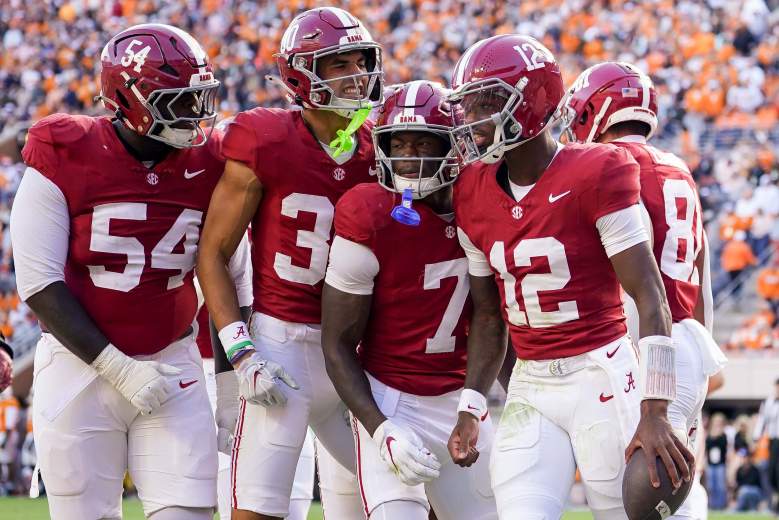
The Alabama Crimson Tide’s embarrassing road loss to Tennessee on Saturday was difficult enough for fans to watch. However, the individual grades from Pro Football Focus (PFF) paint an even uglier picture of just how poorly Kalen DeBoer’s team performed against the Volunteers.
Alabama entered the rivalry matchup hoping to bounce back from its disappointing loss to Georgia. Instead, the Crimson Tide delivered another frustrating performance that raised serious questions about the direction of the team.
The offensive inconsistencies were impossible to ignore, while defensive breakdowns continued to plague Kane Wommack’s unit.
Now, the Alabama football PFF grades from the Tennessee loss provide additional evidence that the Crimson Tide’s problems extend well beyond a handful of mistakes.
Several Alabama starters received disappointing marks, and some of the lowest grades came from players the Crimson Tide desperately needed to perform at a high level.
Here are the biggest takeaways from Alabama’s individual PFF grades against Tennessee.
Alabama’s Linebacker Grades Reveal a Major Defensive Problem
Perhaps the most alarming takeaway from Alabama’s defensive PFF grades was the performance of its linebackers.
Starting linebacker Caleb Woodson finished with a 39.1 overall defensive grade, the lowest mark among Alabama’s 24 graded defensive players.
Woodson’s struggles were particularly evident against the run, where he received a 27.5 grade. His 39.2 coverage grade wasn’t much better.
The numbers were hardly encouraging for fellow starting linebacker Luke Metz, either.
Metz finished with a 63.7 overall defensive grade but received a concerning 32.7 mark against the run.
Together, those grades illustrate one of the biggest problems facing Alabama’s defense: the inability to consistently control the middle of the field.
Woodson and Metz combined to play 131 defensive snaps, making their struggles particularly significant.
For a defense that has repeatedly struggled to get off the field and prevent sustained drives, those numbers should raise some serious concerns.
Alabama’s Offensive Line Struggles Were Impossible to Ignore
Alabama’s offensive line has been a major talking point throughout the season, and the PFF grades against Tennessee offer a mixed assessment of the unit.
The most concerning performance came from starting left guard William Sanders, who finished with a 46.3 overall offensive grade.
Sanders also received a disastrous 23.2 pass-blocking grade, the lowest among Alabama’s offensive linemen.
Right guard Michael Carroll wasn’t much better overall, finishing with a 55.7 offensive grade.
However, Carroll’s performance was particularly interesting because he received an outstanding 88.8 pass-blocking grade while earning just a 48.4 run-blocking grade.
Jayvin James also performed well in pass protection, earning an 80.7 pass-blocking grade.
Meanwhile, Jackson Lloyd finished with a 71.4 overall offensive grade, the highest among Alabama’s starting offensive linemen.
These numbers suggest that Alabama’s offensive line struggles weren’t universal, but the inconsistency across the unit remains a significant concern.
Perhaps more importantly, they raise additional questions about offensive coordinator Ryan Grubb’s approach to the game.
When multiple offensive linemen perform reasonably well in pass protection, the coaching staff must find ways to capitalize on those performances while helping the players who are struggling.
That simply hasn’t happened consistently enough.
Keelon Russell’s PFF Grade Reflects Another Frustrating Offensive Performance
Alabama quarterback Keelon Russell has experienced the expected ups and downs of a young starting quarterback this season.
Unfortunately, Saturday’s performance against Tennessee represented another difficult learning experience.
Russell finished with a 59.0 overall offensive grade, including a 59.7 passing grade.
Those numbers certainly aren’t encouraging, but they also don’t tell the entire story.
Russell continues to operate within an offensive system that frequently asks him to carry a significant portion of the burden.
The Crimson Tide’s inability to consistently establish a rushing attack has made life considerably more difficult for its young quarterback.
And while Russell deserves his share of criticism for mistakes and missed opportunities, Alabama’s offensive coaching staff must also shoulder responsibility for putting him in better situations.
Grubb’s inability to consistently create offensive balance has become an increasingly frustrating storyline.
Russell is talented enough to make spectacular plays, but Alabama cannot expect its young quarterback to overcome every offensive deficiency by himself.
Alabama’s Secondary Continues to Show Inconsistency
The defensive backfield wasn’t immune to disappointing PFF grades, either.
Starting defensive back Red Morgan finished with a 50.5 overall defensive grade and a 46.5 coverage grade.
Ivan Taylor received a 54.9 overall defensive grade, including a particularly troubling 21.1 run-defense grade.
Carmelo O’Neal finished with a 63.1 overall defensive grade, but his 29.1 run-defense grade was another concerning number.
Meanwhile, Bray Hubbard finished with a 62.3 overall grade, and Keon Sabb received a 64.6.
One of the few encouraging performances came from Dijon Lee Jr., who earned a 65.8 overall defensive grade and a 78.0 run-defense grade.
The larger issue, however, remains Alabama’s inability to consistently prevent opposing offenses from sustaining drives.
Wommack’s defensive philosophy has drawn increasing scrutiny, particularly when the Crimson Tide allows opposing quarterbacks to operate comfortably underneath its coverage.
Although individual PFF grades cannot explain every schematic decision, they reinforce the reality that Alabama’s defense simply hasn’t performed at the level expected of the program.
A Few Alabama Players Actually Earned Strong PFF Grades
Despite the disappointing overall performance, several Crimson Tide players managed to produce encouraging individual grades.
Tight end Marshall Pritchett led Alabama’s offense with a 74.1 overall grade, including a 76.8 receiving grade.
Jackson Lloyd followed with his 71.4 offensive grade, while Mal Waldrep Jr. received a 63.2.
On defense, reserve linebacker QB Reese earned an impressive 84.6 overall grade, although he played just 13 snaps.
Defensive lineman London Simmons received a 74.7 overall grade across 44 snaps, including an outstanding 90.1 run-defense grade.
Isaia Faga also performed well, earning a 74.2 overall defensive grade.
Yhonzae Pierre finished with a 69.9 overall defensive grade and a 79.8 tackling grade.
Those performances deserve recognition, but they also highlight the inconsistency throughout Alabama’s roster.
The Crimson Tide clearly has players capable of performing at a high level.
The challenge is getting enough of them to do so simultaneously.
Alabama’s PFF Grades Should Put Kalen DeBoer and His Coordinators Under the Microscope
Individual player grades are useful, but they shouldn’t distract from the larger questions surrounding Alabama’s coaching staff.
The Crimson Tide’s struggles against Tennessee weren’t isolated to one position group.
They appeared throughout the offense and defense, suggesting problems that extend beyond individual execution.
Grubb must find ways to establish a more consistent rushing attack and make life easier for Russell.
Wommack must address the defensive inconsistencies that continue to allow opponents to sustain drives and exploit Alabama’s weaknesses.
And ultimately, DeBoer is responsible for ensuring that both coordinators make the necessary adjustments.
PFF grades aren’t a perfect measurement of football performance, and they certainly don’t tell the entire story of a game.
But when the numbers reinforce what was obvious on the field, they become difficult to dismiss.
Alabama’s loss to Tennessee wasn’t simply a case of a few players having an off day.
It was a disappointing team-wide performance that exposed significant weaknesses on both sides of the football.
And unless DeBoer and his coaching staff find answers quickly, those weaknesses could continue to define the Crimson Tide’s season.
Alabama’s Ugly PFF Grades Expose Just How Bad Tennessee Loss Really Was